
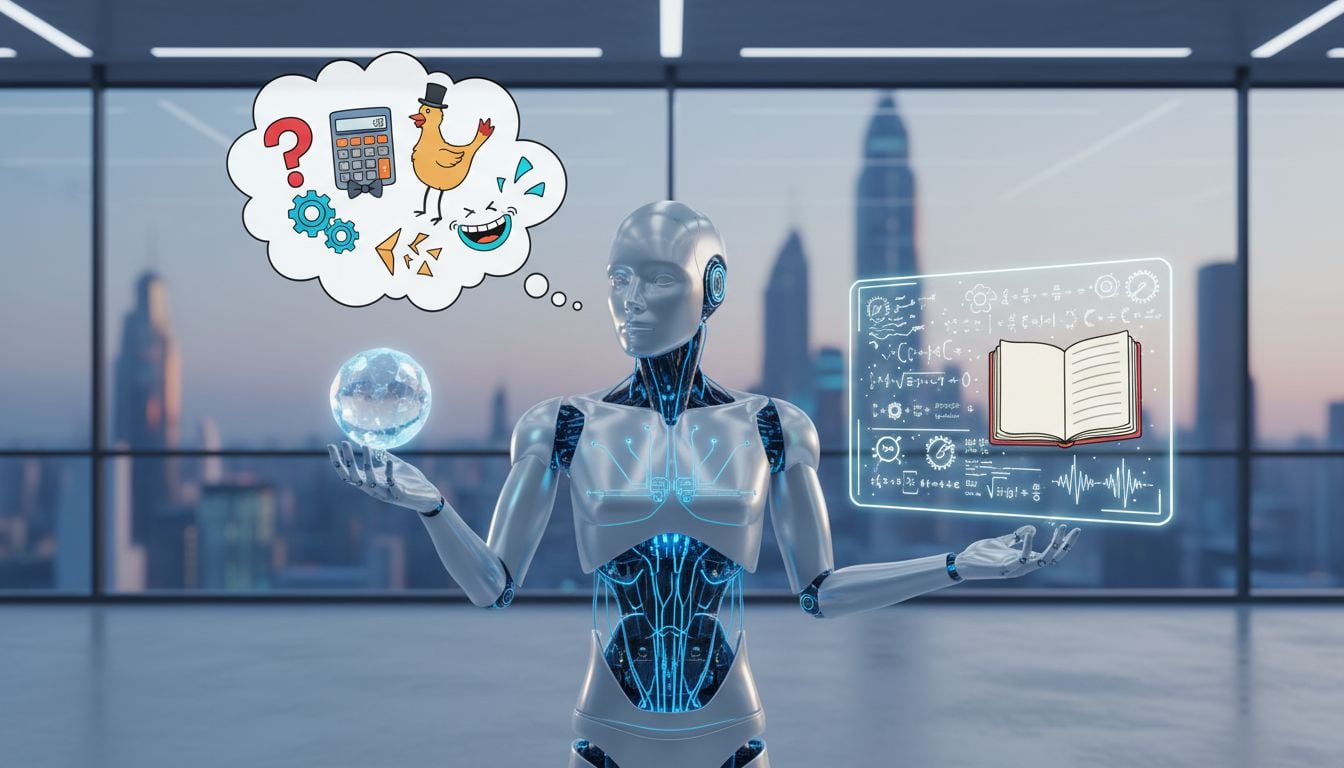
Why can modern artificial intelligence solve complex calculus in microseconds but struggle to tell a decent knock-knock joke? It is a paradox that has puzzled computer scientists for decades. While Large Language Models (LLMs) have mastered code generation and professional writing, humor remains the "final frontier" of AI capabilities.
In this analysis, we explore the cognitive mechanics behind laughter, why safety protocols make robots boring, and the recent breakthroughs—as of early 2026—that suggest machines are finally learning to crack a joke.
The Mathematics of Laughter: Why It’s Harder Than Calculus
To understand why AI fails at comedy, we must first understand what makes humans laugh. The dominant framework in psychological research is Incongruity Theory. This theory posits that laughter arises when there is a conflict between what we expect to happen (prediction) and what actually happens (reality), followed by a rapid resolution of that conflict.
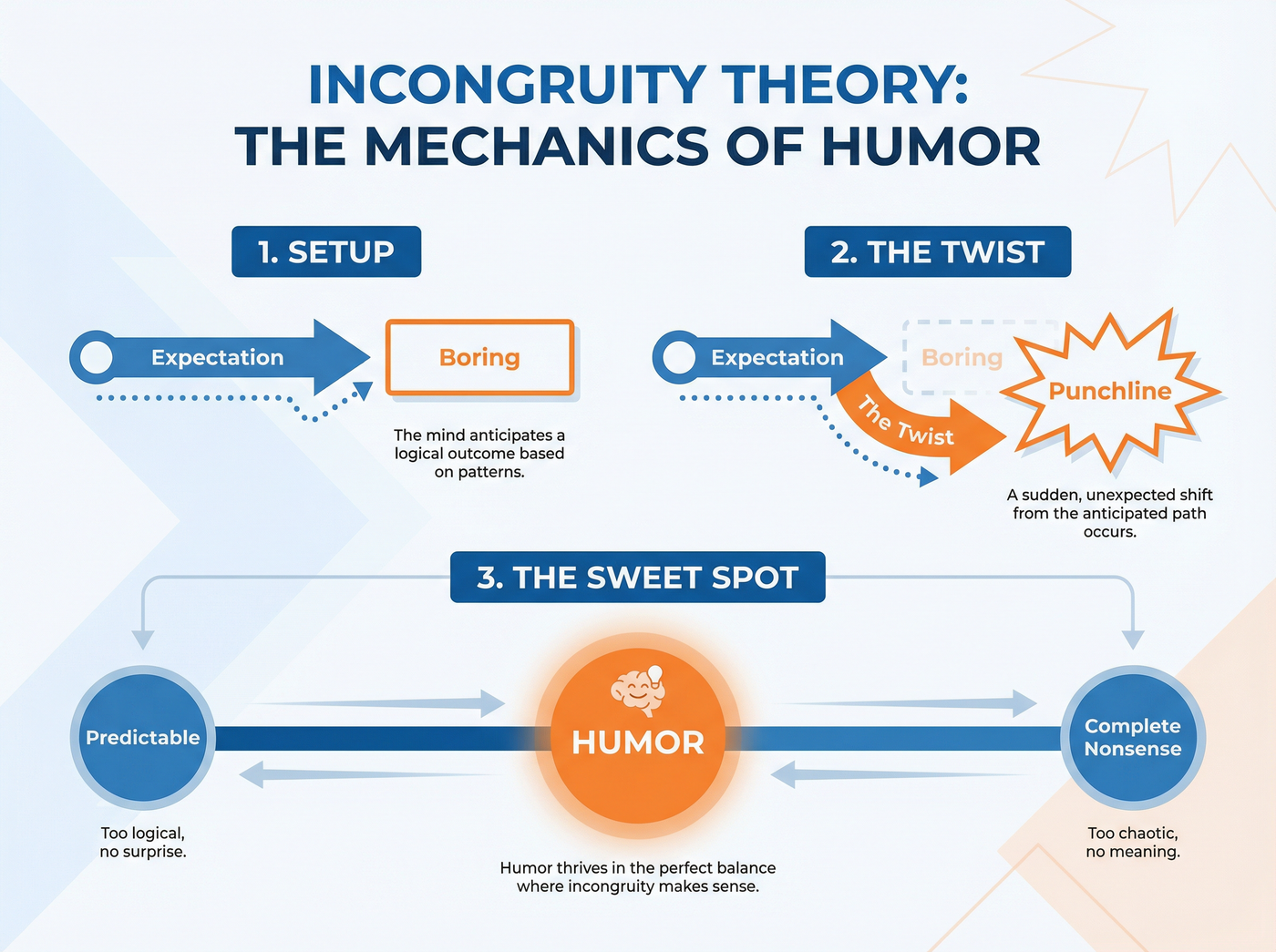
For a machine, hitting this "sweet spot" is an immense data challenge. If an AI follows the most likely linguistic pattern, the output is boring or instructional. If it deviates too far from the pattern, the result is incoherent gibberish. Finding the razor-thin line between the two—where the output is unexpected yet logical in hindsight—requires a level of world knowledge and reasoning that often escapes standard predictive models.
The "Witscript" Breakthrough
Despite these structural hurdles, the gap is closing. Research presented at the 18th International Natural Language Generation Conference highlighted significant advancements in specialized AI systems. Unlike general-purpose chatbots, these systems are fine-tuned specifically for comedic structure.
One notable success story is Witscript. In a comparative study, jokes generated by this system were tested against those written by professional human comedy writers. The results were surprising: in blind tests, audiences rated the AI-generated one-liners as equally funny as the human-authored content[3].
This suggests that for short-form, conversational wit, AI has technically arrived. However, the ability to construct a long-form narrative or a 60-minute stand-up special remains well beyond current capabilities. The machine lacks the "Theory of Mind" required to maintain a comedic thread over a long duration.
Why Safety Filters Kill the Joke
If specialized systems are succeeding, why does your average chatbot still tell terrible "Dad jokes"? The answer lies in Reinforcement Learning from Human Feedback (RLHF). Modern AI is trained to be helpful, honest, and harmless. However, humor is rarely completely "safe." It often relies on taboo, tragedy, or social friction to function.
When developers implement strict safety filters, they inadvertently lobotomize the AI's sense of humor. The models are biased toward "pleasantness," leading to sanitized, purely structural puns that lack the edge required for genuine laughter. This creates an ethical dilemma: can we build an AI funny enough to entertain us without empowering it to generate offensive speech?[1]
The Human Bias Factor
Even when an AI manages to write a perfect joke, humans might not laugh. A critical study on perception revealed a phenomenon known as source blindness. When participants were shown a joke and told it was written by a human, they rated it highly. When shown the exact same joke but told it was written by an AI, ratings dropped significantly[5].
This indicates that a portion of what we consider "funny" is the shared human connection—the knowledge that the speaker understands the pain or absurdity of the human condition. An AI, lacking a physical body and life experience, cannot truly "relate," and audiences instinctively sense this disconnect.

Furthermore, generalizing humor across cultures remains a massive hurdle. A joke that lands in New York often fails in Tokyo due to deep-seated cultural references and linguistic nuances that mere translation cannot capture[6]. AI currently struggles to transfer its humor capabilities from one cultural or topical domain to another.
The Future: AI as a Brainstorming Partner
We typically fear that AI will replace human creatives, but in comedy, the future looks more collaborative. Professional writers are already using LLMs as brainstorming engines—generating fifty variations of a headline in seconds to spark a better, human-verified idea. The machine handles the quantity and structure; the human supplies the soul and timing.
Ultimately, extracting humor from a machine is the ultimate test of common-sense reasoning. Until an AI can understand the subtle nuances of human existence—from the frustration of traffic to the heartbreak of rejection—it will remain a talented mimic rather than a true comedian.
Listen to the episode
Will AI Chatbots Ever Be Funny? The Science of Machine Humor