

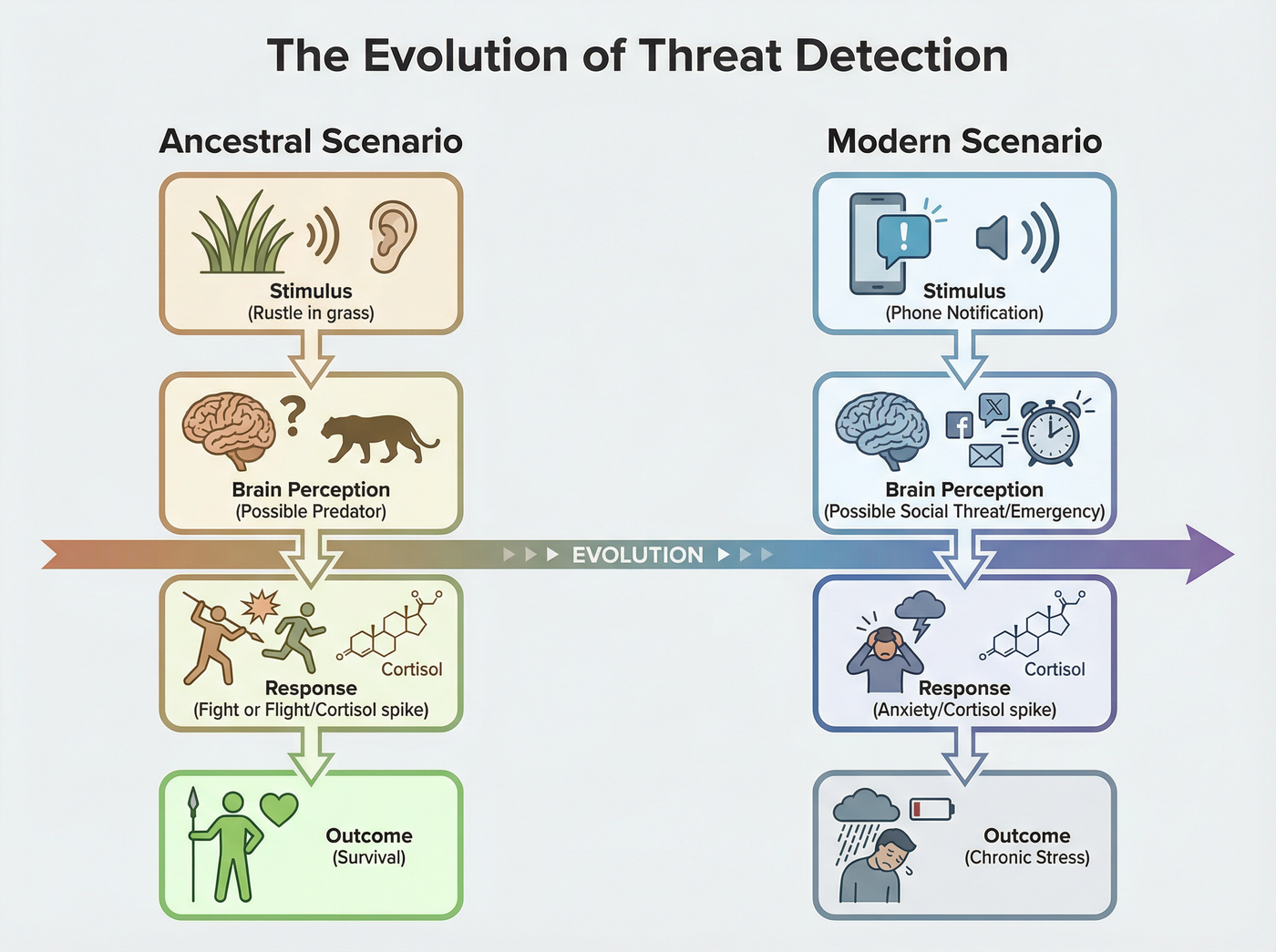
Do you ever feel a jolt of anxiety when your phone buzzes? Or perhaps a lingering sense of dread when your inbox count ticks upward? You are not alone, and more importantly, you are not broken. You are simply running 50,000-year-old software in a 21st-century world.
It turns out that the same biological machinery that once kept our ancestors from becoming a leopard’s lunch is now being triggered by vague subject lines and missed calls. Your brain is treating digital notifications as if they were physical predators.
The Security Motivation System: Why we are wired for worry
Deep within our neural architecture lies a mechanism known as the Security Motivation System. This system did not evolve to handle overflowing inboxes or Slack pings; it evolved to handle uncertain, potentially catastrophic risks—like a predator hiding in the brush. Its primary goal is not accuracy, but survival.
This system operates on a principle often described in evolutionary psychology as the Rauch signal detection theory. The logic is brutally simple: it is biologically "cheaper" to mistake a harmless rustle in the grass for a lion than to mistake a lion for the wind. The former results in unnecessary anxiety; the latter results in death. Consequently, humans who were prone to heightened vigilance survived and reproduced, passing down these traits to us. Today, this means your brain acts on a hair-trigger, treating ambiguous digital signals as potential tigers[2].
The Amygdala: Your brain’s smoke detector
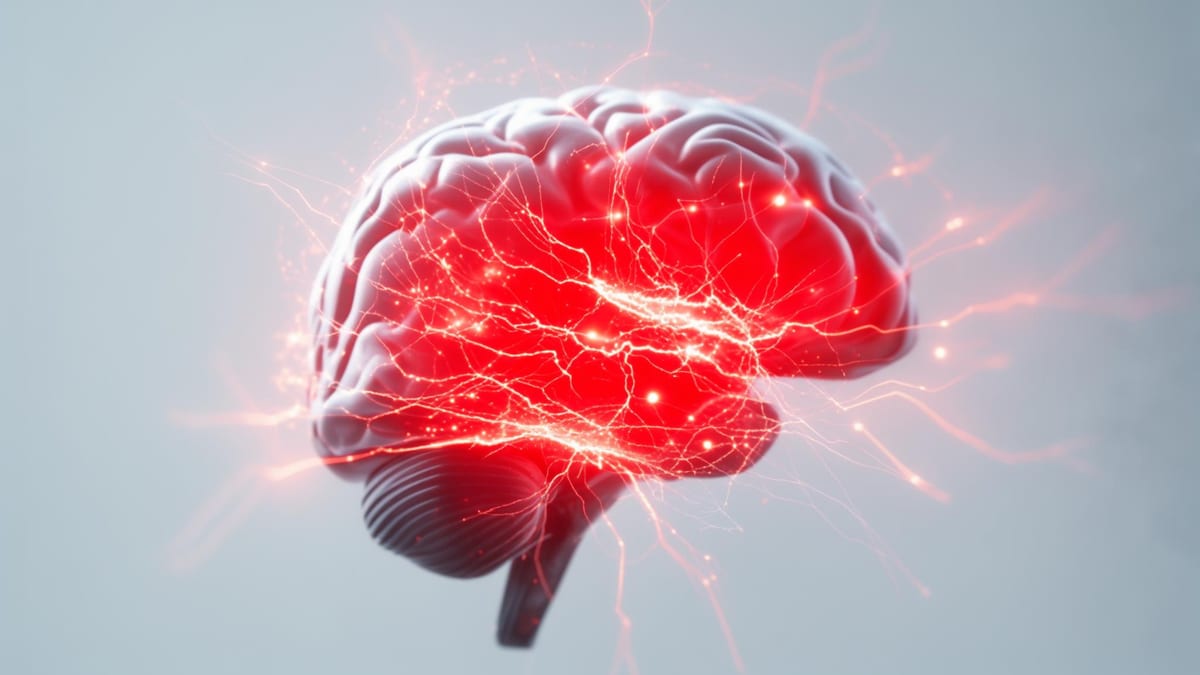
The core of this reaction takes place in the amygdala, a small, almond-shaped structure in the temporal lobe. Think of the amygdala as a high-speed smoke detector. When it perceives a threat, it doesn’t wait for the rational part of your brain—the prefrontal cortex—to analyze the situation. Speed is the priority.
Upon detecting a trigger, the amygdala signals the hypothalamus to release a cascade of stress hormones, including cortisol and adrenaline[5]. This physiological shift prepares you for immediate physical action. The problem is that while this response is perfect for running from a bear, it is maladaptive for sitting at a desk reading an email from your boss. Your body is revving up for a fight that never happens, leaving you stewing in a cocktail of stress chemicals.
Why a missed call feels like a death threat
It isn't just the fear of physical danger that triggers us; it is the fear of social disconnection. This is best explained by Social Baseline Theory. For our ancestors, being part of a tribe was just as vital as food or water. Exclusion or rejection meant a significantly higher risk of death.
Because of this, our brains monitor our social standing with the same intensity used to scan for predators. In the modern landscape, social signals constitute a major part of our environment. A vague text, a lack of "likes," or being ignored constitutes a potential threat to our social safety[3]. The brain perceives these digital cold shoulders not as minor annoyances, but as existential risks, triggering the same ancient defensive circuits used for survival[4].
The trap of precautionary behavior
To manage this uncertainty, we engage in what researchers call precautionary behaviors. In the wild, an animal might scan its environment repeatedly to ensure safety. Today, humans check their phones. Research suggests the average user checks their phone roughly 144 times a day. Each check is a micro-attempt to resolve uncertainty and "terminate" the security motivation signal.
However, modern technology is designed with intermittent reinforcement—unpredictable rewards that keep us checking. This keeps the brain in a state of low-grade, chronic activation. We are effectively performing digital grooming rituals to soothe a primitive system that doesn’t know how to switch off[1].
Understanding that this is a biological mismatch—not a personal failure—is the first step toward managing it. By recognizing that your brain is simply trying to keep you safe in a way that is no longer helpful, you can begin to use cognitive strategies to manually signal "safety" to your amygdala, allowing your modern mind to regain control.
Listen to the episode
Dive deeper into the evolutionary science of your inbox anxiety in the full episode below.
Listen to "Why Your Brain Treats Emails Like Tigers" on Pody.fm
Sources
- The neuroscience of notifications: why you can’t ignore them
- Adaptation to potential threat: The evolution, neurobiology, and psychopathology of the security motivation system
- Threat detection, precautionary responses, and anxiety disorders
- The ecology of human fear: survival optimization and the nervous system
- How the Brain Reacts to Stress and Trauma