
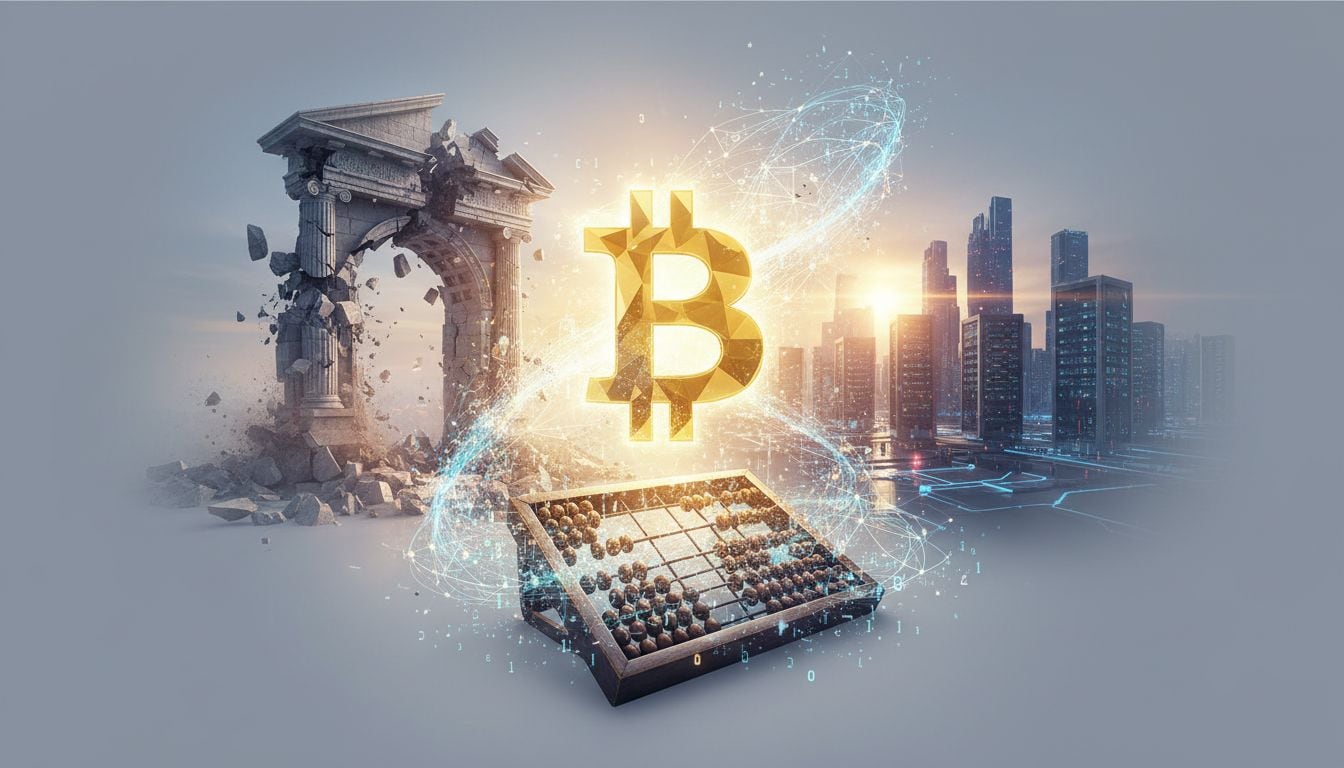
To understand Bitcoin is to understand a fundamental shift in how humanity perceives value, trust, and the architecture of the internet. It began as a quiet rebellion against the traditional financial order, emerging at a time when the world’s banking systems were on the brink of collapse. Today, in 2026, it stands as a mature asset class, yet its core identity remains rooted in a nine-page technical document published by an anonymous figure known as Satoshi Nakamoto.
Listen to the episode
Dive deeper into the origins and mechanics of the world's first cryptocurrency in our latest episode:
What is Bitcoin? A Complete Introduction
The Genesis: A Response to Financial Collapse
The timing of Bitcoin’s birth was no coincidence. In October 2008, the global financial system was crumbling. Major investment banks were failing, governments were printing money for bailouts, and public trust in financial institutions had evaporated. Amidst this turmoil, a pseudonym—Satoshi Nakamoto—published a white paper titled Bitcoin: A Peer-to-Peer Electronic Cash System to a cryptography mailing list.[1]
Nakamoto proposed a radical idea: a way for people to transfer value directly to one another without relying on a bank, credit card company, or any trusted third party. This was not merely a new form of currency; it was a technological blueprint designed to liberate value transfer from the intermediaries that had just proven themselves to be fragile and unreliable.[3]
The Double-Spending Problem
For decades prior to 2008, digital cash remained a theoretical dream because of one specific hurdle: the double-spending problem. In the physical world, if you hand someone a dollar bill, you no longer possess it. But in the digital realm, data can be copied infinitely—like emailing a photo to a friend while keeping the original.
Traditionally, banks solved this by maintaining a private central ledger. They debit the sender and credit the receiver, acting as the sole arbiter of truth.[5] Satoshi’s genius lay in devising a way to achieve this validation without a central authority. By creating a transparent, public record, the network itself could verify that a user actually held the funds they were attempting to spend, ensuring that the same digital token could not be spent twice.
How It Works: The Blockchain
The solution Nakamoto deployed is what we now call the blockchain. Think of it as a giant, transparent notebook shared by everyone on the network.
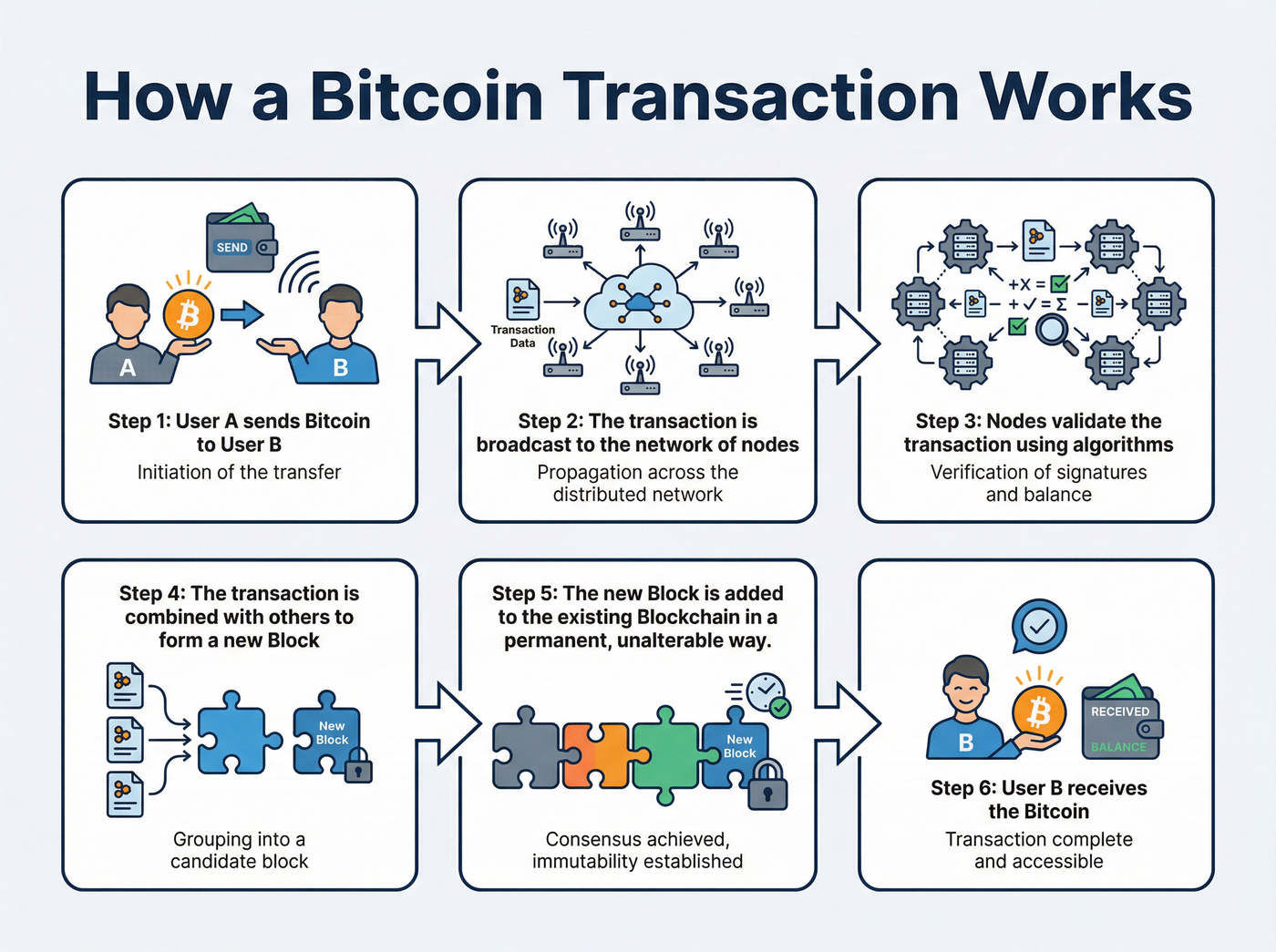
This notebook is divided into pages, or "blocks." When transactions occur, they are broadcast to a network of computers (nodes). These nodes independently verify the transactions. Once verified, a batch of transactions is sealed into a block and cryptographically chained to the previous one. This creates a chronological history that is virtually impossible to alter.[6]
Decentralized Consensus
But who decides which transactions are valid if there is no bank? The network relies on a mechanism called Proof-of-Work. Specialized computers, known as miners, compete to solve complex mathematical puzzles. The first to solve the puzzle earns the right to add the next block to the chain and is rewarded with newly minted bitcoin.[2]
This process does two things:
- Security: It makes attacking the network prohibitively expensive (requiring massive inputs of electricity and hardware).
- Distribution: It provides a fair way to introduce new coins into circulation without a central bank deciding who gets them.
More Than Just Digital Cash
While the white paper described an "electronic cash system," Bitcoin has evolved into something often described as "digital gold." This is largely due to its scarcity. The protocol dictates that there will only ever be 21 million bitcoins.[5]
This scarcity stands in stark contrast to fiat currencies, which can be printed in unlimited quantities by central banks. For many, Bitcoin represents a store of value—a hedge against inflation and currency debasement. Whether used as a medium of exchange or a long-term asset, it offers a level of financial sovereignty previously impossible in the digital age.
As of today, Thursday, January 22, 2026, the network continues to operate without interruption, governed not by a CEO or a board of directors, but by the open-source code released nearly two decades ago.

Conclusion
Bitcoin is more than a speculative asset; it is a "truth machine." It proved that a global consensus on the state of a financial ledger could be achieved without a central referee. By removing the need for trust in fallible human institutions, it offers a system where you only need to trust the mathematics and the code. For anyone looking to understand the future of money, understanding these fundamentals is the first step toward self-sovereignty.