

In today's fast-paced digital environment, modern professionals often exist in a state of continuous cognitive siege. We are submerged in a relentless deluge of data, news, and notifications. While the concept of "information overload" was popularized decades ago, it is clearer than ever securely managing this flow is a core requirement for success. Futurist Ross Dawson argues that what was once a psychological burden has now transformed into the fundamental landscape of survival.
Instead of responding with higher walls and stricter digital detoxes, high-velocity leaders must fundamentally change their mindset. By treating this data not as a rising flood to be survived but as a superabundance of raw material, we can shift from playing defense to going on the offensive.[1]
Escaping the Trap of Aimless Grazing
Much of our modern cognitive fatigue stems from the habit of aimless grazing. This occurs when individuals consume content without a specific objective, effectively acting as passengers on a runaway train of notifications. In the absence of a distinct purpose, we surrender our valuable attention to external algorithms designed to prioritize engagement over personal utility.[2]
Dawson observes that elite performers do not attempt to read everything. Instead, they operate as conscious architects of their own media environments. For a strategist or entrepreneur, the perceived "overload" is actually the presence of untapped opportunity, provided one has the internal architecture to process it appropriately. Turning aimless grazing into systematic inquiry changes the way you interact with every email, article, and market report.
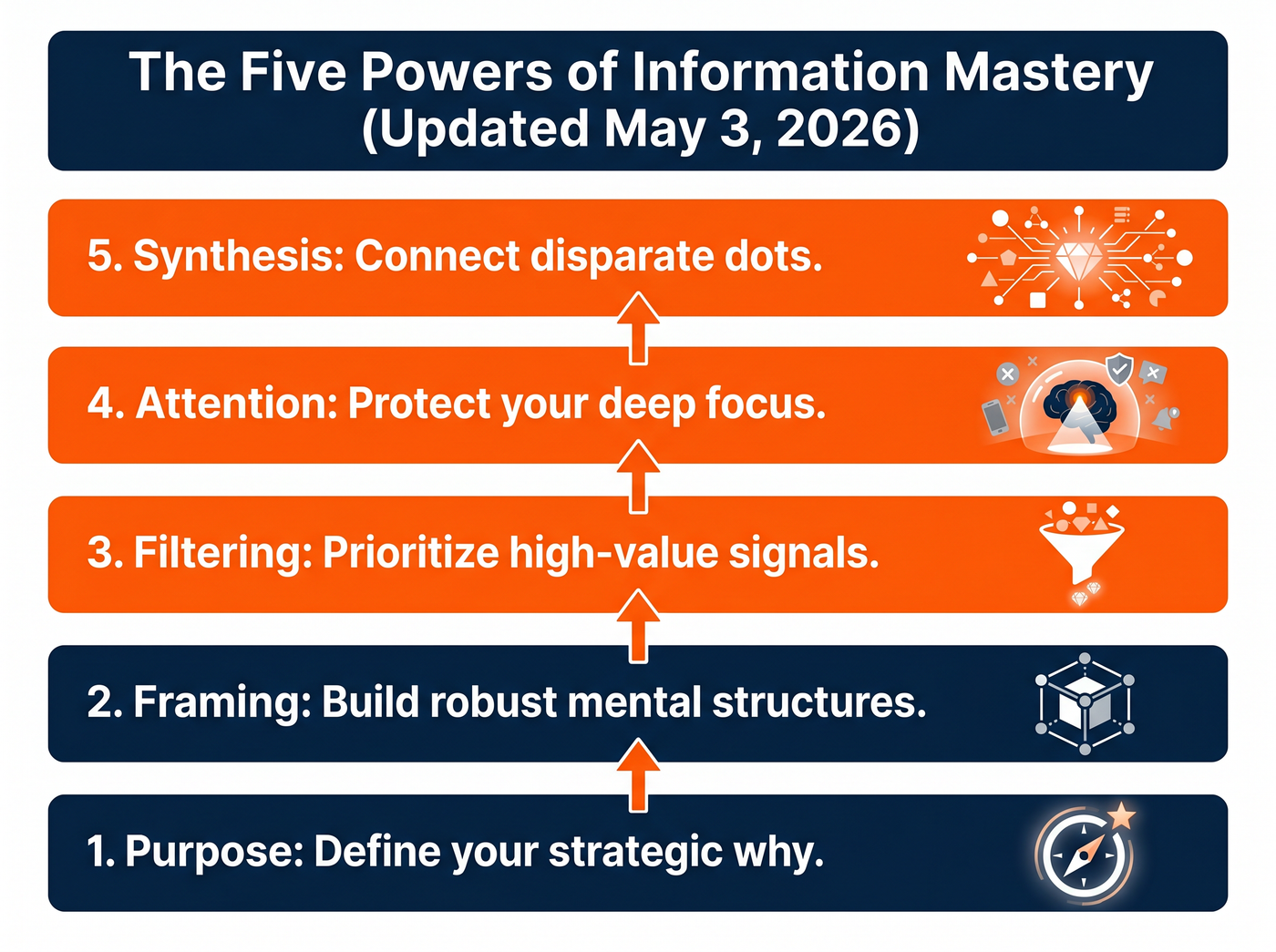
The Five Powers of Information Mastery
In his highly acclaimed work Thriving on Overload, Dawson introduces a robust blueprint for navigating infinite content.[3] This strategy hinges on five distinct capabilities that professionals can cultivate to improve decision-making and innovation.
1. PurposeThe most effective way to filter noise is to anchor your intake in a defined intent. Without a specific "why," you are outsourcing your focus. When you frame your work around a clear goal, you establish a gravitational lens that naturally attracts relevant insights and repels irrelevant distractions.2. FramingFraming is the process of building mental maps that provide vital context to isolated facts. Elite innovators do not just memorize data points. They construct flexible frameworks that allow them to "hang" new information in the correct place, instantly identifying its implications for their specific sector.3. FilteringIn an era of limitless data, we must embrace a layered approach to filtering. This means prioritizing sources based on their "signal density" and actively seeking out the quiet, early indicators of major changes before they become obvious trends to the broader market.[6]4. AttentionAttention is the ultimate scarce resource. High-velocity environments often force us into a state of continuous partial attention, which destroys our ability to evaluate complex ideas. Becoming an information master requires fiercely protecting the "laser-focus" needed for deep, uninterrupted work.5. SynthesisThis is the uniquely human ability to merge unrelated data points into a completely original strategy. A visionary leader might take a trend from biotechnology, fold in a behavioral shift from gaming, and apply it to financial services. Synthesis is where raw data is converted into a competitive unfair advantage.
Navigating the Era of Synthetic Information
A pressing debate in the modern knowledge economy is the role of artificial intelligence. As systems become more adept at scraping and summarizing data, a common temptation is to offload the burden of processing information entirely. However, the exact opposite approach is often required for true strategic foresight.
We are firmly planted in the era of synthetic information, where AI algorithms generate content on a massive scale. In a world where data is essentially free and infinite, the premium human skill shifts from merely "knowing things" to "making sense of things." While automated tools are excellent at the filtering stage, framing and synthesis remain deeply human prerogatives. Relying entirely on automated summaries risks removing the creative friction that sparks genuine breakthroughs.
Reclaiming Your Agency
There is a well-documented psychological toll associated with navigating global crises and market volatility on a daily basis. By treating information consumption as a deliberate, structured practice, professionals shift their emotional state from paralyzed anxiety to confident agency. Building a robust internal architecture for processing the world replaces the fear of missing out with the clarity required to thrive.[5]
We are the architects of our own digital experiences. By defining our purpose, building mental models, and aggressively defending our attention, we can transform the chaos of numerical abundance into the wind in our sails. When you stop trying to keep up with the world and start trying to make sense of it, you stop drowning and begin to thrive.
Listen to the episode
Discover deeper insights and practical steps for redefining your digital consumption by tuning into the full conversation here: Thriving on Overload: Mastering Information Strategy.