

For decades, the professional world has clung to a singular metric for success, which is the famous 10,000-hour rule. We are repeatedly told that endurance equals excellence and that putting in the time eventually crystallize into mastery. However, as the modern professional landscape becomes increasingly volatile, this linear model of simply showing up is proving to be a recipe for stagnation. Relying purely on accumulated time is no longer a viable strategy for true mastery today, as of May 2, 2026.
Ozan Varol, a rocket scientist turned constitutional law professor, challenges the traditional status quo by dismantling the mechanics of how high-achievers actually acquire skill. Top performers do not just practice more. They practice differently by treating skill acquisition as a sophisticated engineering project rather than a marathon of endurance.
The Trap of Naive Practice
Experience alone does not lead to expertise. If it did, every driver with twenty years on the road would be a Formula 1 racing professional [4]. The persistent belief that hours put into a task equate to mastery is a significant barrier to real growth. Simple repetition without active correction leads to the reinforcement of existing habits, a phenomenon categorized as naive practice [3].
People naturally gravitate toward practicing elements they already perform well because it provides immediate and gratifying feedback. However, without the rigors of targeted effort, the brain stays within its comfort zone. To move beyond this plateau, one must stop seeing mastery as a marathon of duration and start viewing it as a structured process of intentional improvement.
Deconstruction and the Lead Domino
When facing an overwhelming goal, such as becoming a professional-grade negotiator or a world-class coder, the human brain often struggles under extreme cognitive load [6]. The strategy for overcoming this barrier is the systematic process of deconstruction. High-achievers view a singular massive task as a collection of smaller discrete sub-skills.
Instead of attempting to master an entire domain at once, you must isolate and interrogate specific components. By narrowing the focus to one micro-skill at a time, you allow the brain to encode new patterns more effectively without being overwhelmed by the big picture.
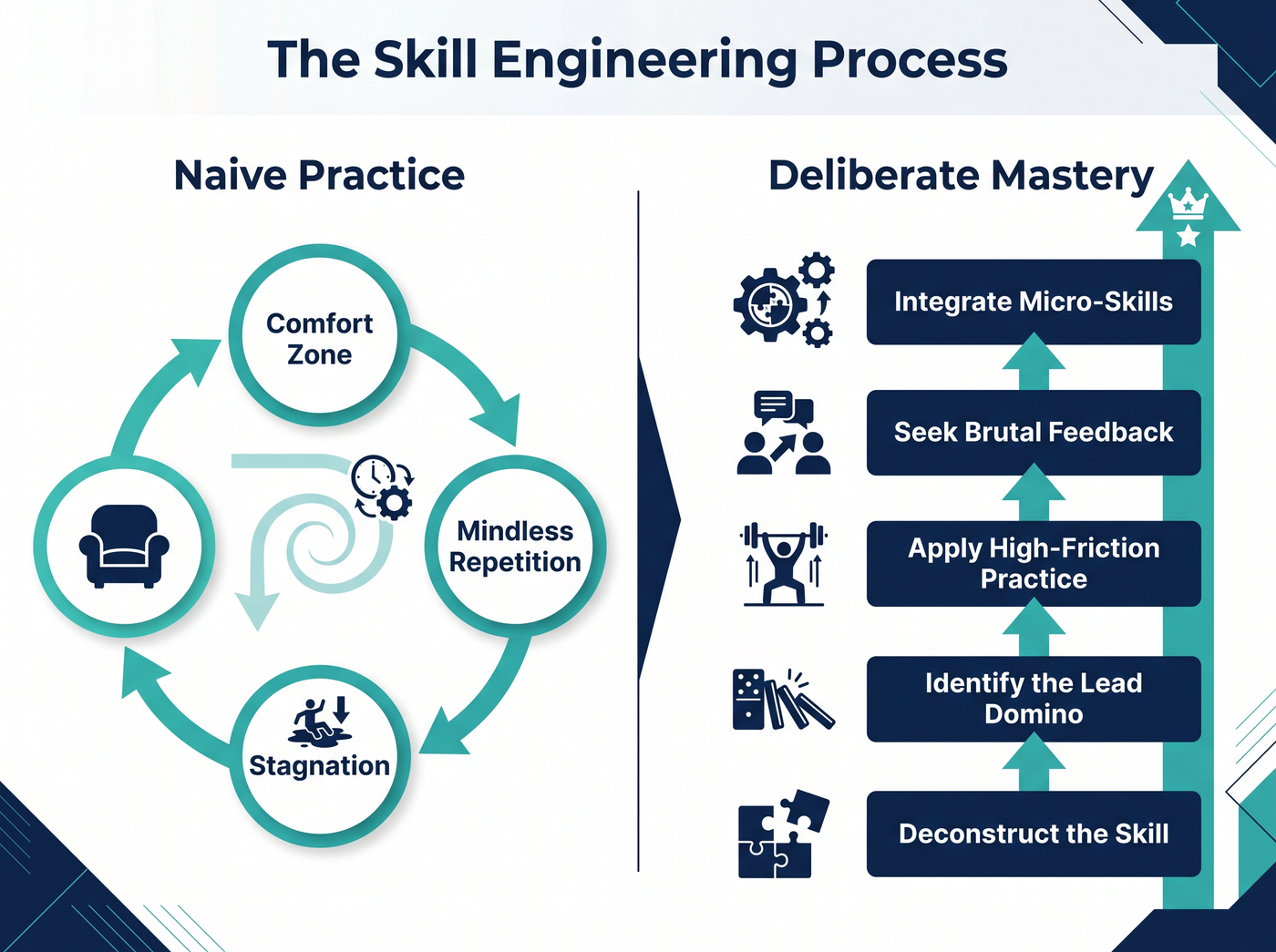
Once a skill is deconstructed, the next step is finding your lead domino. This is a specific sub-skill that provides a disproportionate amount of leverage when mastered, making all other aspects of the larger goal significantly easier to achieve.
For example, if you are a public speaker, vocabulary and content are undeniably important. However, the lead domino might actually be the fundamental mechanics of breath control or the strategic use of a pause. By identifying and doubling down on this high-leverage component, you bypass the need to improve every single sub-skill with equal intensity.
The Biology of Frustration and Feedback
The mechanics of deliberate practice are rigorous and exhausting [2]. Unlike naive practice, deliberate practice demands full concentration and immediate feedback. It pushes you into the stretch zone, which is that uncomfortable space just beyond your current capabilities where failure is frequent but highly informative.
The neurobiology of this process is fascinating. When we engage in high-friction practice, our brains physically change by building myelin. This fatty sheath wraps around nerve fibers to increase the speed and strength of electrical signals, allowing an expert to perform complex tasks with instinctual fluidity. Crucially, myelin does not grow in the comfort zone. It only grows when we struggle.
High-achievers see frustration as a biological signal that growth is occurring. To maintain this growth, they seek out brutal feedback. True cognitive agility requires finding mentors or data points that expose blind spots with clinical precision. It is about wanting to be corrected far more than wanting to be validated.
Balancing Deliberate Practice with Deliberate Play
While structured practice is perfect for closed systems with fixed rules, like classical music or chess, it can become a trap in open systems like business or modern creative work [1]. If professionals only practice what is known, they risk becoming excellent at a game that may no longer exist by the time they master it.
To solve this, professionals must engage in deliberate play. The iconic riff from the R.E.M. hit song 'Losing My Religion' was born because guitarist Peter Buck grew bored and picked up a mandolin, an instrument he did not know how to play. By embracing a playful mindset, he stepped away from choreographed excellence and stumbled into a breakthrough discovery.

The strategy for the future-looking professional is to develop T-shaped skills. This means possessing deep expertise in one core area alongside a broad ability to connect dots across completely different disciplines [5]. In a world rapidly shifting due to generative artificial intelligence, being a specialist in a single tool is dangerous. Being a specialist in the process of learning itself is the ultimate competitive advantage.
Engineering Your Own Genius
The science of the skill code suggests that genius is often just the visible result of a very long and disciplined process. However, true deliberate practice is mentally taxing. Research shows that even the absolute best in the world can only sustain it for about four hours a day. The remaining time must be spent in recovery or play.
If you want to architect your own potential, start with a gap analysis to evaluate the distance between where you are and where world-class performers stand. Identify your lead domino, apply high-friction practice, and protect your capacity for curiosity.
Listen to the episode
Ready to rewire how you acquire new capabilities and stop practicing for effort alone? Listen to our full episode on The Skill Code to uncover the exact blueprint for mastering human capability.