
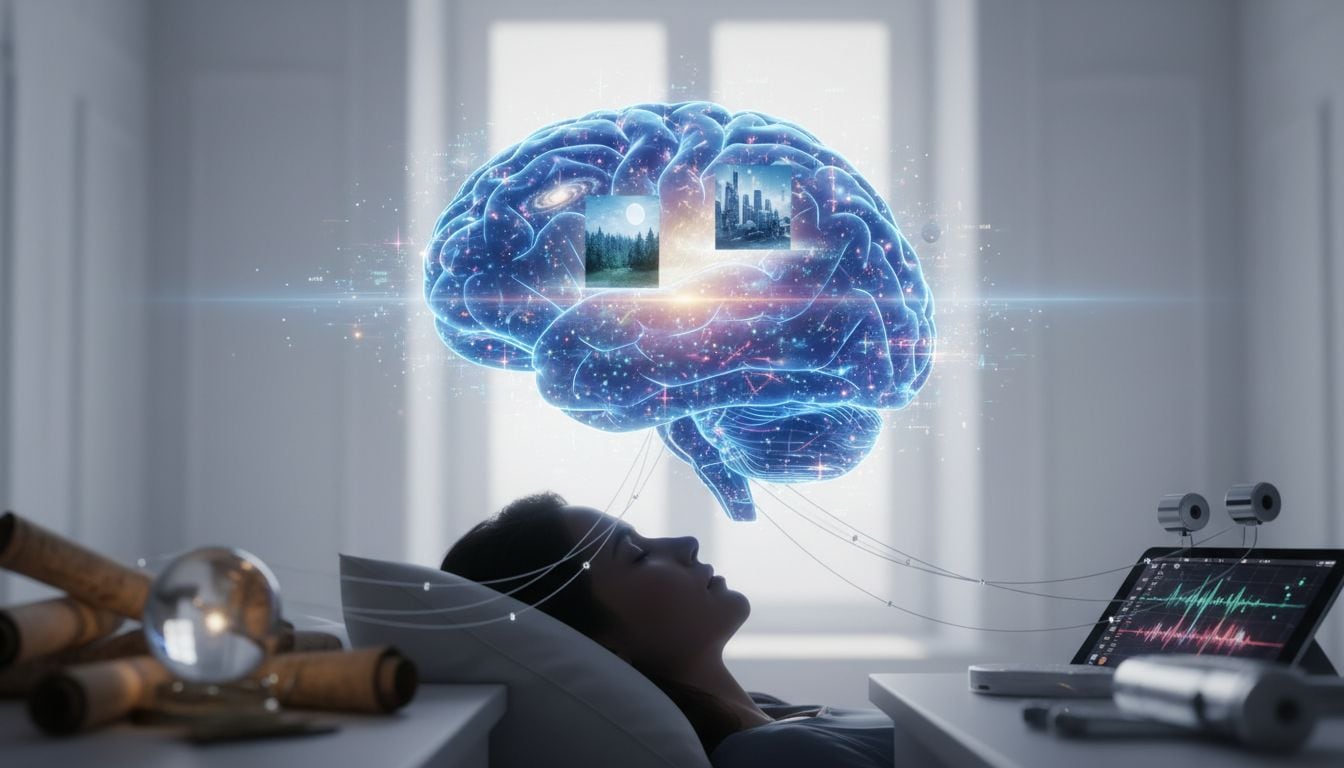
For centuries, humanity has looked at dreams with a mix of awe and confusion, often dismissing them as mystical warnings or meaningless random nerve firings. However, modern neuroscience has fundamentally shifted this narrative. We now understand that when you drift off, your brain isn't shutting down—it is checking into a sophisticated "biological theater."
Far from being a passive state, the dreaming brain is a high-fidelity virtual reality simulator designed to strip the sting from painful memories and solve complex problems. Understanding this mechanism reveals why a full night's sleep is non-negotiable for anyone looking to maintain their emotional health.
The Biological Theater: What Happens During REM?
When you enter Rapid Eye Movement (REM) sleep, your body undergoes a fascinating transformation. Your primary motor cortex is chemically inhibited, effectively paralyzing you to prevent you from acting out your dreams physically. Meanwhile, the rest of your brain becomes a beehive of activity.
The amygdala and hippocampus—the centers responsible for emotion and memory—fire with an intensity that often exceeds their waking levels. This activity is part of what experts call the Neurocognitive Theory of Dreaming. Championed by researchers like G. William Domhoff, this theory suggests that dreaming is a sophisticated cognitive simulation.[1][2]
During this state, the brain's Default Mode Network (DMN)—the system active during daydreaming and self-reflection—simulates complex social dynamics. This allows us to navigate interpersonal challenges and "practice" our social lives in a safe, risk-free environment.
Dreaming to Forget: A Natural Anxiety Cure
One of the most profound discoveries in sleep science is the concept of "dreaming to forget." This doesn't mean erasing memories, but rather diffusing their emotional volatility. This process relies on a unique neurochemical shift that only occurs during REM sleep.
While you dream, the concentration of noradrenaline—a key stress-inducing molecule—drops to near zero. This creates a calm biological environment where your brain can re-process distressing events from the day without triggering the physiological panic that accompanied them originally. Theories on this active role of dreaming suggest that this mechanism creates an "overnight therapy" session.[4]
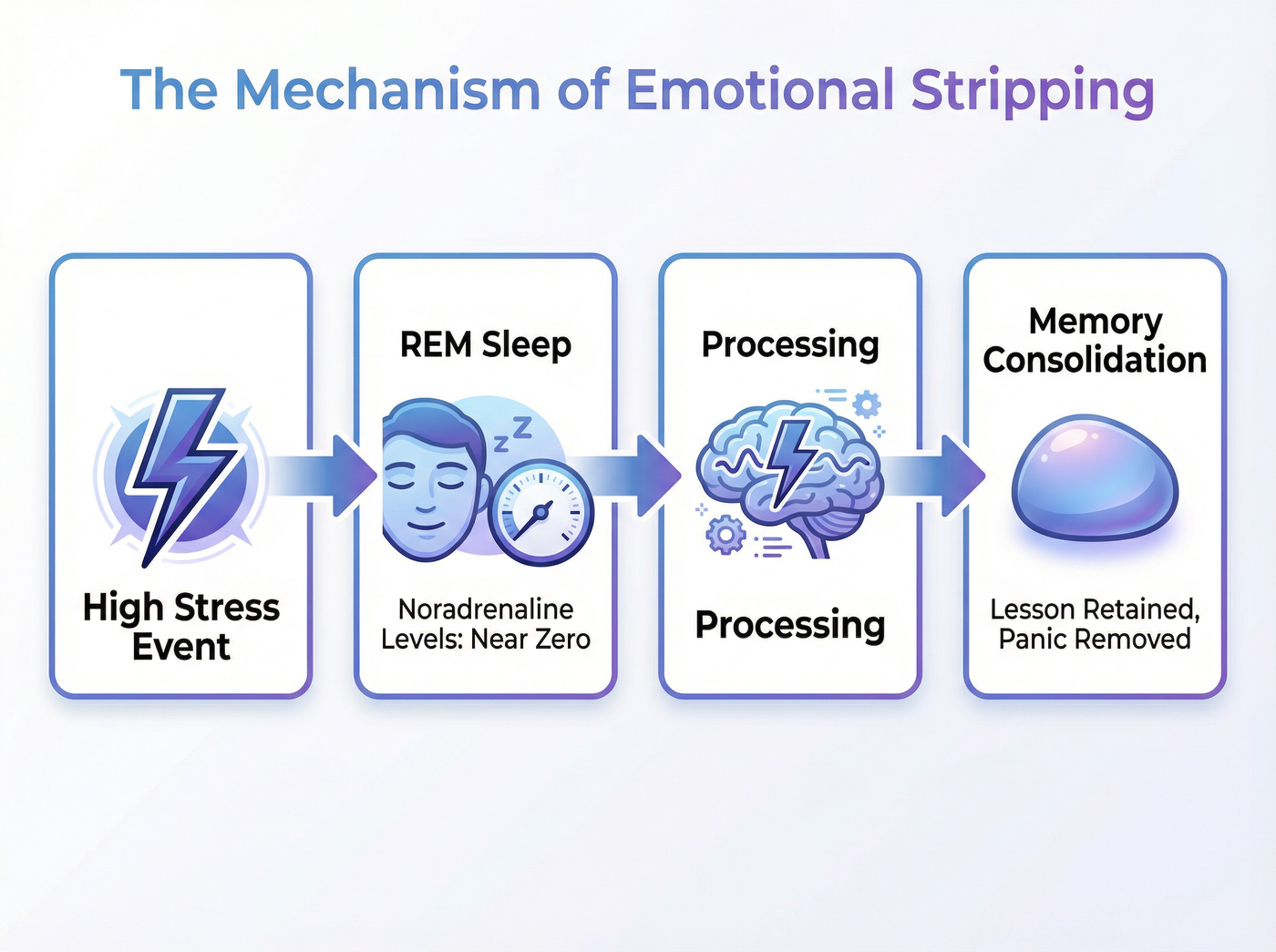
By revisiting painful experiences in this low-stress state, the brain strips away the sharp emotional "sting." The result is that you wake up with the memory of the event intact, but the chronic anxiety associated with it is significantly reduced. This prevents negative experiences from calcifying into long-term trauma.
Sleep on It: Solving Problems While You Rest
The old adage "sleep on it" is scientifically sound. Dreaming acts as a master organizer for the mind. Throughout the day, we accumulate disparate pieces of information. During sleep, our brains engage in memory consolidation and reorganization.
Research underscores that this sleep-dependent neuronal plasticity allows the brain to connect loosely related facts, leading to novel solutions that were invisible during waking hours.[3] This is why people often wake up with a sudden epiphany regarding a problem that seemed impossible the night before; the brain has actively reorganized the puzzle pieces overnight.

The Two-Hour Warning: Protecting Your REM Cycles
A critical misunderstanding about sleep is the belief that all hours of rest are created equal. They are not. The structure of sleep is cyclical, but the distribution of deep sleep versus REM sleep changes as the night progresses.
The longest, most vivid, and most emotionally productive REM cycles occur in the final hours of a standard eight-hour sleep window. If you cut your sleep short, you are disproportionately affecting your dream time.
Reducing your sleep by just two hours (for example, sleeping six hours instead of eight) does not mean you lose 25% of your recovery. Because REM is back-loaded, you may be sacrificing up to 50% of your dreaming time.[5] Skipping these final hours means missing out on the critical cognitive reset and emotional regulation that modern neuroscience—and our own daily experiences—tell us we need.[6]
Listen to the episode
Listen to The Science of Dreams: The Brain’s Virtual Reality
Sources
- The Neurocognitive Theory of Dreaming
- The Neurocognitive Theory of Dreams at Age 20
- Overnight neuronal plasticity and adaptation to emotional distress – Nature Reviews Neuroscience
- Evidence of an active role of dreaming in emotional memory processing – Scientific Reports
- The Possible Functions of REM Sleep and Dreaming – Neuroscience (NCBI)
- The functions of sleep: A cognitive neuroscience perspective – PNAS