

For over two decades, the internet had a standard operating procedure: type a keyword, scroll through a list of ten blue links, and click until you found what you needed. Google reigned supreme as the world's digital librarian, and its dominance seemed unshakeable. But as of February 2026, that era is officially fading. The paradigm has shifted from searching for information to receiving answers.
Leading this charge is Perplexity AI, a company that has transformed from a niche experiment into a mainstream habit, boasting a valuation of $18 billion and challenging the fundamental economics of the web.
- The era of the Answer Engine: Users are moving away from navigating links to receiving synthesized, cited answers directly.
- Explosive adoption: Perplexity was projected to process nearly 780 million queries per month by mid-2025, signaling mainstream acceptance[1].
- Google’s dilemma: The search giant’s $175 billion annual ad revenue depends on user friction—something AI efficiently eliminates.
- Monetizing the truth: While Perplexity relies on subscriptions, it is also testing "sponsored questions" and revenue-sharing models with publishers to sustain growth[3][6].
From Blue Links to Direct Answers
The core innovation of Perplexity AI is not just a better search algorithm; it is a fundamental architectural change. Traditional search engines index the web and rank pages based on authority and keywords. In contrast, Perplexity operates as an "answer engine." It uses large language models (LLMs) to read, synthesize, and cite real-time information, delivering a finished product rather than a list of ingredients.
This shift has resonated deeply with users. By mid-2025, Perplexity was on track to handle approximately 780 million queries monthly, a volume that proves this is no longer just a tool for early adopters[1]. Investors have validated this disruption with a staggering $18 billion valuation, betting that the future of the internet belongs to synthesis, not navigation[1].
The Innovator’s Dilemma: Google’s $175 Billion Problem
Why hasn't Google simply crushed this competition with its own superior data and talent? The answer lies in the classic Innovator’s Dilemma. Google's business model is built on "monetizing the hunt."
Google generates roughly $175 billion annually largely through advertising that appears during the search process. This model ironically thrives on friction; the more pages a user visits and the more time they spend searching, the more ad impressions Google can serve. An AI that provides a perfect, immediate answer effectively bypasses the ad ecosystem. For Google, every query answered directly by AI is a lost opportunity to show an ad.
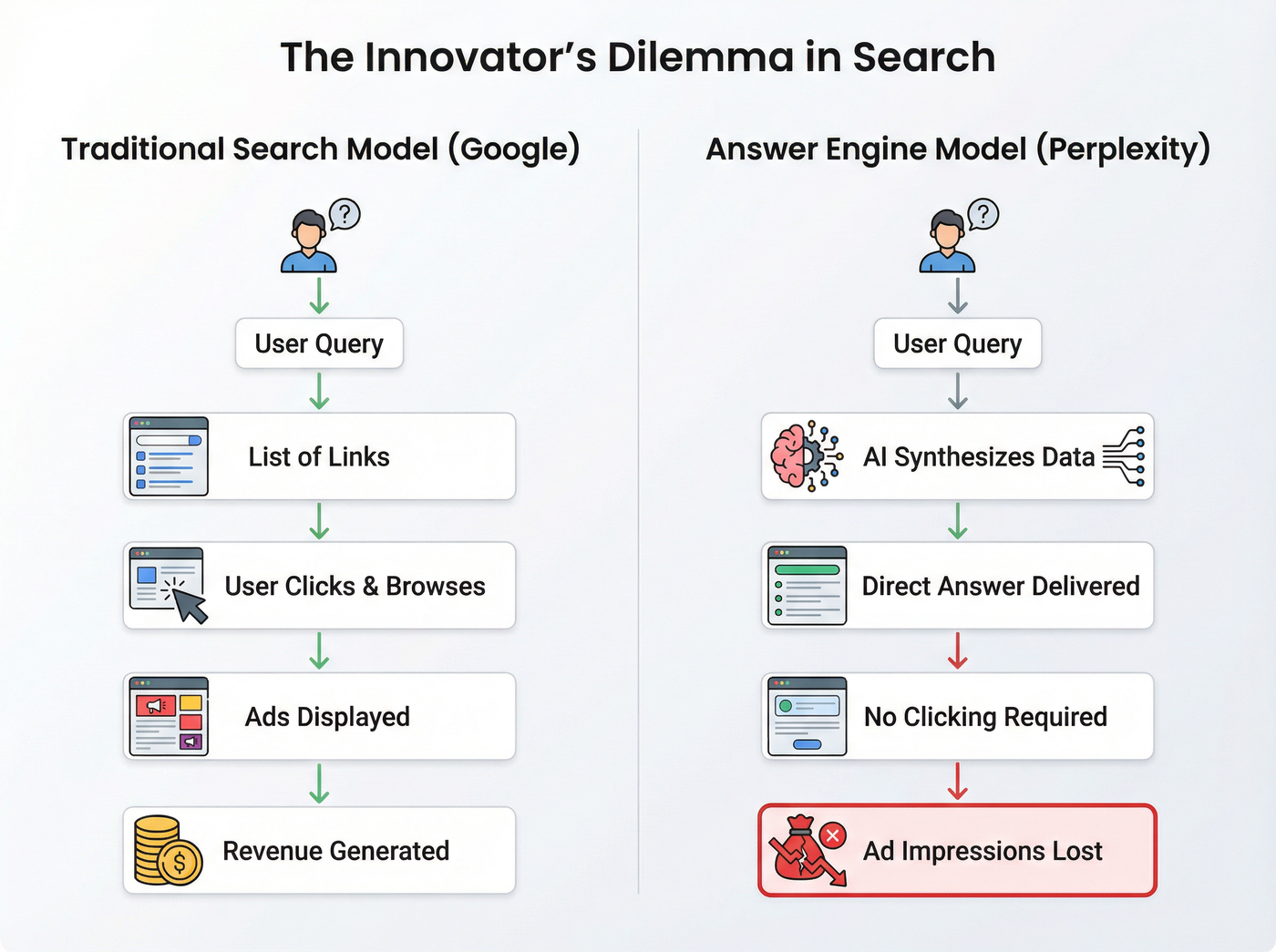
Perplexity, unburdened by a legacy ad network, has been free to prioritize efficiency. Its primary monetization has been a clean subscription model—charging around $20 per month for its "Pro" tier—which aligns incentives directly with the user: you pay for the best possible answer, not for a list of advertisers[4].
New Business Models for a New Era
While subscriptions provided the initial fuel, the economics of AI search are brutal. Generating an AI answer requires significantly more computing power than retrieving a database link. To address this, Perplexity has had to evolve its strategy beyond just subscriptions.
By 2025, the company began exploring "sponsored follow-up questions," a format that integrates advertising without breaking the conversational flow or cluttering the interface with banner ads[3]. This pivot suggests that even disruptors must eventually reckon with the immense costs of scaling AI.
The Publisher Partnerships
Perhaps the most critical battleground is the relationship with content creators. Generative AI has been accused of "scraping" the web without giving back, threatening the very publishers who create the information AI needs. To mitigate this, Perplexity introduced Comet Plus, a revenue-sharing program.
This initiative reportedly shares a portion of subscription revenue—up to 80% in specific tiers—with publisher partners when their content is cited[6]. This move attempts to build a sustainable ecosystem where the AI engine and the content source can coexist, addressing the legal and ethical backlash that has plagued other AI companies.

The Risks Ahead
Despite the hype, the path forward is not without obstacles. The "hallucination gap" remains a persistent risk. When a traditional search engine gives you a bad link, you notice it immediately upon clicking. When an answer engine gives you a subtly incorrect summary, it is harder to detect. This places a premium on Perplexity’s citation feature, which allows users to verify claims—a feature that has become the platform's hallmark reliability test.
Furthermore, scaling the business side has proven difficult. Reports indicate that while user retention is high, Perplexity has had to frequently pivot its commerce and advertising strategies to find a model that scales as effectively as Google's ad machine[4][5].
Conclusion
As we navigate 2026, the definition of "search" has permanently changed. We are no longer just looking for websites; we are looking for insights. While Google remains a titan, Perplexity has exposed a crack in the armor by proving that users prefer answers over links. The winner of this war will be the platform that can best balance the immense cost of AI compute with a business model that rewards both the platform and the publishers that feed it.
Listen to the episode
The Rise of Perplexity AI: A Threat to Google's Search Domain?
Sources
- Report: Perplexity Business Breakdown & Founding Story | Contrary Research
- Perplexity AI's plan for search ads looks nothing like Google
- Perplexity AI Challenges Google: Monetization Hurdles and Strategic Pivot
- Perplexity AI: Business Model, Competitive Advantages and Market Performance
- AI Content Monetization and Publisher Partnerships