
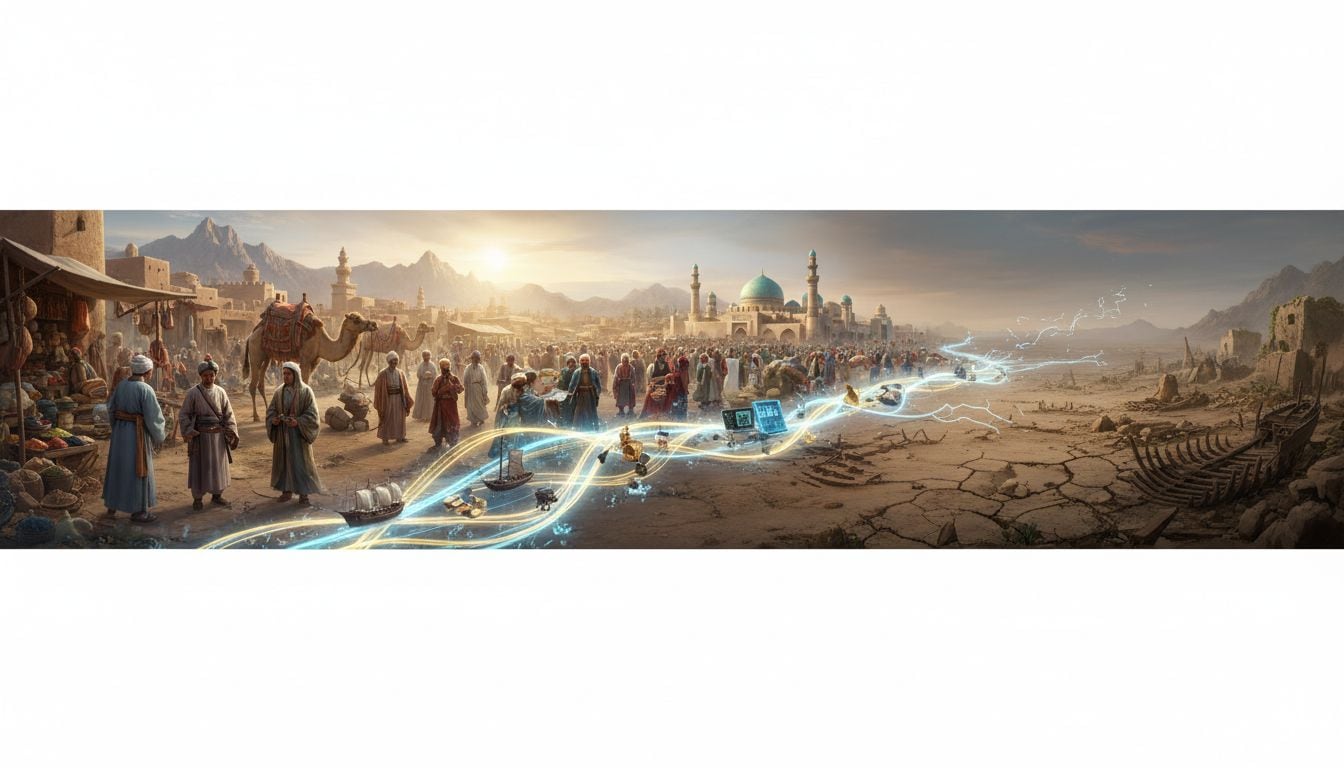
For nearly fifteen centuries, the Silk Road was not merely a set of coordinates on a map but the central nervous system of the Old World. Stretching from the jade markets of China to the Mediterranean coast, this sprawling network facilitated the greatest exchange of wealth, religion, and technology in human history. However, its decline in the 15th century wasn't just an end—it was the catalyst that forced the world to turn toward the oceans, sparking the Age of Discovery.
Below, we explore the two golden ages of this overland monopoly, the surprising fragility of its economy, and the geopolitical shifts that eventually rendered it obsolete.
The Anatomy of an Ancient Superhighway
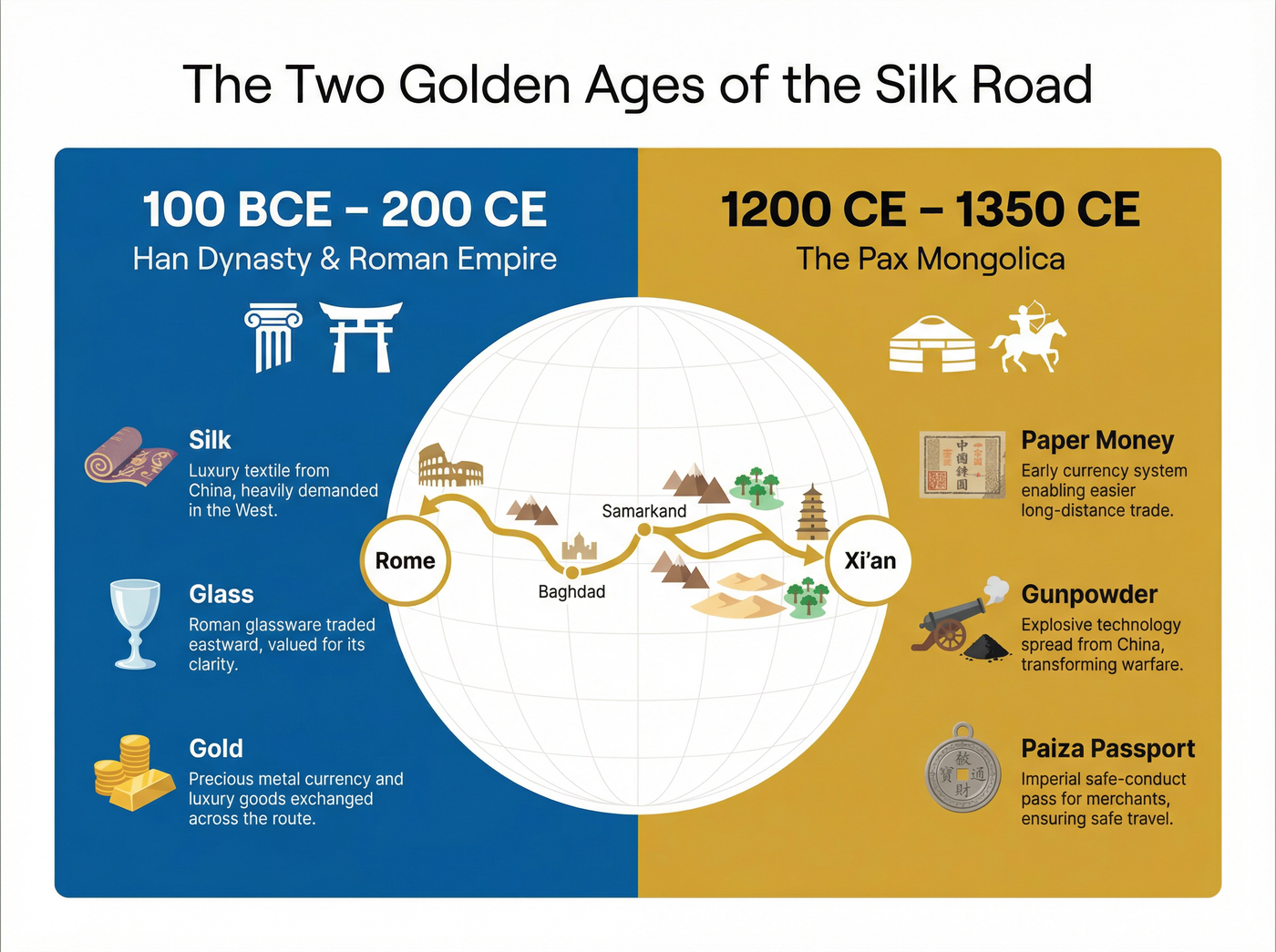
Contrary to popular imagination, the Silk Road was rarely traversed from end to end by single merchants. Instead, it operated as a relay system of peddler trade. Goods like silk, glass, and spices changed hands dozens of times at cosmopolitan hubs such as Dunhuang and Samarkand.[6] These oasis cities served as vital nodes, stitching together civilizations from the Han Dynasty in the East to the Roman Empire in the West.
This network flourished between 100 BCE and 1400 CE, serving as the primary conduit for distinct cultures to interact. However, the volume of trade was often dictated not just by consumer demand, but by the strategic needs of empires to provision their armies along these desolate frontiers.
The Pax Mongolica: A Masterclass in Logistics
The Silk Road experienced its second and perhaps most significant "golden age" in the 13th century under the Mongol Empire. The Mongols, often remembered primarily for their conquests, were also sophisticated administrators who unified the entire route under a single political umbrella.[2]
They exported a crucial commodity: security. By issuing universal passports known as paiza, the Mongol administration allowed merchants and travelers—including the famous Marco Polo—to cross the continent with relative safety. This lowered the transaction costs of trade significantly, creating an era of stability known as the Pax Mongolica. During this period, ideas and technologies flowed as freely as physical goods.
The Precarious Foundations of Private Trade
Despite the boom years, the Silk Road was built on surprisingly fragile foundations. Historical analysis suggests the network functioned in many ways as an artificial economy. A massive percentage of the material moving across the desert was grain and fabric for imperial logistics—government subsidies essentially kept the oasis towns alive.
The system depended heavily on geopolitical stability. When central governments collapsed or withdrew military support, the local economies often withered. Furthermore, the region faced a slow-motion environmental crisis. As "fossil water" reserves from shrinking glaciers were depleted, vital water sources disappeared, allowing the Taklamakan Desert to reclaim once-thriving cities.[4]
Death by a Thousand Cuts: The Decline
The collapse of the Silk Road was not a singular event but a convergence of catastrophes. In the mid-14th century, the connectivity that enriched the world also doomed it, as the Black Death traveled the same routes as silk, decimating the labor variance and distinct consumer markets of Eurasia.
Geopolitics dealt the final blows. In the East, the rising Ming Dynasty (1368) turned inward, prioritizing the Great Wall and isolationism over expansion. In the West, the fall of Constantinople to the Ottoman Turks in 1453 placed the gateway to Europe under strict control.[1] While trade did not stop entirely, heavy taxation and regulation spurred European powers to seek alternatives.

The Technological Pivot to the Sea
When the overland routes became too expensive and dangerous, the economic incentive shifted to the oceans. The logic was undeniable: a single ship could carry the cargo of a thousand camels at a fraction of the cost.[3]
This "technological pivot" birthed the Age of Discovery. Explorers like Vasco da Gama didn't just find new routes; they rendered the old internal network obsolete. The center of gravity for global trade moved from the heart of Central Asia to the Atlantic and Indian Oceans, leaving the ancient Silk Road to fade into history.[5]
Listen to the episode
Dive deeper into the geopolitical maneuvers and economic forces that shaped the ancient world in our latest episode.
Listen to "The Rise and Fall of the Silk Road Trade Monopoly" on Pody.fm
Sources
- Decline of the Silk Road | EBSCO Research Starters
- Empires of the Silk Road
- Role of Trade Networks in the Rise and Fall of Empires
- Silk Road Trade and Foreign Economic Influences - Cambridge University Press
- Exploration by land; Silk and spice routes series (UNESCO)
- The Classical Silk Road: Trade and Connectivity across Central Asia, 100 BCE–1200 CE