
When you first look at a page of written Norwegian, it might feel surprisingly familiar. As a Germanic language, it shares a significant amount of DNA with English. However, stepping from reading to speaking involves navigating a few twists and turns. The language is often described as “melodic” or “sing-song,” a quality that comes from its unique pitch accents and vowel structures. Mastering these sounds is the first step toward fluency.
Before you book your trip to the fjords, it helps to understand the building blocks of the language: the 29 letters of the Norwegian alphabet and the rules that govern them.
The Consonants: Familiar Friends and One Trap
For English speakers, the Norwegian consonant system is largely recognizable. Letters like B, D, F, L, M, N, P, S, and T generally behave exactly as you expect them to. However, there are a few critical differences that can trip up beginners.
The most famous “trap” is the letter J. In Norwegian, J acts like the English “Y”.[1] When you see the Norwegian word for “yes” (ja), it is pronounced “yah.” If you see the word for “girl” (jente), it starts with a “y” sound. It is almost never pronounced with a hard “J” sound like in “jump.”
Another distinction is the letter R. While pronunciation varies by dialect, the standard Norwegian R is often tapped or rolled, similar to the sound found in Spanish or Scottish English. It is distinct from the distinctively round American “R.”
You may also notice letters like C, Q, W, X, and Z. These are considered “foreign” letters in the Norwegian alphabet.[4] They rarely appear in native Norwegian words and are mostly found in loanwords (like pizza, taxi, or camping). If you see these letters, you can usually pronounce them just as you would in English.
The Nine Vowels
While English relies on five vowels (and sometimes Y), Norwegian explicitly uses nine vowels: A, E, I, O, U, Y, Æ, Ø, and Å.[6]
The letter Y is treated strictly as a vowel in Norwegian. It produces a sound that doesn't quite exist in English—a mix between the “ee” in “cheese” and the “ew” in “new.” To pronounce it, try saying “ee” while pursing your lips specifically into a tight circle.
The Unique Trio: Æ, Ø, and Å
The last three letters of the alphabet are what give Norwegian its distinct visual and auditory character. These are not just accents; they are independent letters that appear at the very end of the dictionary.
Æ (Ash) Pronounced like the “a” in the English words “bad,” “cat,” or “sad.” It is a wide, open sound. Ø This sound has no direct English equivalent, though it is similar to the sound in “burn” or “bird” if pronounced with a British accent (dropping the R). It is very similar to the “eu” in French or “ö” in German.[1] Å Pronounced like the “aw” in “saw,” “law,” or “ball.” Historically, this was written as “aa,” and you may still see the double-a spelling in old maps or family names.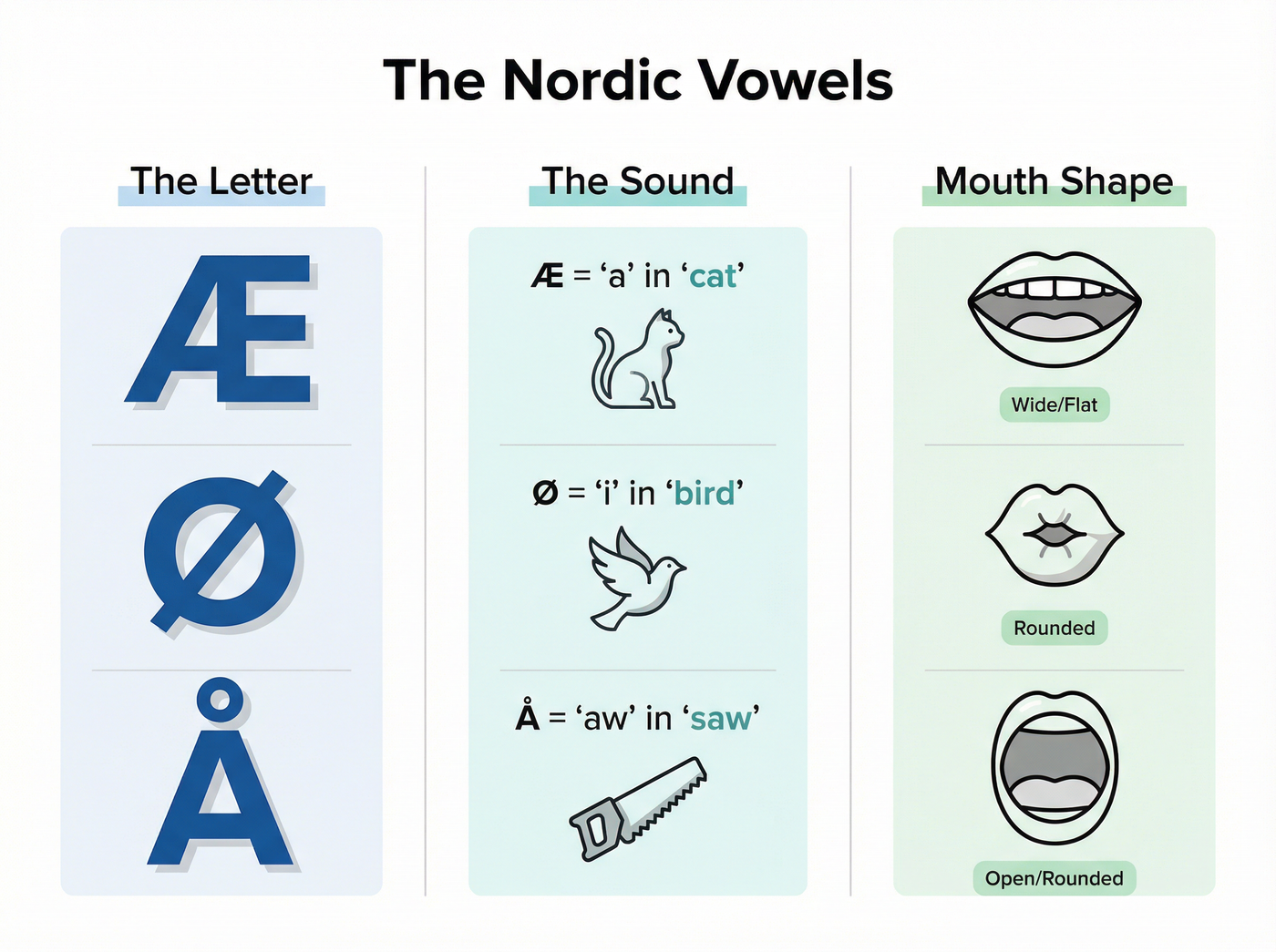
The Golden Rule: Vowel Length
One of the most vital rules in Norwegian pronunciation is determining whether a vowel is long or short. This is not random; it is strictly governed by the consonants that follow the vowel.
The rule is simple: A vowel is long if it is followed by one consonant. A vowel is short if it is followed by two consonants.[6]
This distinction frequently changes the entire meaning of a word. A classic example is:
- Tak (one 'k'): Pronounced with a long 'a' (like tah-k). This means “roof.”
- Takk (two 'k's): Pronounced with a short, clipped 'a' (like tack). This means “thanks.”
Mastering this rhythm is essential for being understood. If you hold a vowel too long or cut it too short, you might accidentally say a different word entirely.

The Melody: Pitch Accent
Norwegian is a tonal language, though not in the same way as Mandarin or Vietnamese. It utilizes two distinct pitch patterns, often called Accent 1 and Accent 2. This gives the language its characteristic bounce.
For example, the words bønder (farmers) and bønner (beans) sound nearly identical in terms of phonetic segments, but the intonation—the rise and fall of the voice—tells the listener which word you mean. While this can be intimidating for beginners, context usually helps, and Norwegians will generally understand you even if your pitch isn't perfect.
Listen to the episode
Ready to hear these sounds in action? Join us as we break down the alphabet and practice pronunciation drills together.
Listen to The Norwegian Alphabet & Pronunciation: Getting Started