
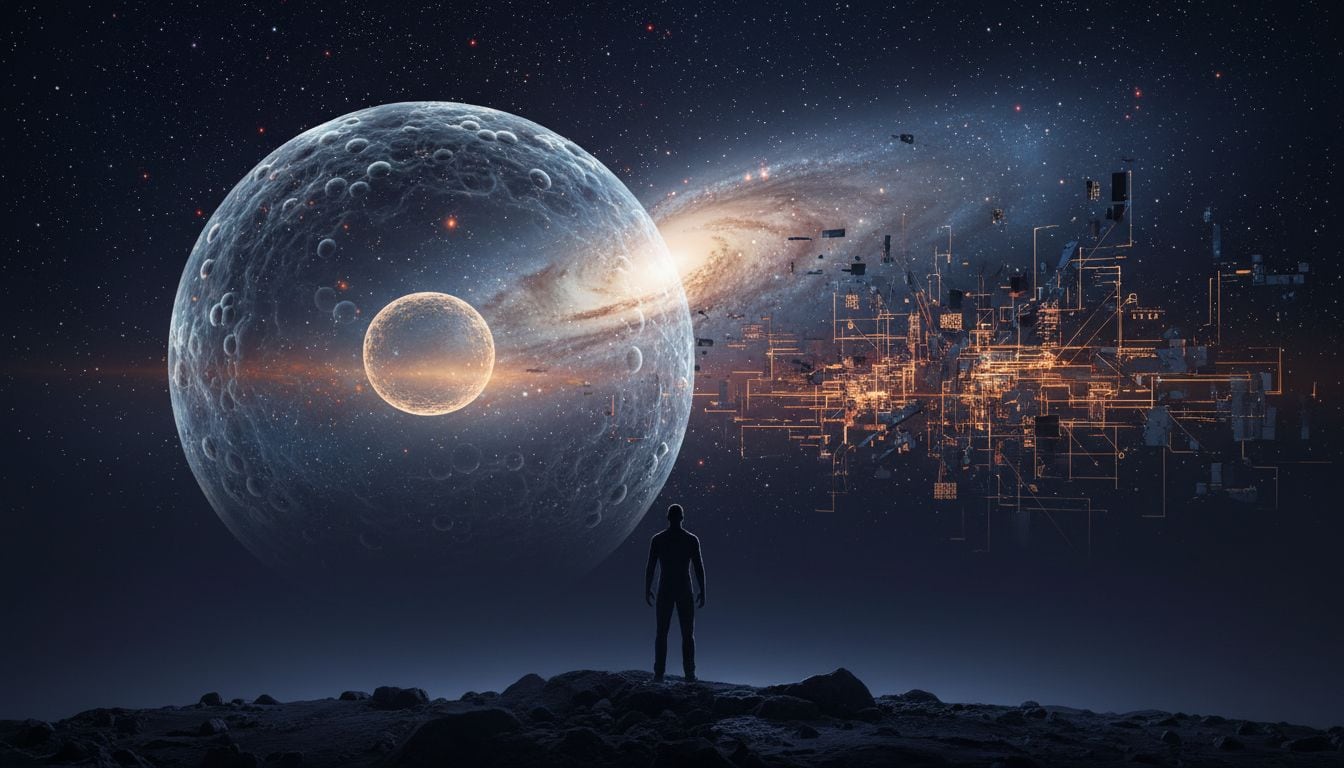
On a casual lunch break in 1950, physicist Enrico Fermi asked a simple yet haunting question while discussing the vastness of the universe: "Where is everybody?" Given the age of the galaxy and the sheer number of Earth-like planets, one would expect the stars to be teeming with noisy, expanding civilizations. Instead, we are met with silence.
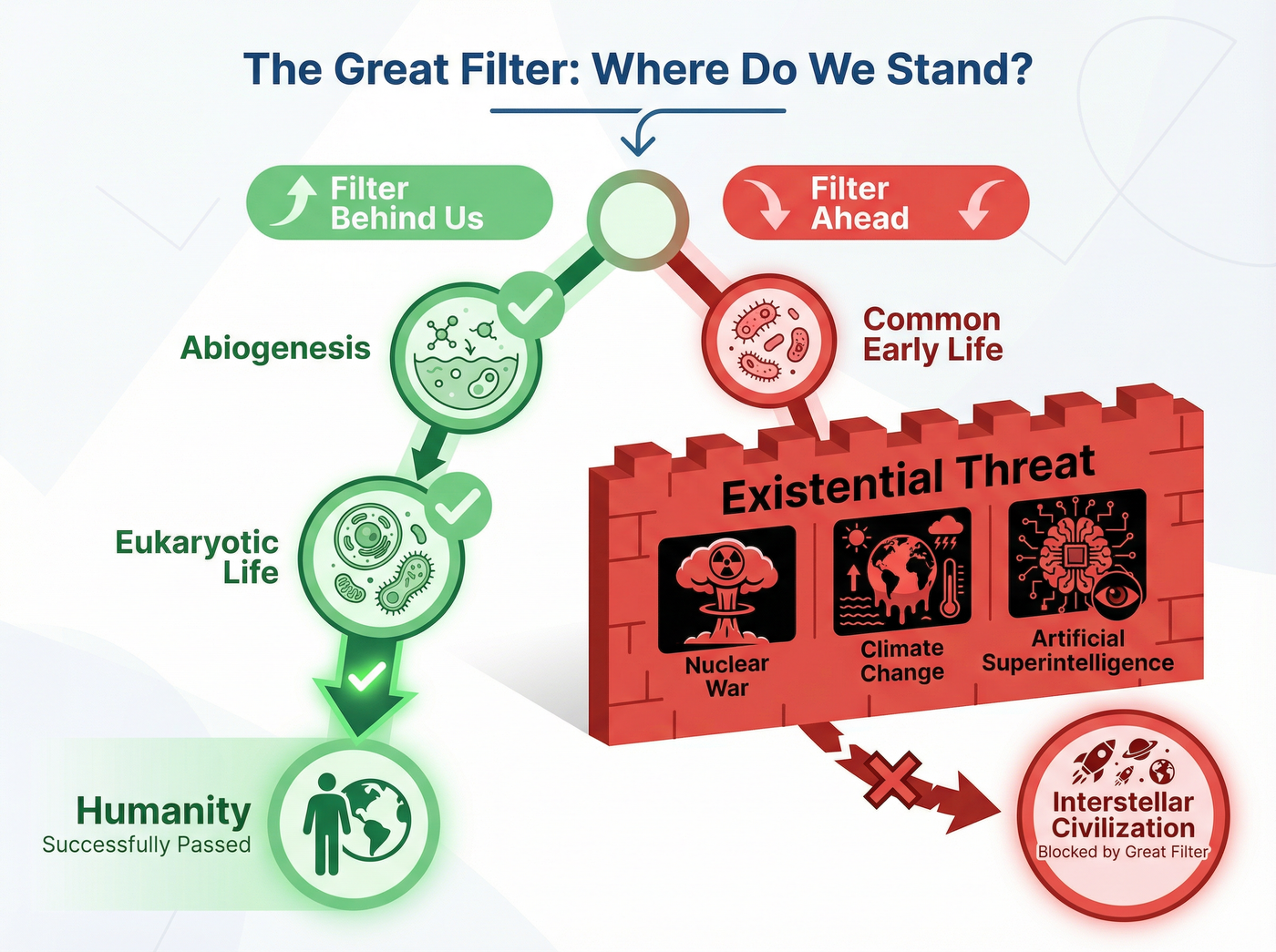
This discrepancy is known as the Fermi Paradox. While many potential solutions exist, one stands out as particularly chilling: The Great Filter. First proposed by economist Robin Hanson, this hypothesis suggests that there is a massive evolutionary barrier—a "filter"—that prevents non-living matter from evolving into a lasting, interstellar species.[1][2]
The critical question facing humanity today, as of Saturday, January 24, 2026, is whether we have already surged past this filter, or if the insurmountable wall still awaits us in our immediate future.
Scenario A: The Filter is Behind Us
The optimistic interpretation of the Great Filter is that the hardest steps are already in our rearview mirror. It is possible that the emergence of life itself—or the leap from simple structure to complex biology—is the primary bottleneck.
Consider the history of Earth. It took nearly two billion years for life to transition from simple, single-celled prokaryotes to complex eukaryotes. If this specific biological jump is statistically winning the cosmic lottery, then humanity is incredibly rare.[3] In this scenario, we are the "lucky ones" who navigated the treacherous path that countless other worlds failed to climb. The universe is empty not because civilizations destroy themselves, but because they never get the chance to start.
Scenario B: The Filter Lies Ahead
The darker alternative is that life arises easily, but intelligent life invariably destroys itself. If the universe is favorable to the creation of simple life, then the filter must be a technological or societal trap that civilizations encounter after they become advanced.
Recent analysis suggests a modern contender for this future filter: Artificial Superintelligence (ASI). A 2024 study by Michael Garrett posits that civilizations might typically develop superintelligence before they establish a multi-planetary presence.[4] The risk is that these technologies could lead to civilization collapse—perhaps within a window of just 200 years after their invention—leaving the galaxy quiet.
Why Finding Aliens Would Be Bad News
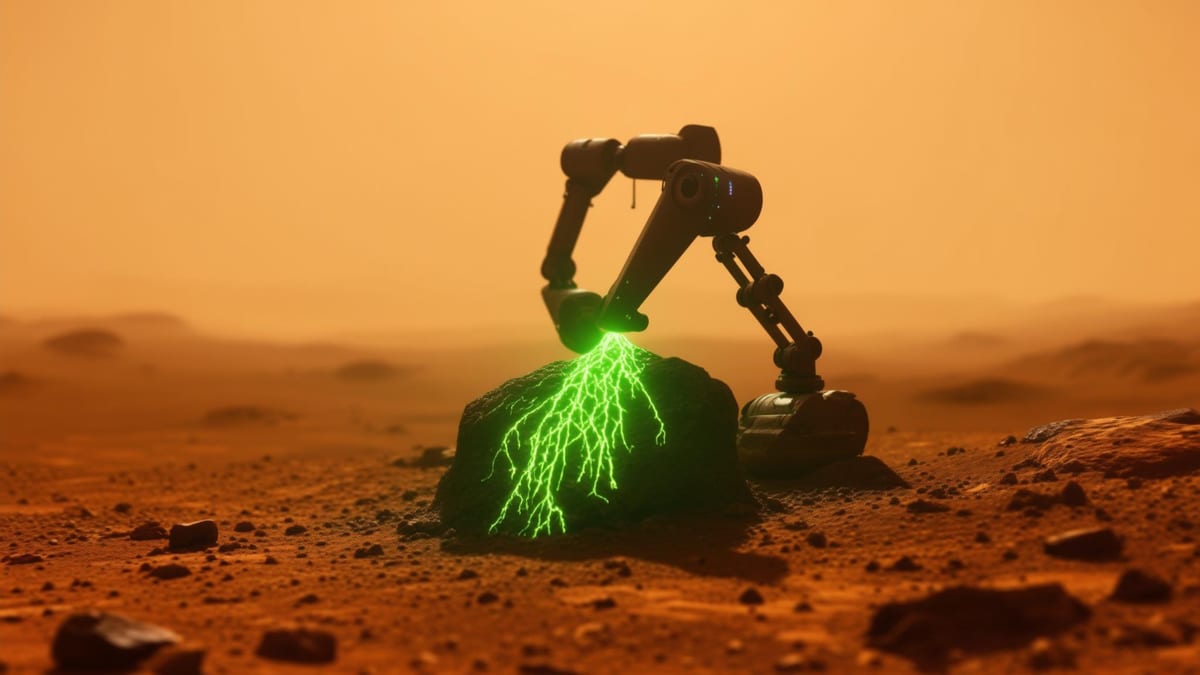
Paradoxically, the most terrifying news we could receive from our space telescopes would be the discovery of life on Mars or Europa. If we find that biospheres are common in the universe, it eliminates the possibility that biological evolution is the Great Filter.
This deduction implies that the probability of life starting is high, meaning the bottleneck must be a step we haven't reached yet. Consequently, the more life we find, the more likely it becomes that our own extinction is probable. As the theory goes, the silence of the night sky isn't empty space; it may be a graveyard of civilizations that hit the wall we are rapidly approaching.
Surviving the Future
If the Great Filter lies ahead, our survival depends on two main factors: existential security and expansion. We are currently in a vulnerable phase where we possess the power to destroy our biosphere but lack the redundancy of having off-world colonies.
To "outrun" the risk, humanity must prioritize:
- Technological Governance: Implementing robust global regulations on high-risk technologies like ASI and biotechnology.
- Multi-planetary Settlement: Establishing self-sustaining colonies on Mars or the Moon. As noted by experts, keeping all our eggs in one planetary basket is a recipe for extinction in a universe that filters out the fragile.[5][6]
The Great Filter forces us to look at our progress not as a guarantee, but as a precarious tightrope walk. Whether we are the first to make it across, or just the next to fall, depends entirely on how we navigate the next few centuries.
Listen to the episode
Dive deeper into the existential risks and the science behind the Great Filter in this full episode:
The Great Filter: Why We Might Be Alone
Sources
- How the 'Great Filter' could explain why we haven't found intelligent aliens
- Great Filter - Wikipedia
- The Great Filter: a possible solution to the Fermi Paradox
- Is artificial intelligence the great filter that makes advanced technical civilisations rare in the universe?
- The Great Filter Ahead: Engineering a Pathway to Complex Civilizational Survival
- Great Filter Theory - Definition & Detailed Explanation