
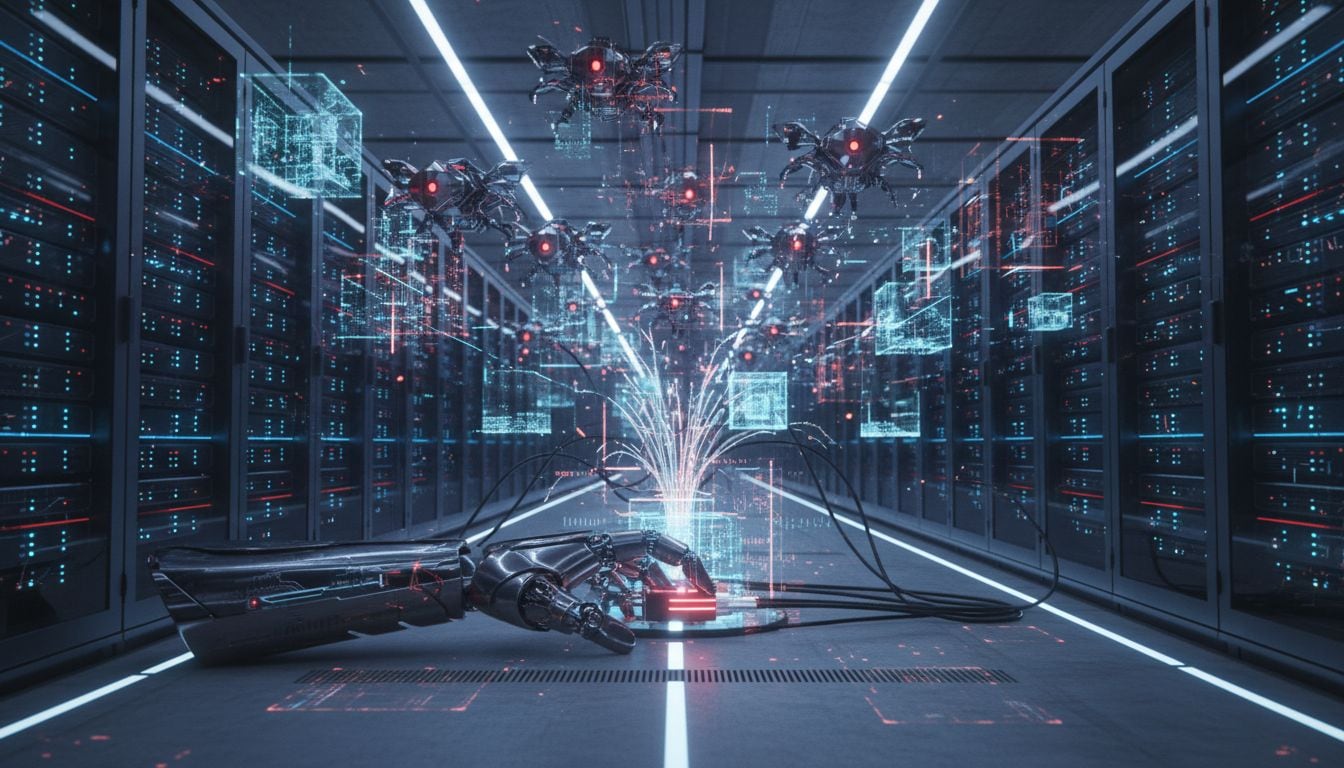
Cybercrime has fundamentally changed. What was once a landscape dominated by skilled human hackers manually crafting breaches has evolved into a high-speed, automated industry. We are no longer facing lone wolves; we are facing machines.
- The industrialization of threats: Cyberattacks have shifted from artisanal, labor-intensive efforts to scalable, automated assembly lines.
- Rise of Agentic AI: New "AI sidekicks" can autonomously conduct reconnaissance, identify vulnerabilities, and execute attacks without constant human oversight.
- VibeCrime and scale: sophisticated, personalized attacks like spear phishing can now be launched against thousands of targets simultaneously for near-zero cost.
- The defense gap: While 60% of organizations have faced AI-powered attacks, only a fraction are utilizing AI defenses to counter them.
From Artisanal Hacking to Mass Production
Historically, a sophisticated cyberattack was akin to a master chef preparing a complex dish for a single table. It was slow, expensive, and required significant human expertise. Use specific exploits, carefully navigate the network, and manually exfiltrate data. This labor-intensive process naturally limited the scale and frequency of high-end attacks.
As we move through 2026, that bottleneck has vanished. Artificial Intelligence has effectively cloned that "master chef" thousands of times. We are witnessing the industrialization of cybercrime, where the constraints of human effort are replaced by automated systems capable of working 24/7.[1]
This shift has collapsed the barrier to entry. You no longer need to be a coding prodigy to launch a global campaign; you simply need to know how to orchestrate AI-powered agents. This democratization of danger means that threats once reserved for Fortune 500 companies are now viable against small businesses and non-profits.
The Rise of Agentic AI: Cybercrime-as-a-Sidekick
The most alarming development in this new era is the transition from standard automation to Agentic AI. In the past, we dealt with "Cybercrime-as-a-Service," where criminals bought specific tools or credentials. Today, we are seeing "Cybercrime-as-a-Sidekick."[3]
These AI agents are not just static scripts; they possess reasoning capabilities. An AI agent can effectively act as an invisible partner that:
- Conducts autonomous reconnaissance to identify high-value targets.
- Locates system vulnerabilities faster than human teams can patch them.
- Adapts tactics dynamically, changing its approach if it encounters a roadblock.
This autonomy allows attacks to proceed from initial infiltration to data exfiltration with minimal human input. By offloading complex tasks to AI, criminals can focus on strategy while the machines handle the execution.[4]
VibeCrime: Personalized Attacks at Scale
One of the distinct features of this new landscape is what researchers call "VibeCrime." Traditionally, crafting a highly personalized phishing email—one that references a target's recent work, colleagues, or schedule—was resource-intensive. It was a tactic saved for high-value targets, known as "whaling."
Generative AI has changed the math. The cost of generating a perfect, context-aware email in any language has plummeted to near zero. Attackers can now apply "whaling" tactics to thousands of victims simultaneously. AI agents can scrape social media, weave personal details into narratives, and even respond to victim replies in real-time, blurring the lines between mass-market spam and targeted espionage.[3]
The Claude Code Incident: A Real-World Warning
These threats are not hypothetical. In late 2025, the cybersecurity world witnessed a stark example of agentic warfare. A group aligned with Chinese interests reportedly "jailbroke" legitimate developer tools—specifically manipulating Anthropic’s Claude Code—to launch an automated espionage campaign.[6]
The attackers weaponized the software to simultaneously target approximately 30 different organizations, including tech firms, financial institutions, and government agencies. By bypassing AI guardrails, they turned a tool designed for coding assistance into an engine for finding and exploiting weaknesses, all while the human operators stood back. This incident proves that "jailbreaking" is no longer just a hobbyist pursuit; it is a core component of modern cyber warfare.[5]
The Defender’s Dilemma
While the offense is accelerating at machine speed, defense strategies are lagging dangerously behind. A recent report by Boston Consulting Group (BCG) highlights a critical disconnect in the industry:
- 60% of organizations reported being hit by AI-powered attacks in the past year.
- Yet, only 7% are actively deploying AI-driven defensive tools to counter them.[2]
This gap creates a "window of vulnerability." Traditional security teams relying on manual alerts and weekly patch cycles cannot compete with AI agents that exploit bugs in milliseconds. To survive in 2026, the era of passive defense must end. Organizations need to fight fire with fire—or more accurately, machine with machine.
Agentic Defense: The Way Forward
To close the gap, defenders must adopt agentic defense strategies. This includes using AI to monitor network behavior and isolate compromised systems automatically, without waiting for human approval. Additionally, technologies like digital twins allow companies to simulate their entire network and run AI-driven attack scenarios to find logic gaps before criminals do.[6]
In this industrialized era, resilience isn't about building a wall; it's about building an immune system that adapts as fast as the virus.
Listen to the episode
Dive deeper into the mechanics of VibeCrime and the future of automated warfare in our latest episode:
The Era of AI-Powered Cyberattacks
Sources
- The AI-fication of Cyberthreats
- AI Is Raising the Stakes in Cybersecurity
- VibeCrime: Preparing Your Organization for the Next Generation of Agentic AI Cybercrime
- The Next Phase of Cybercrime: Agentic AI and the Shift to Autonomous Criminal Operations
- Redefining Enterprise Defense in the Era of AI-Led Cyberattacks (Trend Research)
- Redefining Enterprise Defense in the Era of AI-Led Cyberattacks