
For centuries, the question "Are we alone?" was purely philosophical. It was a query for poets and dreamers, not scientists. That changed in 1961 at the Green Bank Observatory in West Virginia, where a young astronomer named Frank Drake gathered a group of elite researchers—including a young Carl Sagan and Nobel laureate Melvin Calvin—to seriously discuss the possibility of extraterrestrial life. To structure their conversation, Drake sketched a simple formula on a piece of paper. He didn't intend to write a legendary law of physics; he just wanted a meeting agenda.[1][2]
That sketch became the Drake Equation, a probabilistic framework used to estimate N, the number of active, communicative civilizations in the Milky Way galaxy. Today, roughly 65 years later, this equation remains the backbone of the Search for Extraterrestrial Intelligence (SETI), though the way we fill in its blanks has changed dramatically.
Breaking Down the Math
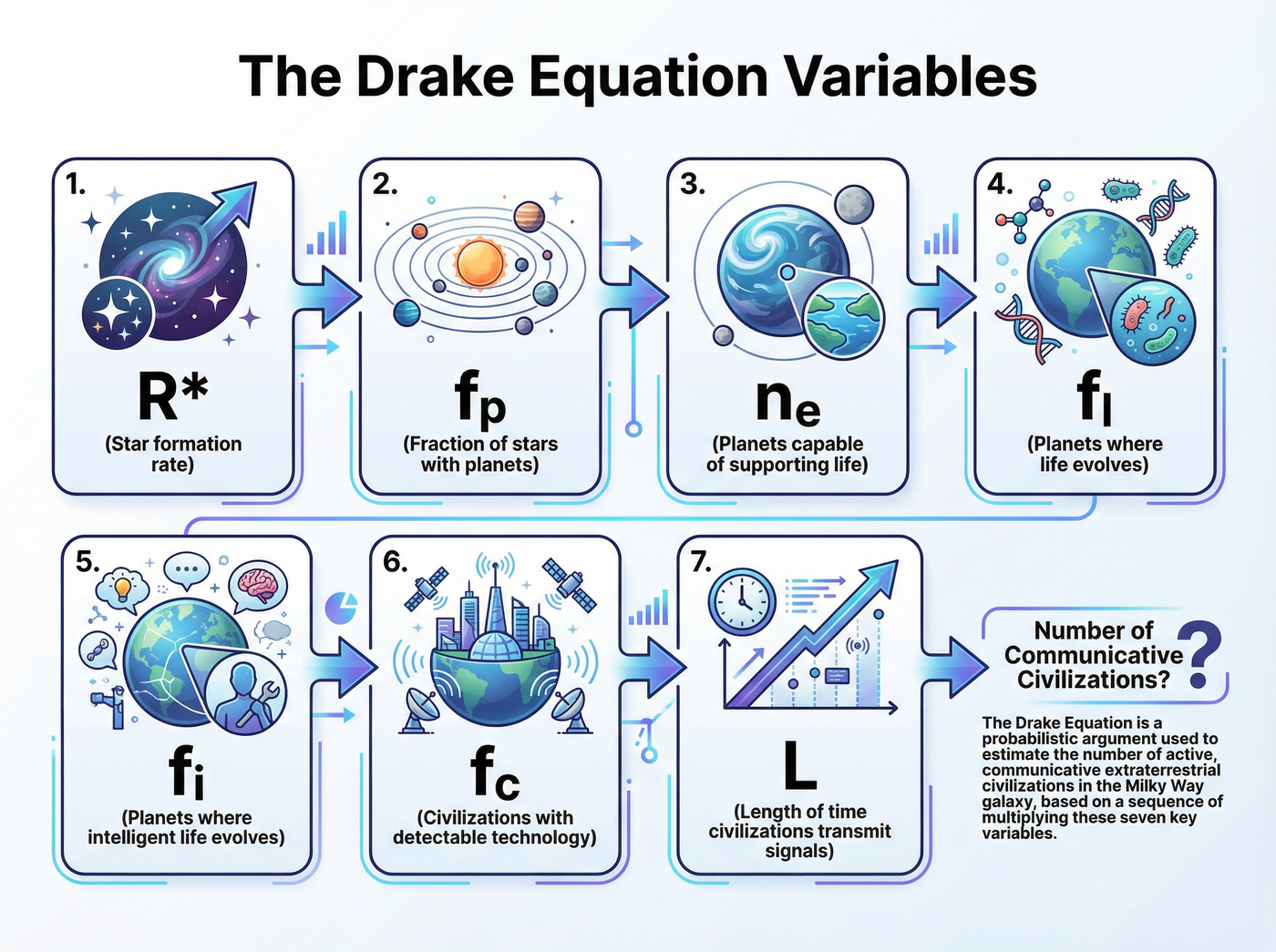
The equation breaks the massive problem of alien life into seven manageable variables. While it looks like a math problem, it functions more like a roadmap for ignorance—highlighting exactly what we don't know.
The formula is expressed as:
N = R* × fp × ne × fl × fi × fc × L
In the early days, almost every variable was a complete guess. However, the last few decades of astronomy have turned speculation into hard data.
From Philosophical Guesses to Hard Numbers
The most significant shift in our understanding concerns the variable fp, the fraction of stars that host planetary systems. For decades, astronomers wondered if our solar system was a rare cosmic accident. Without data, they could only speculate on whether other stars had potential habitats.
The launch of space telescopes like Kepler and TESS (Transiting Exoplanet Survey Satellite) fundamentally altered this landscape. We now have observational evidence confirming that planets are not the exception—they are the rule. Current data suggests that virtually every star in our galaxy hosts at least one planet.[1][6]
This realization has immense implications: the galaxy is teeming with real estate. Even if only a tiny fraction of these planets reside in the "Goldilocks zone" (where liquid water can exist), the sheer number of stars means there are billions of potential habitats in the Milky Way alone.
Hunting for Biosignatures, Not Just Radio Waves
Traditionally, the Drake Equation focused on finding communicative civilizations—aliens capable of building radio telescopes. This is represented by fc. But what if life exists but isn't broadcasting episodes of I Love Lucy into space?
Pioneering researchers like MIT professor Sara Seager are championing a pivot in how we use the equation. Instead of waiting for a radio signal, modern astronomy is moving toward detecting biosignatures. These are chemical fingerprints—gases like oxygen and methane found in a planet's atmosphere—that are difficult to explain without the presence of biological processes.[3]
This approach modifies the spirit of the equation. Finding a planet covered in moss or microbial slime might not result in a conversation, but it would answer the fundamental question of whether biology is unique to Earth. It broadens the search from "intelligence" to "life" in any form.
The Fragility of Civilization
Despite our progress in finding planets and identifying atmospheres, one variable remains stubbornly elusive and deeply unsettling: L. This stands for the length of time a civilization releases detectable signals into space.
This variable forces us to confront the concept of the Great Filter. Does intelligent life tend to destroy itself shortly after developing advanced technology? Whether through nuclear war, climate collapse, or unchecked AI, the silence of the universe might be a grim statistic indicating that high-tech civilizations are naturally short-lived.[1]

If L is short, then N (the number of current civilizations) drops toward zero, regardless of how many habitable planets exist. In this way, the Drake Equation serves as more than a scientific calculator; it is a mirror reflecting our own fragility. It reminds us that survival is not guaranteed and that the longevity of our own civilization is the variable we have the most control over.
Listen to the episode
Dive deeper into the history and future of the search for alien life in our episode, The Drake Equation: Calculating Alien Life.