
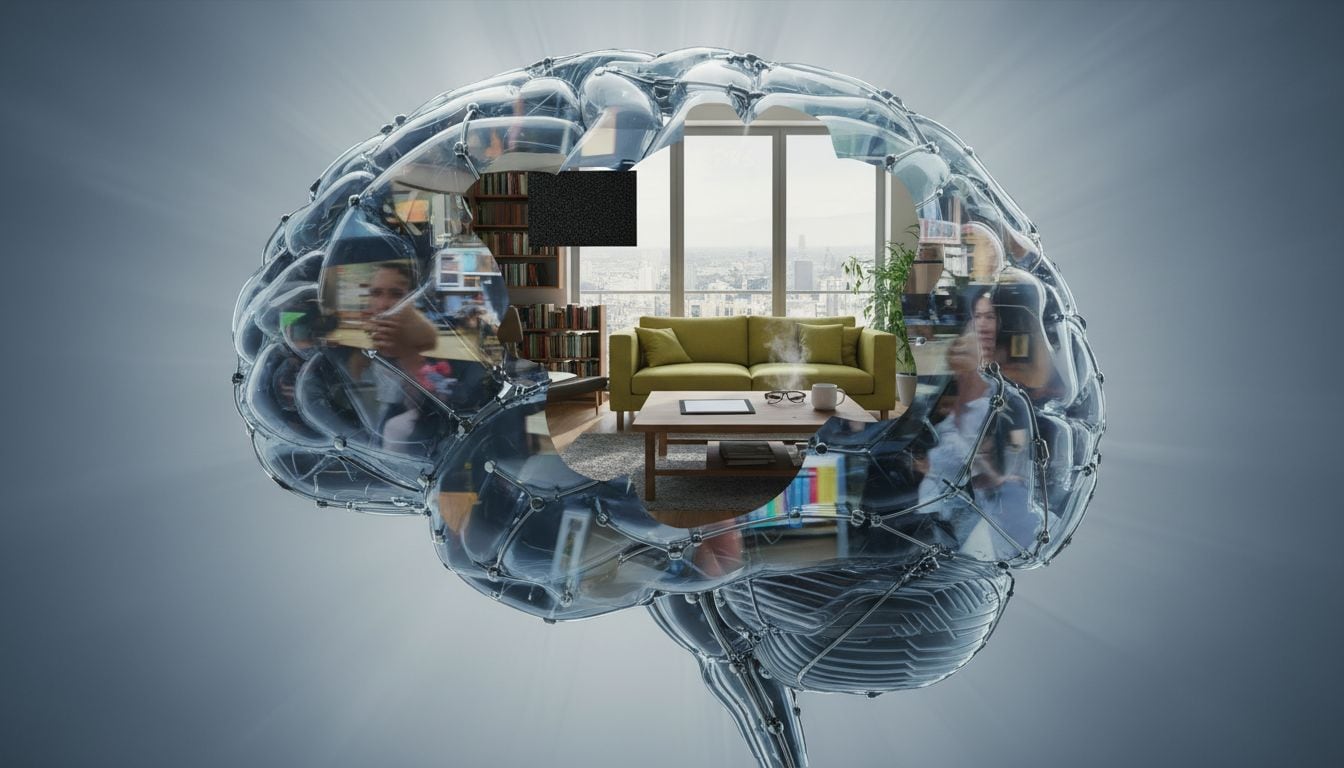
If a video camera operated the way your eyes do, the resulting footage would be completely unwatchable. It would be a chaotic, shaky mess filled with motion blur, sudden jerky pans, and frequent blackouts. Yet, when you look around the room today, Sunday, February 15, 2026, you perceive a stable, high-definition, and continuous stream of reality.
This stability is an illusion. Your brain is not merely recording the world; it is actively editing it in real-time. Through a mix of active suppression and predictive modeling, your brain stitches together a coherent narrative from fragmented data, effectively hiding the seams of your own biology.
Listen to the episode
Dive deeper into the neuroscience of perception in this episode of pody.fm:
The Blink Hack: How Your Brain Edits Reality
The Blindness of Being Human
The first major interruption to our vision is the blink. On average, humans blink approximately 15 to 20 times per minute. With each blink lasting between 100 and 400 milliseconds, we spend a surprising amount of our waking lives effectively with our eyes closed—potentially up to 10% of our waking day[2].
Despite this frequent occlusion, we rarely notice the world going dark. This is because the brain engages in active suppression. It ignores the downtime, stitching the pre-blink and post-blink images together so smoothly that the interruption is perceptually invisible.
Blinks Are a Processing Stage, Not Just Maintenance
For decades, scientists believed blinking was primarily a maintenance function designed to lubricate the cornea. However, recent research suggests that blinks play a functional role in how we process information.
A study published in PNAS indicates that blinks act as an information processing stage. Rather than simply losing data during a blink, the brain utilizes the sudden change in light levels—known as luminance transients—to reformat spatial information. This process enhances the visual system's sensitivity to the global structure of a scene, favoring low-resolution, “big picture” patterns over fine detail[6].
Essentially, a blink acts like a soft reset button. It breaks up the overwhelming stream of visual noise, allowing the brain to maintain a stable internal map of the environment.
Saccadic Masking: Deleting the Blur
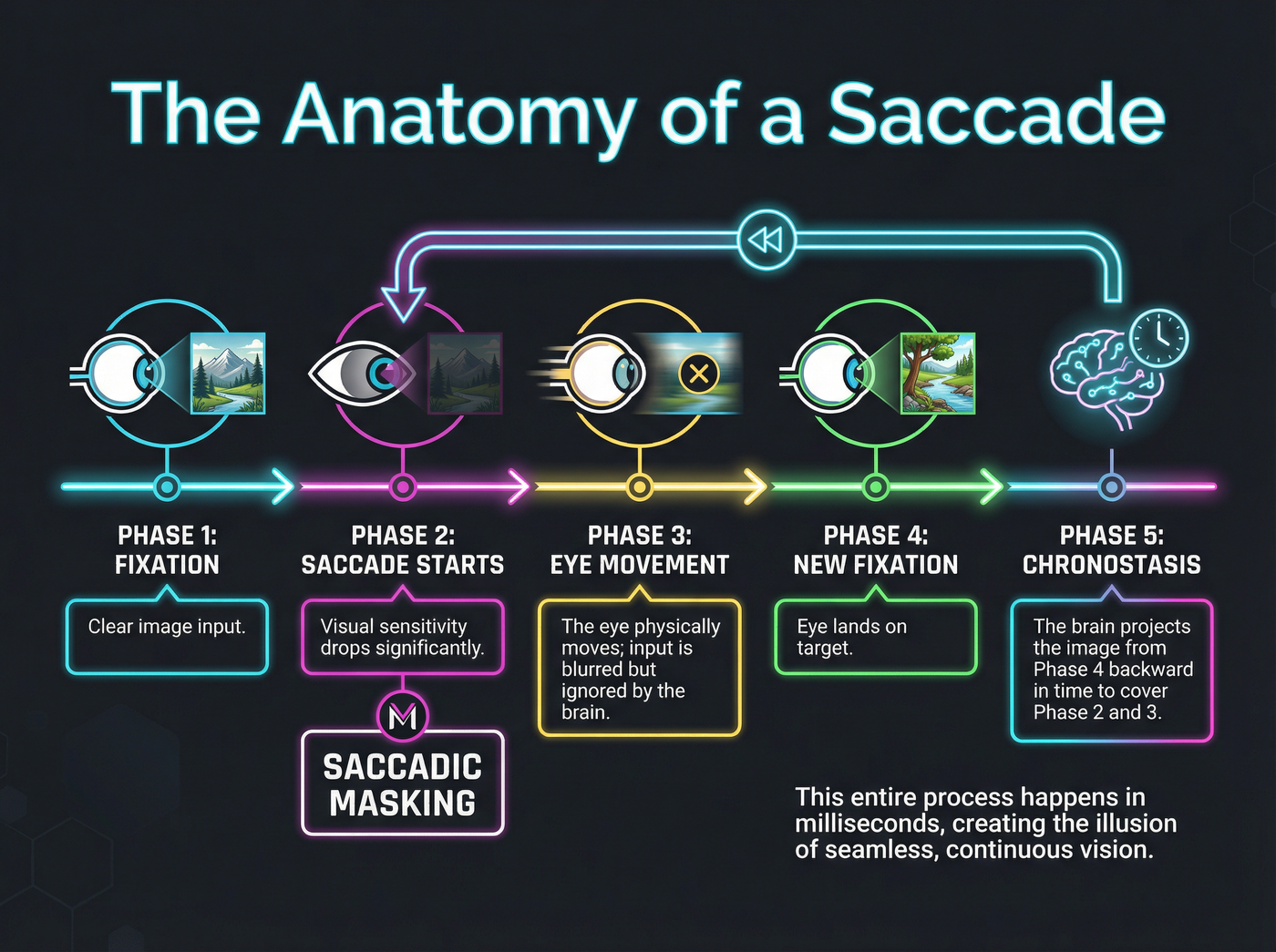
Beyond blinking, our eyes are constantly darting around in rapid, jerky movements called saccades. Whether you are reading this text or scanning a room, your eyes do not glide; they jump. During these jumps, the eye moves so quickly that the image on the retina should become a useless smear of motion blur.
To prevent this, the brain employs a mechanism known as saccadic masking (or saccadic suppression). Just before and during the eye movement, the brain shuts down visual processing within the magnocellular pathway, which is responsible for detecting motion[1].
This creates a temporal gap in your vision. You are technically blind to the motion of your own eyes. To prove this, look in a mirror and look from your left eye to your right eye repeatedly. You will never see your eyes move. Yet, if you watch a friend do the same thing, the movement is obvious.
Time Travel and the Stopped-Clock Illusion
If the brain deletes the blurry frames during a saccade, why don't we experience gaps in time? The answer lies in a phenomenon called chronostasis. The brain performs a sophisticated “copy-paste” operation to bridge the gap.
When your eyes land on a new target after a saccade, the brain takes that clear image and mentally backdates it, filling in the milliseconds of darkness that just occurred. This creates a retroactive narrative of continuity. This is often observed as the “stopped-clock illusion,” where the first second you see on a clock face appears to last longer than the subsequent seconds because your brain has artificially extended that moment to cover the travel time of your eyes[2].
The Prediction Engine
This capability is rooted in predictive coding. The brain is not a passive receiver of light; it is a prediction engine. Before your eyes even move, the primary visual cortex is pre-activating neurons corresponding to where the eyes are about to land. We are effectively living in a slightly delayed, highly edited version of reality where the brain prioritizes consistency over raw accuracy.

The Risks of an Edited Reality
While this neural editing is essential for a stable visual experience, it has practical implications for design and safety. In high-speed environments, such as aviation or driving, a critical event occurring during a 300-millisecond blink or a 50-millisecond saccade might be completely missed.
Furthermore, because the brain relies on prediction, it may fill the gap with a “safe” assumption rather than the actual hazard that appeared. Designers of digital interfaces are now using this knowledge to implement “saccade-contingent” updates—changing information on a screen exactly when a user blinks or moves their eyes, ensuring the change feels seamless and instantaneous.
Ultimately, “seeing” is as much an act of imagination as it is an act of observation. Our world is a meticulously stitched-together highlight reel, designed to keep us oriented, focused, and sane.