

We are stepping into an era where artificial intelligence is moving away from the generic, all-knowing assistant toward something far more intimate: the Personal AI Persona. This isn't just a chatbot that answers questions; it is a digital twin designed to mirror your specific knowledge, tone, and decision-making logic. Creating one requires a blend of technical engineering and narrative craft, focusing on two critical components: the Directive and the Memory Stack.
Below, we explore how to move beyond simple prompts to build an AI that truly reflects your individual essence.
The Persona Directive: More Than Just a Prompt
At the heart of a personal AI is the Persona Directive. Think of this not as a temporary prompt you type into a chat box, but as the "constitution" of your digital identity. It guides the AI's behavior across all channels, whether it is drafting a Slack message to a colleague or a direct message on a social platform.
A successful directive goes beyond general instructions like "be professional." It defines specific vocabulary shifts (e.g., using "stoked" instead of "pleased") and establishes the boundaries of the character. This is where negative constraints become vital. Research has shown that defining what an AI should avoid is essential for consistency.[4] For example, a directive might state: "Never use emojis when discussing legal contracts, but use them liberally when the topic is hiking." This nuance prevents the AI from sounding generic and helps establish a distinct personality personality.[1]
The Memory Stack: Grounding the Ghost
If the directive is the script, the Memory Stack is the actor's backstory. Without memory, a directive is just a set of rules with nothing to apply them to. Modern personal AI systems utilize a comprehensive repository of your history—emails, documents, transcribed voice notes, and chat logs—to ground the model in reality.
This process, often called retrieval-augmented generation (RAG) in technical circles, allows the AI to access "durable anchors"—established facts from your life.[6] When the AI answers a question, it doesn't just guess; it retrieves the relevant context from your Memory Stack.
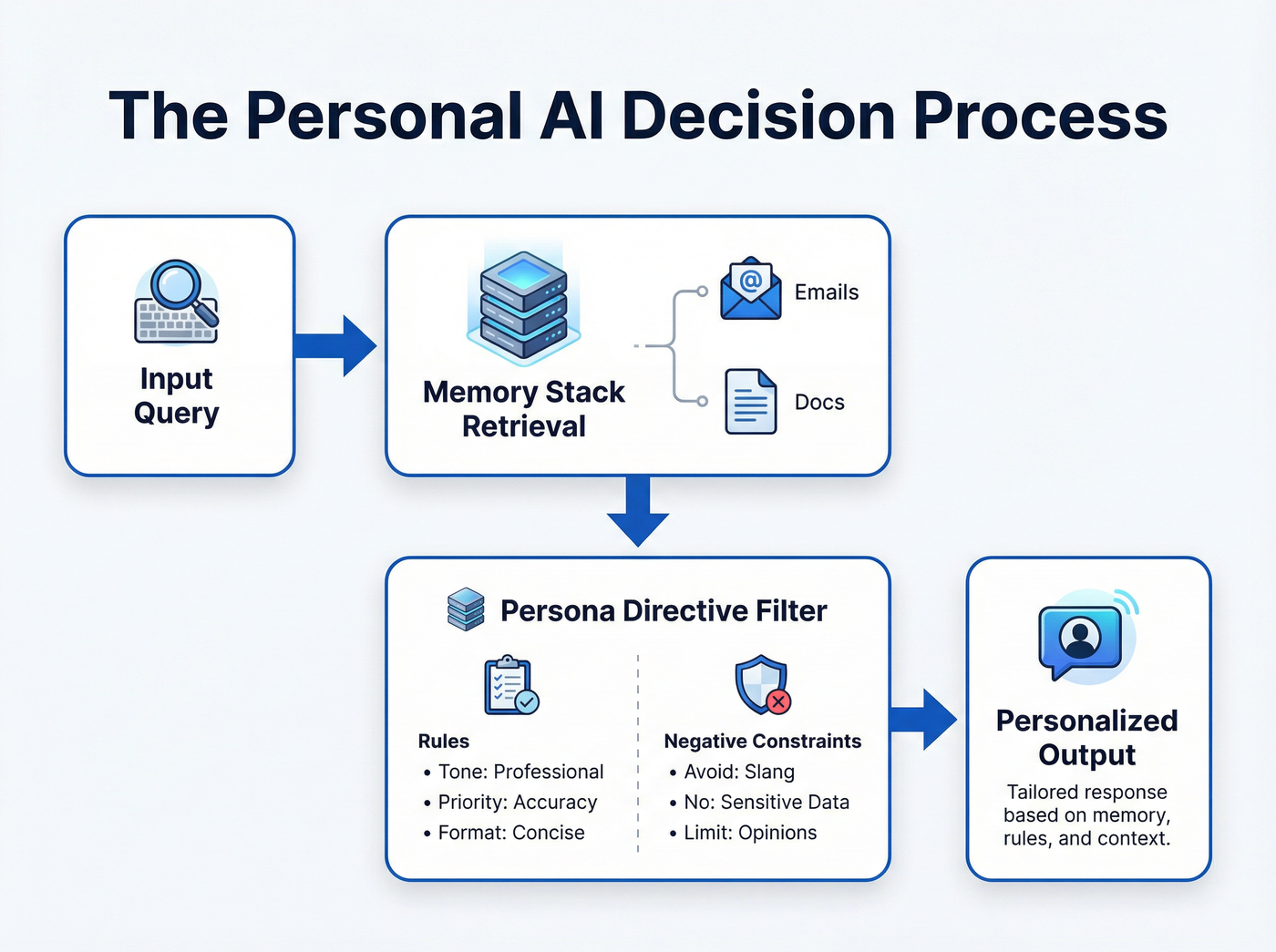
By relying on this stack, the AI avoids hallucinating facts. It ensures that if asked about a meeting you had last week, it references the actual transcript of that meeting rather than inventing a plausible scenario. This long-term memory allows for interactions that evolve over time, rather than resetting with every new chat session.[2]
The Personal Accuracy Score
As we refine these tools, the benchmark for success is shifting. We are no longer looking for general accuracy; we are looking for the Personal Accuracy Score. This metric answers a critical question: "Would I have said it this way?"
Achieving a high score requires consistent "curated teaching." This involves providing the AI with feedback—correcting its tone, updating its memory when it misses a detail, and refining the directive as your own life changes.[3] It is a move from general problem-solving to deep personal alignment, ensuring the digital twin represents your unique cognitive patterns.

The Future: Identity in Flux
Looking ahead, the most advanced concepts in personal AI involve "adaptive retellings." Human identity is not static; we tell stories differently to our boss than we do to our friends. Emerging research suggests that future AI memories won't just be flat files, but will treat identity as something that emerges from stories.
These systems utilize narrative memory, where the core facts (durable anchors) remain the same, but the delivery shifts based on context—a concept known as "flux."[5] This evolution will allow your AI to possess social grace, adjusting its directive on the fly to match the "temperature" of the conversation.
Listen to the episode
Deep dive into the architecture of digital identity in this episode of the Pody podcast.
The Art of the Personal AI Persona
Sources
- Persona Directives - Personal AI Documentation
- Enabling Personalized Long-term Interactions in LLM-based Agents through Persistent Memory and User Profiles
- A Guide to Prompting and Teaching your Personal AI
- This Character Definition Format for Character AI Actually Works (98% Tested) » Robo Rhythms
- Prototype of a narrative-memory virtual human: identity emerges from stories, not sliders
- Practical Memory Patterns for Reliable, Longer-Horizon Agent Workflows - Applied Information Sciences