
When you look at a pay stub, it is easy to focus on the money that is gone. But have you ever stopped to consider what you are actually buying with that deduction? In this episode, we reframe taxation not as a penalty, but as a subscription service to civilization itself. It is the financial backbone of the social contract—an agreement where we pool resources to buy things that no single individual could efficiently afford alone.
From the sidewalk under your feet to the fire station around the corner, taxes build the invisible scaffolding of our daily lives. Understanding the economics behind these public goods helps explain why the government steps in where the free market cannot.
Listen to the episode
Dive deeper into the mechanics of public funding in our latest episode.
The Price We Pay for Government
The concept of taxation is often debated, but at its core, it is the primary method by which governments raise revenue to cover the costs of general services. Think of it as a mandatory purchase order for things we all need but cannot buy individually.[1]
This collective funding supports the "invisible scaffolding" of society. When you drive on a paved road or visit a clean public park, you are utilizing a system maintained by tax dollars. Economists refer to many of these as public goods. These are goods that are both non-excludable (you can't stop people from using them) and non-rivalrous (one person using them doesn't ruin it for everyone else).
The classic historical example of a public good is the lighthouse. If a private company built a lighthouse, they would struggle to charge passing ships for the light; the captain could see the beam regardless of whether they paid a fee. Because the market cannot easily capture value from a lighthouse, the government steps in to fund it for the safety of all.[2] Today, this logic extends to modern necessities like clean air initiatives and street lighting.
How We Fund Our Neighbors: The Role of Local Taxes
While federal taxes often dominate the headlines, the taxes that most directly impact your daily routine—funding for garbage collection, pothole repair, and local police—are collected by state and local governments. These entities rely on a specific mix of revenue sources, but for local municipalities, one stands out: the property tax.
Why is property tax the bedrock of local funding? The answer lies in stability. Unlike income, which fluctuates with the economy, or sales, which can move across borders, land cannot move. Real estate provides a broad, stable tax base that allows local governments to budget for essential services regardless of economic trends.[4]
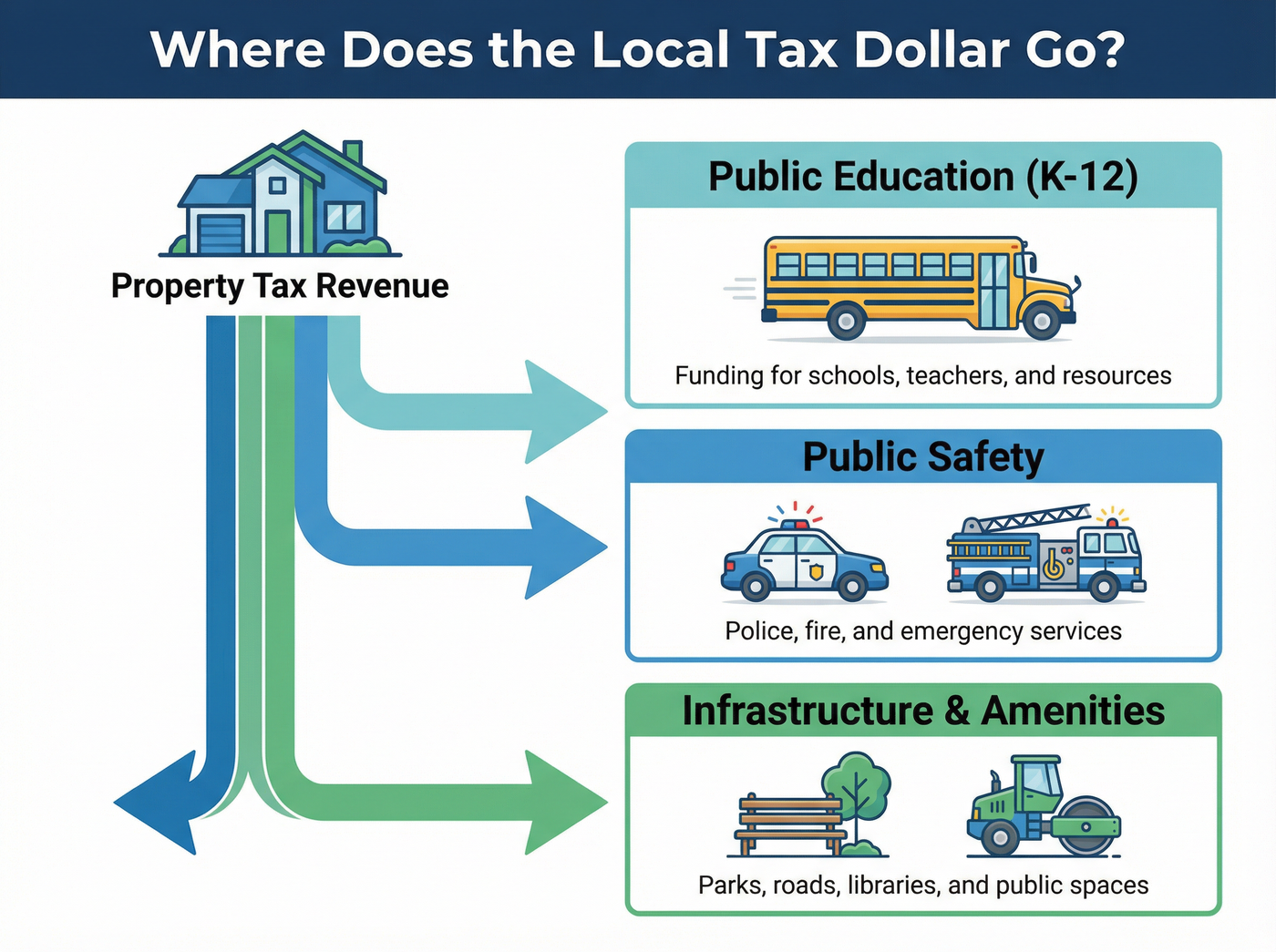
This stability is crucial for emergency services. A community cannot afford to have a fire department that only operates when the economy is booming. By pooling risk through taxes, we fund a state of "readiness." You are paying for the firefighters to be there before the toast burns, ensuring that a small accident in the kitchen doesn't turn into a neighborhood catastrophe.
The Investment in Education
Perhaps the most significant investment made with these local dollars is in education. In the United States, approximately 88% of school-age children attend public elementary and secondary schools.[3] These institutions are funded largely through state and local tax revenues, rather than federal ones.
This system highlights a critical aspect of the social contract: the generational transfer of value. Taxpayers fund schools not necessarily because they have children currently enrolled, but because a coherent society requires literate, skilled citizens to function. The "tax mix"—the combination of income, sales, and property taxes—varies significantly by state, and these choices determine how much funding reaches the classroom.[5]

The Future of the Tax Mix
As the economy shifts toward digital services and e-commerce, the way governments raise revenue is evolving. Traditional sales taxes, designed for a brick-and-mortar world, are being re-evaluated to ensure the "invisible scaffolding" doesn't rust.[6]
Reframing taxes as a subscription rather than a seizure allows us to better evaluate what we are getting for our money. Whether it is the response time of an ambulance or the books in a public library, these services are the dividends of our shared investment. They are the purchase price of a society where commerce and community can thrive.
Sources
- Taxes: The Price We Pay for Government
- Public Goods and Government Spending – NPR Planet Money for Educators
- A primer on elementary and secondary education in the United States
- A Good Tax: Legal and Policy Issues for the Property Tax in the United States
- What Drives State Spending?
- How Do Governments Raise Revenue?