

When you are learning a new language, the ability to tell a story is a major milestone. Whether you want to share what you did over the weekend or describe a childhood memory, you need to unlock the past tense. In Norwegian, this is primarily done using the preteritum (simple past). Unlike English, which often flips between the simple past and the present perfect ("I ate" vs. "I have eaten"), Norwegian relies heavily on the preteritum to anchor events to a specific, completed time.
- The Preteritum defined: Used for actions that are completed and belong to a specific time in the past (e.g., yesterday).
- The four regular groups: Most verbs follow clear patterns ending in -et, -te, -de, or -dde.
- Time markers matter: Words like i går (yesterday) or i fjor (last year) signal that you must use this tense.
Listen to the episode
The Function of the Simple Past in Norwegian
The preteritum is the tense of "closed chapters." If you are talking about a time period that is finished—such as yesterday, last week, or 1998—you simply cannot use the present perfect form. You must use the simple past.[3] For example, if you say "I have been to Norway," the time is open and relevant to the present. But the moment you specify "I was in Norway last year," grammarians and native speakers alike expect the preterite: Jeg var i Norge i fjor.[1]
This distinction is critical for clear communication. Mastering it allows you to participate in helgeprat (weekend chat), a common social ritual in Norwegian workplaces where colleagues discuss what they did on their days off.[2]
The Four Main Groups of Regular Verbs
While Norwegian has its share of irregular verbs, the vast majority follow predictable patterns. Learning these four groups allows you to guess the past tense of a new verb with high accuracy.
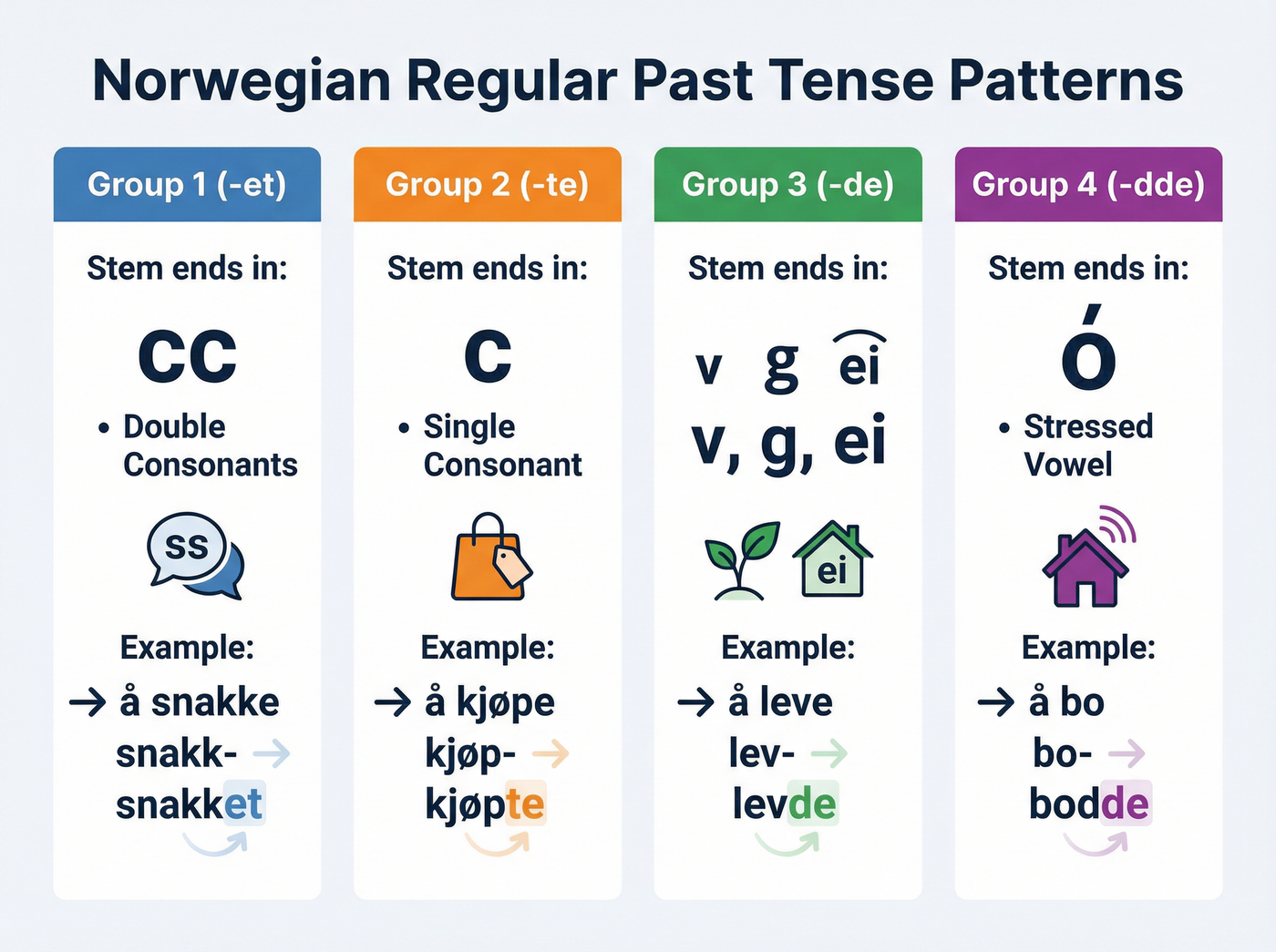
Group 1: The -et Ending
This is the largest group and often the easiest for beginners to recognize. These verbs typically have stems ending in two consonants. To form the past tense, you simply add -et to the verb stem.[5]
- å snakke (to talk) becomes snakket (talked)
- å vaske (to wash) becomes vasket (washed)
- å jobbe (to work) becomes jobbet (worked)
Note on pronunciation: In spoken Norwegian and informal writing, you will often hear the -et ending replaced with -a (e.g., snakka, jobba). This is very common in dialects and modern speech, but sticking to -et is a safe bet for learners aiming for standard grammatical correctness.
Group 2: The -te Ending
Verbs in this group usually have a stem that ends in a single consonant. The transition is crisp and sharp. You replace the final -e of the infinitive with -te.[6]
- å kjøpe (to buy) becomes kjøpte (bought)
- å lese (to read) becomes leste (read)
- å spise (to eat) becomes spiste (ate)
Group 3: The -de Ending
This group includes verbs where the stem ends in softer sounds like v, g, or diphthongs like ei. Instead of the sharp "t" sound, these verbs take a voiced -de ending.[6]
- å leve (to live/be alive) becomes levde (lived)
- å øve (to practice) becomes øvde (practiced)
Group 4: The -dde Ending
Verbs in this group are often short and end in a stressed vowel. Because of the short vowel sound, they require a double consonant ending: -dde.
- å bo (to live/reside) becomes bodde (lived)
- å ha (to have) becomes hadde (had)
Important Irregular Verbs
Just like in English (go/went, see/saw), the most frequently used verbs in Norwegian often break the rules. These "strong" verbs usually change their vowel in the past tense rather than taking an ending.[1]
Use these three essentials to navigate most basic conversations:
- å være (to be) → var (was/were)
- å gå (to go/walk) → gikk (went)
- å drikke (to drink) → drakk (drank)

Practice: Building Sentences
To get comfortable with the preteritum, start by combining a time expression with a verb. Remember that if you start a sentence with a time expression (like "Yesterday"), the verb must come second—this is the V2 rule in Norwegian grammar.
Examples:
- I går jobbet jeg. (Yesterday, I worked.) — Group 1
- Forrige uke kjøpte jeg en bil. (Last week, I bought a car.) — Group 2
- Da jeg var barn, bodde jeg i Oslo. (When I was a child, I lived in Oslo.) — Group 4
By listening for the ending sounds—the steady -et, the sharp -te, or the buzzing -de—you will begin to internalize the rhythm of the past tense without constantly consulting a grammar table.