

If you are learning Greek, you have likely encountered the challenge of describing past events. You might find yourself stuck trying to translate a simple sentence like "I closed the door" or "I said hello." The secret to unlocking these simple, completed past narratives lies in mastering the Aorist tense.
Many learners find the Aorist intimidating because of its name, but it is actually the default tool for storytelling. Unlike other tenses that focus on the duration of an action, the Aorist simply states that it happened. It is the narrative engine of the language, allowing you to move a story from one event to the next.
Aorist vs. Imperfect: Photo vs. Video
To understand the Aorist, it helps to contrast it with the Imperfect tense. In Greek grammar, the difference often comes down to aspect rather than just time. Aspect describes how the action is viewed regarding its internal passage of time.[5]
Imagine a parade passing down the street. If you describe the parade as you watch the floats roll by, observing the movement and the music over time, you are in the realm of the Imperfect tense. This represents an ongoing or repeated action.
However, if you take a single photograph of the parade after it has passed, capturing the event as a specific, finished memory, that is the Aorist. The word itself comes from the Greek aoristos, meaning "undefined" or "unbounded."[3] It does not define the internal texture or duration of the event; it simply reports the occurrence as a whole unit.
How to Form the Aorist: The Mechanics
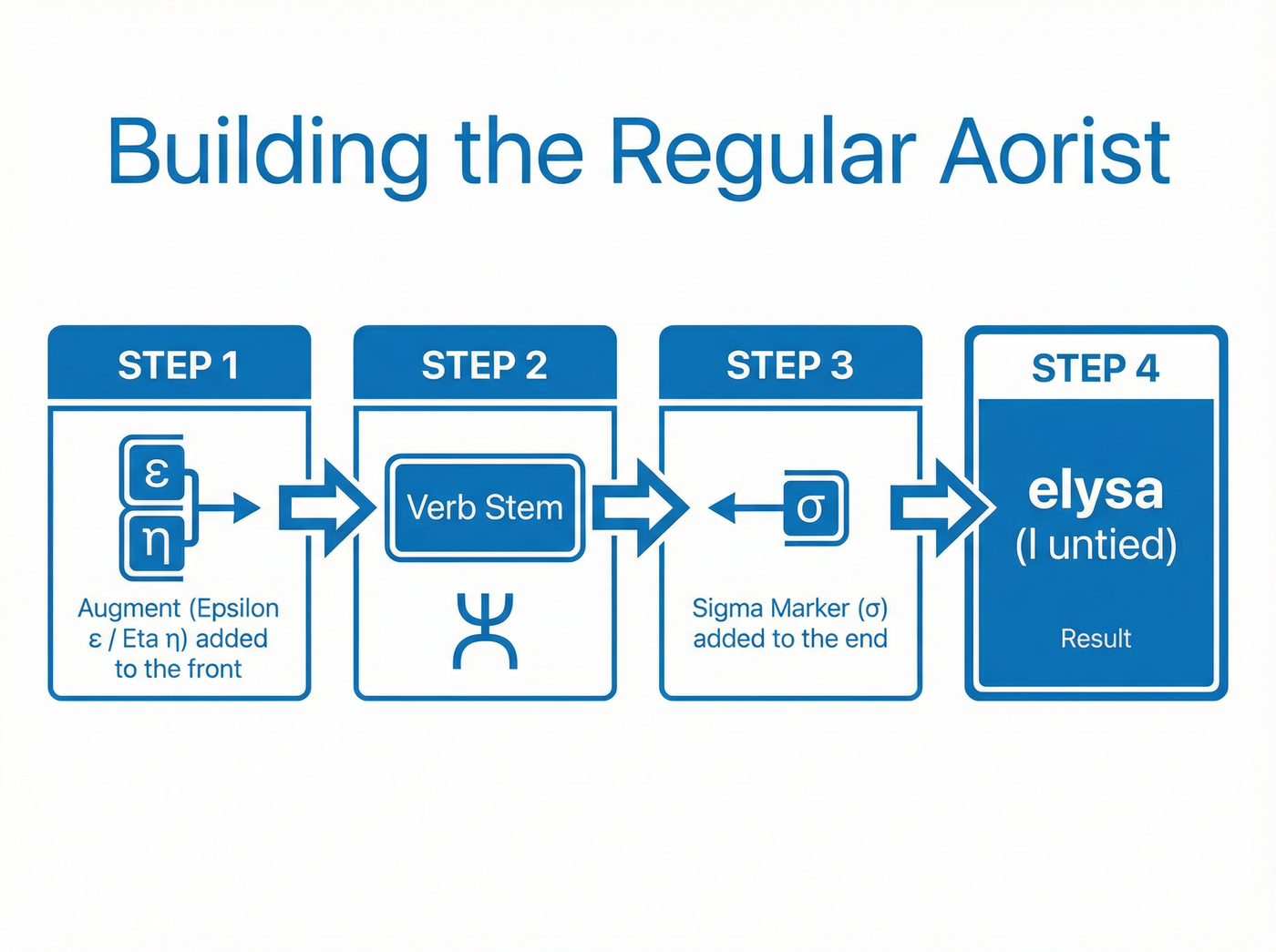
Recognizing the Aorist in speech or text usually involves spotting two distinct markers. For many learners, this is where the grammar becomes practical algebra. To turn a present tense verb into a past "snapshot," Greek uses a combination of a prefix and a suffix.
1. The Augment
The first indicator is the augment. This is typically an epsilon (ε) added to the beginning of the verb stem, creating a distinct "E" sound at the start of the word.[1] This audible marker acts as a signal to the listener that the action has taken place in the past.
2. The Sigma Ending
For regular verbs (often called First Aorist verbs), the stem is followed by a sigma (σ).[4] This results in the characteristic -sa ending for the first person singular ("I did").
For example:
- Lýno (I untie) becomes élysa (I untied).
- Kleíno (I close) becomes ekleisa (I closed).
When you hear that "E" at the start and the "sa" at the end, your brain should immediately register a completed past action.[1]
The Narrative Engines: Irregular Verbs
While regular verbs follow the predictable pattern above, some of the most common verbs in the language differ. These are often referred to as "Second Aorist" verbs.[5] They still tend to use the augment (the "E" sound), but their stems change significantly, much like how "go" becomes "went" in English.
These specific verbs are the "narrative engines" of Greek because they allow you to tell the core of a story. Three critical examples include:
To say/speak (Légo → Eipa) In the present, you say légo. In the Aorist, it transforms to eîpa. If you want to recount a conversation ("He said to me..."), this is the verb you will use. To come (Érchomai → Írtha) The present tense érchomai shifts to írtha. Note the common "-tha" ending here, which appears in several key irregular past forms. To take (Lambánō → Élabon) This verb undergoes a stem change from lamban- to lab-, becoming élabon (or elaba in Modern Greek usage).[4] It represents the simple act of taking something once.
Putting It into Practice
To internalize these forms, it helps to practice "The Three-Verb Drill." This exercise strings together completed actions to form a mini-narrative, helping you feel the rhythm of the Aorist tense.
Try saying: "I took, I ate, I left."
In Greek (using the Aorist stems), this rhythmically becomes: Élabon, éphagon, éphygon. By grouping these high-frequency actions, you move from memorizing charts to actually using the language as a tool for storytelling. The Aorist is not just a grammatical category; it is the way Greek speakers freeze time into a single, understandable moment.
Listen to the episode
Listen to "Talking About the Past: A Gentle Intro to the Aorist" on Pody.fm