
Have you ever considered that your existence is statistically improbable? The story of life is a continuous loop of assembly, instruction, and inheritance. To understand how life carries on, we must look at the biological machinery that allows a single cell to eventually become a complex organism, and how that organism passes its blueprint to the next generation.
The Asexual vs. Sexual Reproduction Strategy
Life continues through two primary strategies: asexual and sexual reproduction. In asexual reproduction, a single parent produces offspring that are genetically identical to itself. This is an efficient, rapid way to colonize an environment since it does not require finding a mate. However, the lack of genetic diversity creates a significant evolutionary bottleneck. If a single pathogen or environmental stressor exposes a specific weakness, the entire population becomes highly susceptible to extinction [2].
Sexual reproduction introduces a biological shuffle. By combining genetic material from two different parents, sexual reproduction creates offspring with unique combinations of traits. This diversity acts as a robust buffer against environmental threats [2]. While it is more energy-intensive, the trade-off is a population where individuals harbor different genetic traits that might offer protection from emerging challenges.
Meiosis: The Master Shuffler
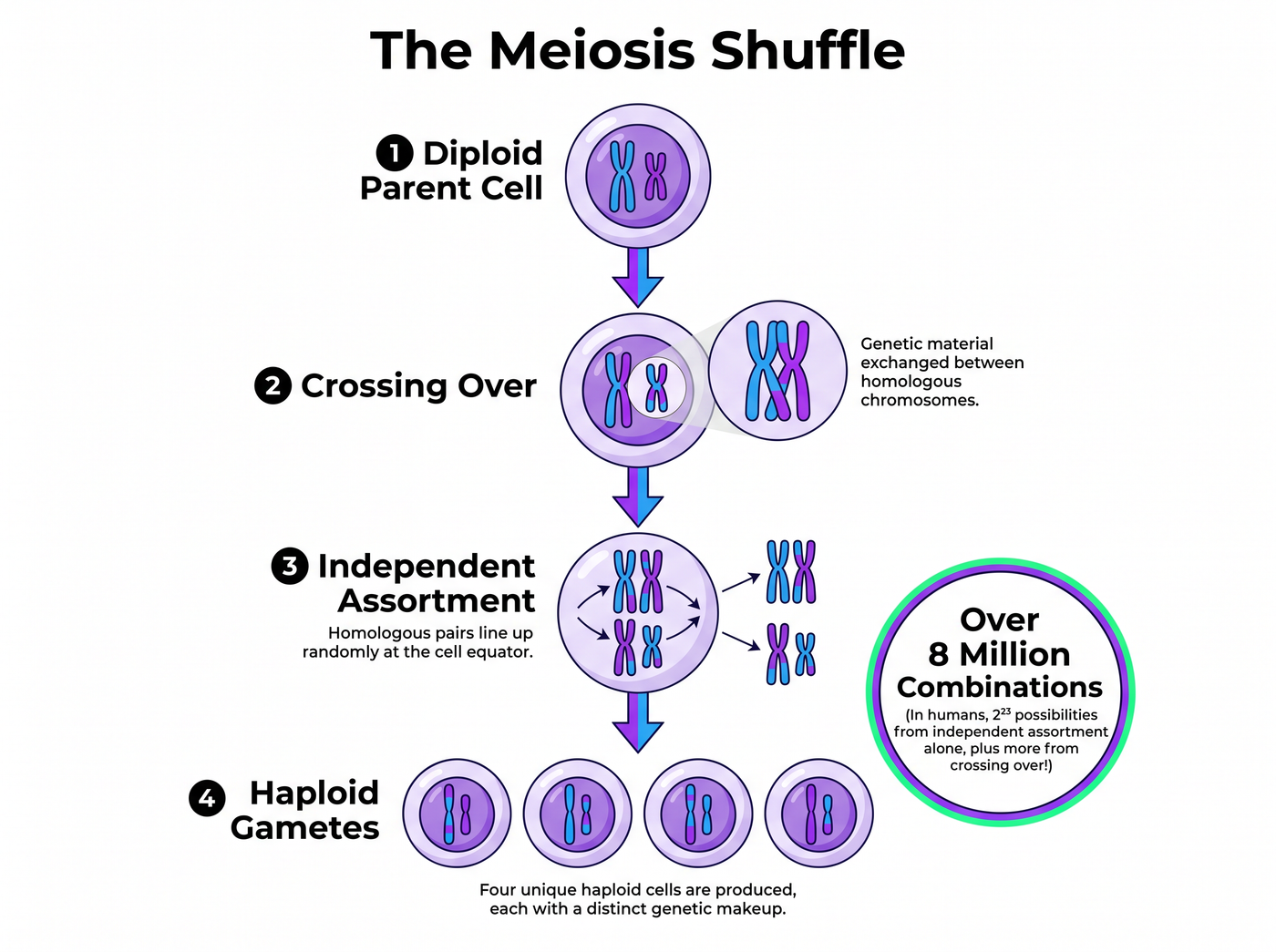
Most cells in the human body are diploid, meaning they contain two complete sets of chromosomes. One set comes from the mother and one from the father. If two normal body cells fused to create an infant, the child would have double the necessary DNA. This exponential doubling would be fatal [5].
Nature solves this with a specialized cell division process called meiosis. Meiosis produces haploid gametes (sperm and egg cells), cutting the chromosome count exactly in half to ensure the resulting zygote maintains the correct species-specific number of chromosomes upon fertilization [6].
Meiosis is a master class in genetic reorganization. During the first division phase, homologous chromosomes line up and swap segments of DNA in a process called crossing over [5]. A single human can produce over eight million different possible chromosome combinations through independent assortment alone [6]. This mechanism explains why offspring share traits with their parents while remaining entirely unique entities.
Beyond the Passive Germline
Scientists historically viewed the germline as a static factory for DNA replication. However, cutting-edge sequencing has challenged this conventional wisdom. Sophisticated breakthrough techniques from 2025, such as NanoSeq, allow researchers to observe fluctuations and shifts within the human germ cells long before fertilization occurs [1].
These studies reveal that the male germline operates as a dynamic, responsive environment. As men age, their sperm-producing cells accumulate mutations. These are not always arbitrary errors. Certain mutations give specific sperm-making cells a competitive advantage, leading to clonal expansions within the testes [1]. While these new mutations help the cells survive inside the individual, they can increase the statistical risk of developmental conditions in the subsequent child.
Development and the Epigenetic Software
When fertilization is complete, the single-cell zygote begins a rapid transformation through cell divisions called mitosis. The resulting embryo soon contains pluripotent cells capable of becoming any tissue type in the body, driven by an instruction manual of genes turning on and off in sequence [4].
However, genes are not absolute destiny. The field of epigenetics demonstrates how environmental factors can change how genes are expressed without altering the underlying DNA sequence. Think of DNA as the structural hardware of a computer and epigenetics as the software that tells the hardware exactly what to do.
Recent studies show that this environmental conversation begins long before pregnancy happens. A late 2025 review in Nature Reviews Endocrinology demonstrated that parental physical activity can actually program the metabolism of future generations [3]. The offspring of active parents showed improved cardiac health and metabolic function. This reveals that the choices we make today act as the first environmental inputs for the next generation.
Listen to the episode
Want to learn more about the incredible statistical improbability of your own existence? Tune into the full Bio 101 episode to uncover the microscopic dance of cells that dictates who we are. Listen to Reproduction, Development, and Inheritance Across Generations on pody.fm today.
Sources
- Sperm sequencing reveals extensive positive selection in the male germline | Nature
- Sexual reproduction and genetic variation (article) | Khan Academy
- Parental exercise mediates fetal metabolic and cardiac programming | Nature Reviews Endocrinology
- 3.1 Genetics and Heredity – Lifespan Development
- Sexual life cycles (article) | Meiosis | Khan Academy
- 7.5: Sexual Reproduction- Meiosis and gametogenesis - Biology LibreTexts