

We have all been there. It is 11 PM on a Tuesday, and instead of finishing that presentation due tomorrow morning, you are reorganizing your spice rack or deep-cleaning the bathroom grout. You know you should be working. You want to be working. But you are stuck in a paralysis of inaction.
It is easy to label this behavior as laziness or a lack of discipline. However, digging into the cognitive architecture of the brain reveals a much more complex story. Procrastination is a sophisticated, albeit frustrating, emotional battle fought between your present self and your future self. It is not about time management; it is about emotion regulation.
The Amygdala Hijack: Why Tasks Feel Like Threats
To understand why we delay, we have to look at the amygdala, the distinct part of the brain that acts as our emotional alarm system. When you look at a daunting task—a complex spreadsheet, a difficult email, or a creative project—your amygdala does not just see work. It perceives a threat.
This threat isn't physical danger; it is psychological. It stems from the fear of boredom, the anxiety of potentially doing a bad job, or the stress of high expectations. Research indicates that psychological factors such as fear play a massive role in the delay process[2]. When the amygdala sounds the alarm, the brain seeks immediate relief to neutralize the stress.
This is where "short-term mood repair" comes in. Your brain craves a quick hit of dopamine—a neurotransmitter associated with pleasure—to function as a balm against the anxiety the task provoked. Checking social media or watching a video offers that immediate gratification. You aren't avoiding work because you are lazy; you are avoiding the bad feelings associated with the work.
The Paradox of Perfectionism
One of the biggest misconceptions about procrastination is that it is the opposite of ambition. In reality, many chronic procrastinators are high achievers struggling with "maladaptive perfectionism."For these individuals, self-worth is dangerously tied to performance.
When you equate your value as a human being with the quality of your output, the stakes of every task become impossibly high. This creates a paralyzing anticipatory anxiety. The logic of the subconscious is simple: if you don’t do the task, you can’t fail at it. In this context, procrastination becomes a form of psychological self-preservation to avoid confirming fears of inadequacy[2][3].

Hyperbolic Discounting: The War Between Now and Later
Why does the brain consistently choose scrolling through photos over completing a career-defining project? Behavioral science calls this phenomenon "hyperbolic discounting." Essentially, humans are wired to value immediate rewards significantly more than future ones.
According to Temporal Motivation Theory, the further away a deadline is, the less motivation we feel[6]. A reward available right now (like a snack or a funny video) is concrete and visceral. A reward scheduled for next month (like praise for a completed project) is abstract and, to our primitive brain, practically invisible. We intend to work, but the "utility-aversion gap"—the difference between how much we want the reward and how much we hate the task—is too wide until the deadline panic kicks in.
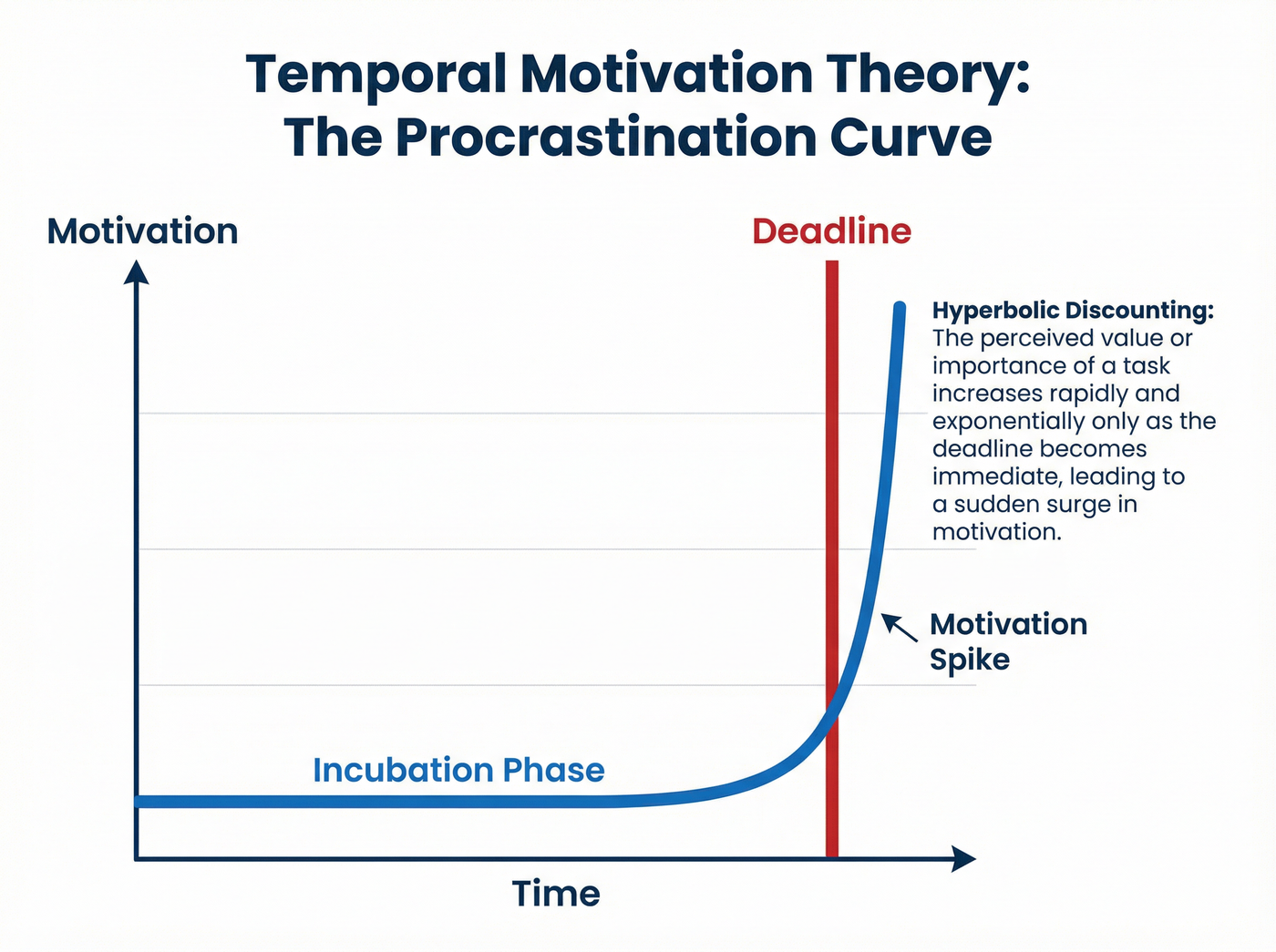
Laziness vs. Procrastination
Because the output (doing nothing) looks the same from the outside, we often confuse procrastination with laziness. However, the internal experience is vastly different.
| Feature | Laziness | Procrastination |
|---|---|---|
| Emotional State | Relaxed, indifferent | Anxious, guilty, stressed |
| Intention | No intention to do the task | Strong intention to do the task |
| Energy | Low energy/motivation overall | High mental energy spent worrying |
| Goal | To rest or do nothing | To avoid negative emotions |
How to Hack the Cycle
Recent studies into scalable interventions suggest that shifting from time management to emotion management is the key to breaking the cycle[4]. Here are two scientifically grounded ways to start:
1. Affect Labeling
Move the processing of the task from your emotional brain to your rational brain by simply naming the feeling. Say out loud, "I am avoiding this email because I am afraid the client will be angry." Identifying the emotion can reduce the amygdala’s reactivity.
2. Radical Smallness
To combat hyperbolic discounting, you must make the task less threatening. Break a project down into a 15-minute sub-goal. This lowers the barrier to entry, reducing the need for "mood repair" and allowing you to bypass the initial wall of anticipated pain. Once started, the dread usually subsides.
Listen to the episode
Dive deeper into the neuroscience of why we put things off and learn how to trick your brain into productivity in our latest episode.
Listen to "The Psychology of Procrastination: Why We Delay" on Pody.fm
Sources
- Extension Journal: Psychological Factors in Procrastination
- The impact of basic psychological needs on academic procrastination: the sequential mediating role of anxiety and self-control
- Now I feel like I’m going to get to it soon: a brief, scalable intervention for state procrastination
- Examining Procrastination Across Multiple Goal Stages: A Longitudinal Study of Temporal Motivation Theory