

When you start learning a new language, the mere thought of verb conjugation tables can be daunting. If you have studied French, Spanish, or even English, you are likely used to memorizing how verbs change depending on who is speaking. But if you are learning Norwegian, we have excellent news: it is surprisingly simple. Today, we delve into the basics of the present tense, the essential verb å være (to be), and the golden rule of Norwegian sentence structure.
The Unchanging "To Be"
In many languages, the verb "to be" is the most irregular and frustrating verb to learn. In English, you must remember "I am," "you are," and "he is." In Norwegian, this obstacle vanishes.
The infinitive form is å være. In the present tense, it simplifies to a single, unchanging word: er. Whether you are speaking about yourself, a friend, or a group of people, the word remains the same.
- Jeg er (I am)
- Du er (You are)
- Vi er (We are)
This consistency allows beginners to start building sentences about identity and location immediately without pausing to conjugate.[1]
Talking About Professions
A helpful tip for sounding more native when using er involves professions. Unlike English, Norwegian usually omits the indefinite article ("a" or "an") when stating what someone does for a living. Instead of saying "I am a student," you simply say Jeg er student. It is a small detail that makes a big difference in natural flow.
Forming Common Verbs with the "R"
Once you have mastered å være, you will find that most other common verbs follow an equally straightforward pattern in the present tense. To change a verb from its infinitive form (what you see in the dictionary) to the present tense (what you use in conversation), you typically just add the letter r.[1]
Here are a few essential verbs to get you started:
- Å bo (to live) → bor (lives)
- Å snakke (to speak) → snakker (speaks)
- Å spise (to eat) → spiser (eats)
- Å komme (to come) → kommer (comes)
Just like with er, these forms do not change based on the subject. You can say Han bor i Oslo (He lives in Oslo) or Vi bor i Oslo (We live in Oslo) without changing the verb.
The V2 Rule: The Secret to Flow
While verb forms are simple, sentence structure requires a bit more attention. Norwegian follows a strict syntax known as the V2 rule (Verb Second rule). This means that the finite verb must always sit in the second position of a standard declarative sentence.[5]
In a standard sentence starting with the subject, this feels natural to English speakers:
- Jeg (1) bor (2) her. (I live here.)
However, if you start the sentence with a time expression or an adverb to add emphasis, the verb refuses to move from its second-place spot. The subject is forced to move to the third position. This is called inversion.[1]
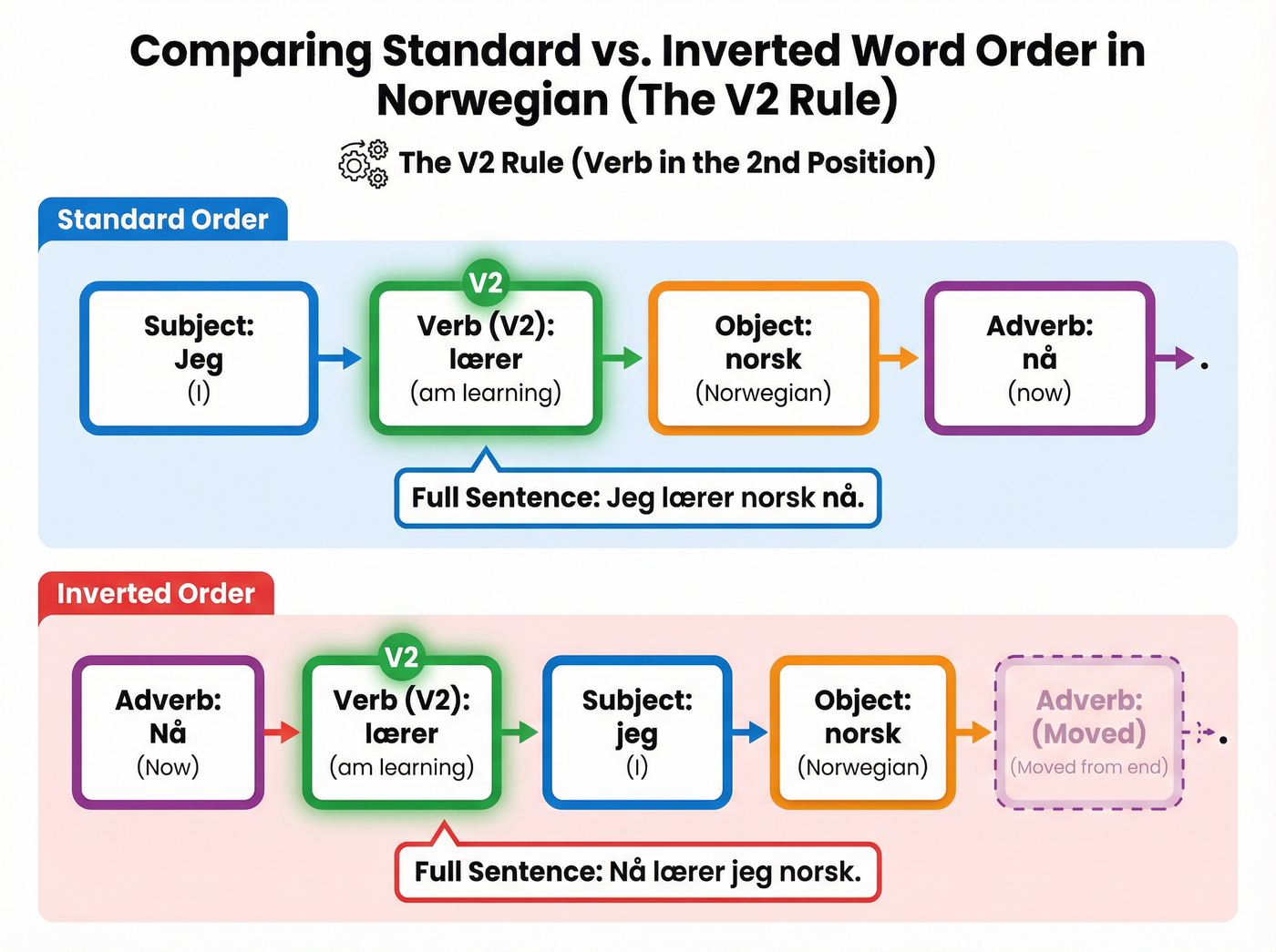
mastering this inversion is key to moving beyond "tourist Norwegian." If you say "Nå jeg snakker," you will be understood, but it will sound incorrect. The correct form is Nå snakker jeg (literally: "Now speak I").
Putting It All Together
By combining the unchanging er, the simple "r-ending" for action verbs, and the V2 rule, you can navigate a variety of daily situations. Whether you are introducing yourself (Jeg er norsk) or describing your routine (Jeg drikker kaffe), the rules remain consistent.
Try practicing with mini-dialogues. Ask questions involving location and respond with details about where you live or work. Remember, keep that verb in the second spot, and you will sound confident and fluent.
Listen to the episode
Want to hear the pronunciation of these verbs and practice along? Listen to the full episode below:
Present Tense Basics: 'å være' & Common Verbs