
Ready to unlock your Greek language journey? Mastering the present tense is your essential first step. While Greek grammar can seem intimidating with its different alphabets and cases, the foundation of communication often rests on a single, powerful verb: είμαι (eimai), meaning "to be."
Whether you are introducing yourself, explaining where you are, or describing how you feel, this verb is your anchor. In this guide, based on our latest episode, we break down the conjugations of είμαι, explore the cultural nuances of politeness, and introduce four high-frequency action verbs to get you speaking immediately.
The Irregular Powerhouse: Είμαι (To Be)
At its core, είμαι allows you to express existence. Unlike regular verbs that follow strict patterns, είμαι is irregular, yet it is widely considered the most important verb to learn first.[1] Mastering it opens the door to forming complex sentences about who you are and where you are.
Present Tense Conjugation
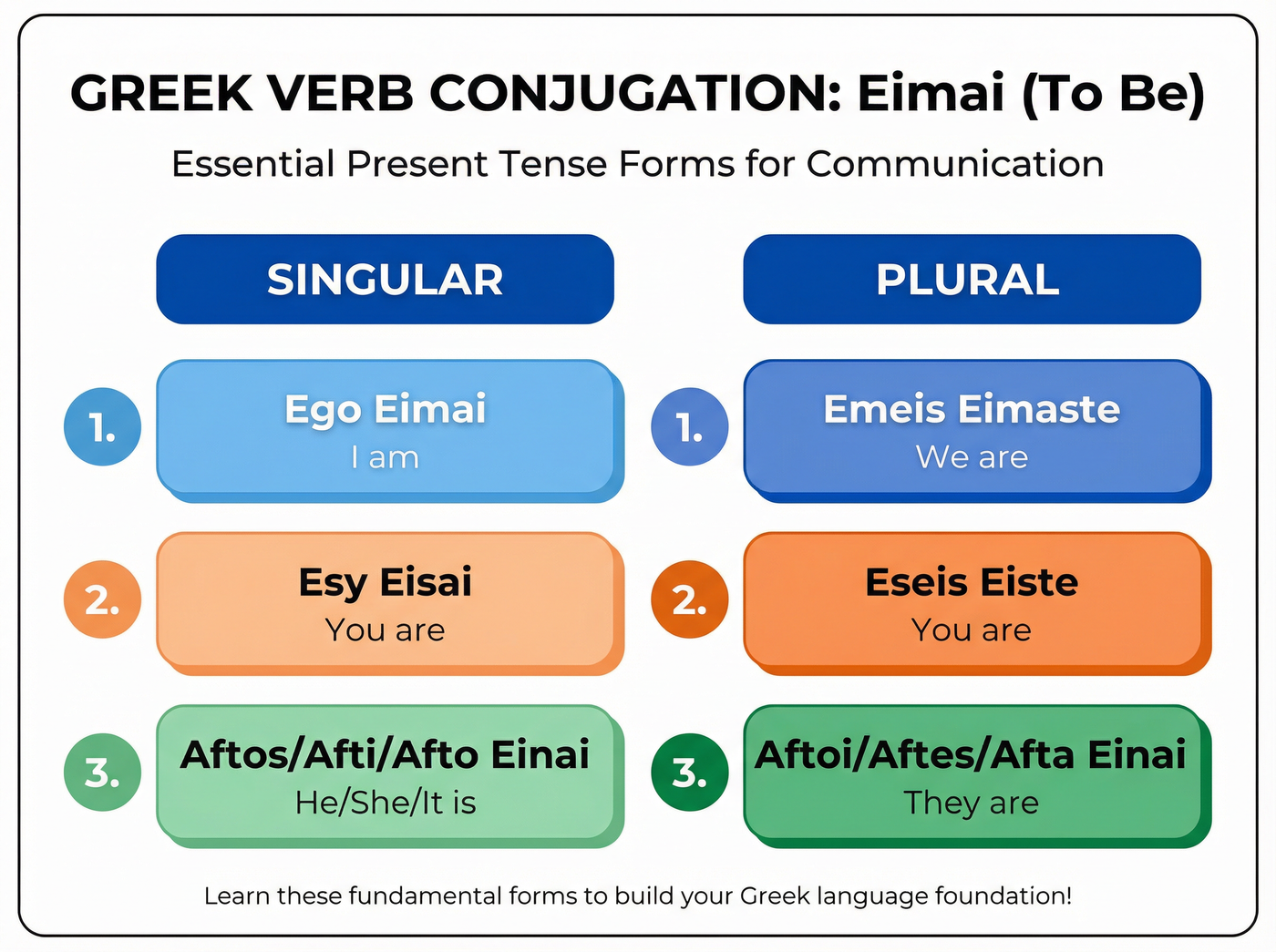
Here are the forms you need to memorize for the present tense:
- Είμαι (Eimai) – I am
- Είσαι (Eisai) – You are
- Είναι (Einai) – He/She/It is
- Είμαστε (Eimaste) – We are
- Είστε (Eiste) – You are (plural or formal)
- Είναι (Einai) – They are
Notice a tricky detail in the list above? The form είναι is used for both the third person singular (he is) and the third person plural (they are).[2] In conversation, you will rely on the context or the surrounding nouns to know if the speaker is talking about one person or a group.
Why You Can Drop the Pronouns
Greek is known as a pro-drop language. This means the subject pronoun is often dropped because the verb ending already provides the necessary information. For example, to say "I am," you rarely need to say Εγώ είμαι (Ego eimai). Simply saying Είμαι is sufficient and sounds more natural to native speakers.[5]
However, you might keep the pronoun if you want to add emphasis, such as "I am the one who is here, not him."
Politeness and Respect: Eisai vs. Eiste
When you travel to Greece or speak with native speakers, social etiquette is crucial. While είσαι (eisai) is the standard way to say "you are" to a friend or child, you should switch to the plural form είστε (eiste) when addressing:
- People older than you.
- Strangers (like shopkeepers or taxi drivers).
- people in formal business settings.
Using είστε creates a "plural of politeness," ensuring you don't come across as overly familiar or rude.
Building Sentences: Identity and Location
Once you know the verb είμαι, you can immediately start building practical sentences.
Identity Drill:
In Greek, you typically use the definite article before a name. To say "I am Kostas," you would say Είμαι ο Κώστας. To say "I am Maria," you say Είμαι η Μαρία.
Location Drill:
To express location, such as "at the office" or "in Athens," you generally use the prepositions στο or στην. For example:
Είμαι στο γραφείο. (I am at the office.)
Είμαι στην Αθήνα. (I am in Athens.)
4 Essential Action Verbs
While "to be" is vital, you also need to describe what you do. In the present tense, Greek verbs often cover both the simple present ("I work") and the present continuous ("I am working"). Here are four high-frequency verbs to add to your vocabulary:
Δουλεύω (Doulevo) I work / I am working. Μένω (Meno) I stay / I live. Μαθαίνω (Mathaino) I learn / I am learning. Πίνω (Pino) I drink / I am drinking.
Try combining these with your new skills. For instance: Μένω στην Αθήνα αλλά δουλεύω στο Λονδίνο. (I live in Athens but I work in London.)
Listen to the episode
Want to hear the correct pronunciation of these verbs and practice with mini-dialogues? Listen to the full episode below:
Present Tense Basics: είμαι & Common Verbs