
Have you ever looked at a tree and thought about how still it seems? We often mistake plants for passive scenery. In reality, every leaf is a high-pressure hydraulic machine operating with a biological complexity that dwarfs our most advanced technology. They weave matter out of thin air and starlight, transforming carbon dioxide, water, and sunlight into the energy that sustains all earthly life.
The Stolen Engine of Life
To understand how a plant functions, one must first uncover an evolutionary anomaly. Plants did not originally invent the primary biological machinery responsible for photosynthesis. Instead, billions of years ago, a larger host cell engulfed a smaller, photosynthetic cyanobacterium. Rather than digesting it, the host formed a cooperative relationship known as endosymbiosis.
Modern plant cells still carry the descendants of these long-ago swallowed microorganisms. We call this ancient relic the chloroplast. This biological pact produced a staggering tradeoff where the bacterium received a safe, nutrient-rich environment, and the host cell gained the unprecedented ability to fuel its life processes directly from solar radiation. Every green leaf is a living monument to this billion-year-old collaborative effort[6].
How Leaves Turn Light into Chemical Battery Power
Photosynthesis is much more complex than just mixing water, light, and carbon dioxide. It is a sophisticated two-stage process that begins with the light-dependent reactions[3]. Inside the thylakoid membranes of the chloroplast, chlorophyll molecules act like highly attuned solar antennae. Interestingly, these antennae are configured to absorb specific wavelengths of red and blue light. Plants appear green precisely because they discard green light, finding those specific wavelengths inefficient for their chemical needs.
When sunlight strikes these solar antennae, it sparks a flow of electrons so severe that it physically breaks water molecules apart. This mechanism is known as photolysis[4]. A critical side effect of splitting water is the sheer volume of oxygen released. For the plant, oxygen is essentially biochemical exhaust, but for oxygen-dependent terrestrial life, it is the breath of life.
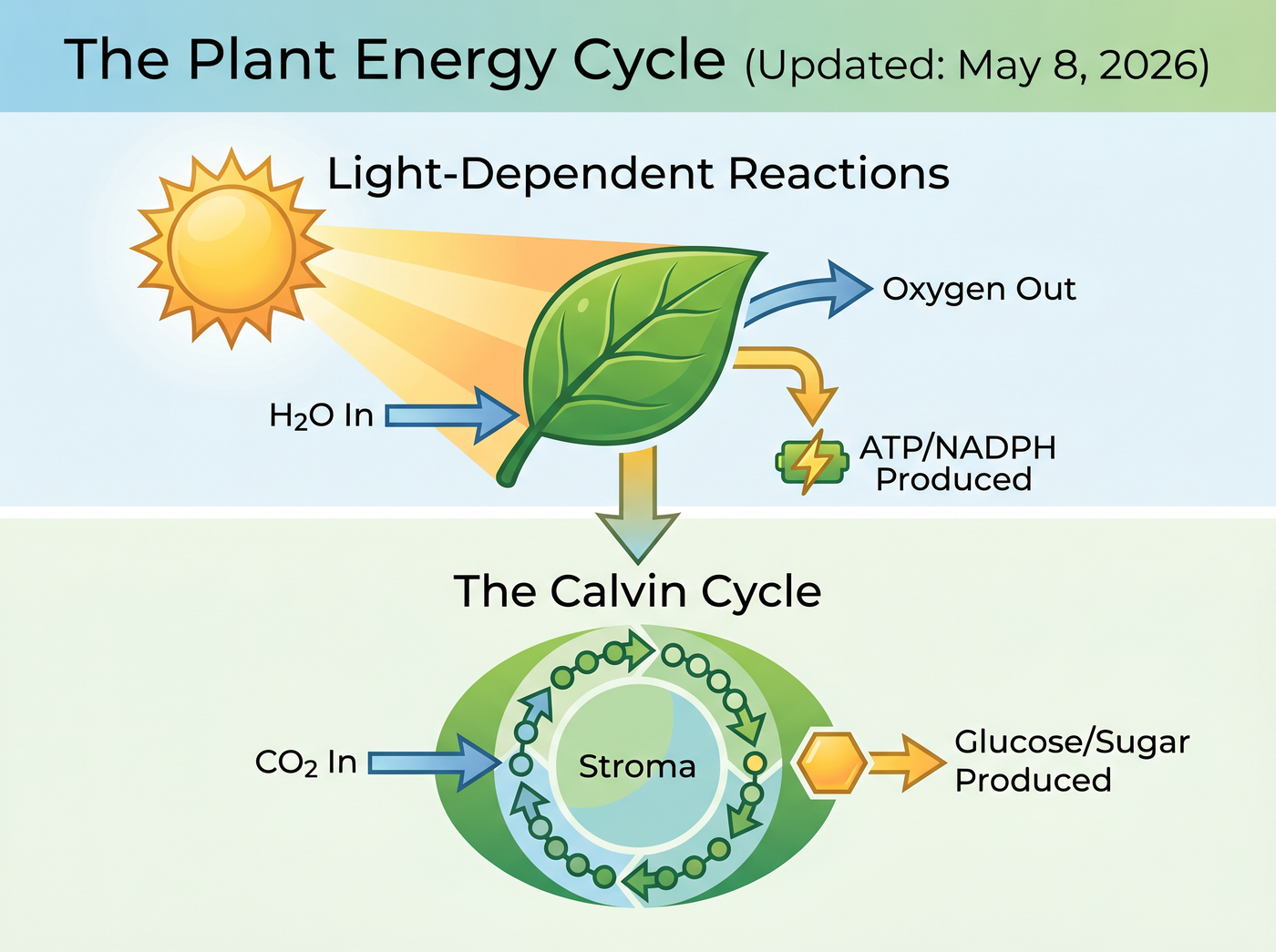
The energy instantly captured during photolysis is packed into short-term storage molecules called ATP and NADPH. These temporary batteries power the second half of the sequence known as the Calvin Cycle. Occurring in the fluid-filled stroma, this is where the plant grabs carbon dioxide from the air and stitches carbon atoms into life-sustaining organic chains to form simple sugars.
The Biological Hydraulics of Xylem and Phloem
Creating sugars is just one part of the plant's struggle. Plants must also move massive amounts of water and nutrients vertically into the sky. Plant cell walls are heavily fortified by cellulose, an organic polymer that allows them to build vertical structure without collapsing. However, rising high into the air makes accessing ground water a serious mechanical challenge.
Plants solve this using a vascular system separated into two primary channels:
- The Xylem: This acts as a one-way upward straw, relying on a phenomenon called transpiration. As water evaporates from microscopic leaf pores (stomata), it creates a negative tension. Because water molecules naturally stick to one another and the walls of the xylem, this tension pulls an unbroken chain of water up from the deepest roots to the canopy. This Cohesion-Tension Theory explains how massive trees pump hundreds of gallons of water skyward daily.
- The Phloem: This serves as a two-way transport avenue that moves the newly manufactured sugars from the leaves to areas that need energy, such as roots and fruits. Unlike the passive upward pull of the xylem, the phloem utilizes osmotic pressure to push sap forcefully through the plant's architecture.

The Photorespiration Glitch
Despite being elegant, photosynthesis is not flawless. The protein responsible for fixing carbon dioxide, an enzyme called RuBisCO, happens to be notoriously inefficient. Periodically, RuBisCO makes a biological error and grabs an oxygen molecule instead of carbon dioxide, resulting in a wasteful cycle known as photorespiration.
In extremely hot and dry environments, plants close their stomata to prevent dehydration. This traps oxygen inside the leaf, causing RuBisCO's error rate to surge. To survive this flaw, certain groups of vegetation evolved radical workarounds. C4 plants (like corn and sugarcane) restructured their internal anatomy to establish physical compartments that shield RuBisCO from oxygen[2]. Other plants, such as cacti, evolved temporal separation, opening stomata only in the cool of night to stockpile carbon for daytime processing.
While traditional views cast photorespiration as an absolute glitch, newer findings suggest a different narrative. Recent botanical research implies that this seemingly wasteful process might act as an essential safety valve, defending the internal cellular machinery against sudden influxes of intense light energy[1]. It is a powerful reminder that natural selection often favors long-term resilience over raw efficiency.
Bioengineering a Greener Future
As of May 8, 2026, finding ways to boost agricultural output without expanding land usage is arguably humanity's most pressing scientific hurdle. Modern agrarian science relies intensely on nitrogen fixation to supply fertilizers, as plants cannot absorb raw atmospheric nitrogen on their own. Now, scientists are turning toward molecular bioengineering to directly modify how crops conduct photosynthesis[5].
By transplanting traits from highly efficient algae or C4 species into standard crops like wheat, laboratories aim to bypass the limitations of RuBisCO. Accelerating how fast a plant recovers from natural light defenses (photoprotection) has already shown potential yield increases of up to 20 percent. However, scaling these innovations requires balancing our demand for maximum caloric efficiency with the biological resilience required to survive a changing global climate.
Listen to the episode
Discover more about the ancient systems that keep our planet breathing. Listen to the full episode here: Plants, Photosynthesis, and Why Most Life Runs on Sunlight.
Sources
- Understanding plant resilience by putting photosynthesis and photorespiration in the metabolic context
- C4 Plants
- Photosynthesis in Plant Cells: Step-by-Step Breakdown
- What is Photosynthesis? A Complete Guide to the Life-Sustaining Process
- Feeding from the sun: Successes and prospects in bioengineering photosynthesis for food security
- Plant Biology and Agriculture