

Cortisol has a notorious reputation. Often vilified as the "stress hormone," it is frequently blamed for everything from stubborn belly fat to burnout. However, this perspective overlooks the hormone's true biological purpose. Far from being a villain, cortisol is your body’s primary metabolic coordinator. It is the fuel that dictates your alertness, drives your focus, and actually helps regulate inflammation when functioning correctly.
The problem usually isn't cortisol itself, but rather the timing of its release. When your cortisol rhythm is aligned with the sun, focus feels effortless and energy remains stable. When it is misaligned, we fall into the modern malaise of being "tired but wired"—exhausted physically but unable to mentally shut down.
Key takeaways:
- Cortisol is fuel: It is not just a stress signal; it is necessary for metabolic energy and alertness.
- Trigger the "CAR": The Cortisol Awakening Response is a critical 30-minute window after waking that "boots up" your brain.
- Light is the key: Low-angle morning sunlight is the primary signal to set your daily cortisol rhythm.
- Delay caffeine: Waiting 90 minutes before coffee allows natural neurochemistry to clear sleepiness effectively.
- Manage the crash: Use the "Physiological Sigh" to manually lower stress in real-time.
Listen to the episode
Discover the science behind the morning sunlight protocol, physiological sighs, and structural changes to your workday to improve mental output.
Listen to "Optimizing Cortisol: Stress Management for Peak Productivity" on Pody.fm
The Cortisol Awakening Response (CAR)
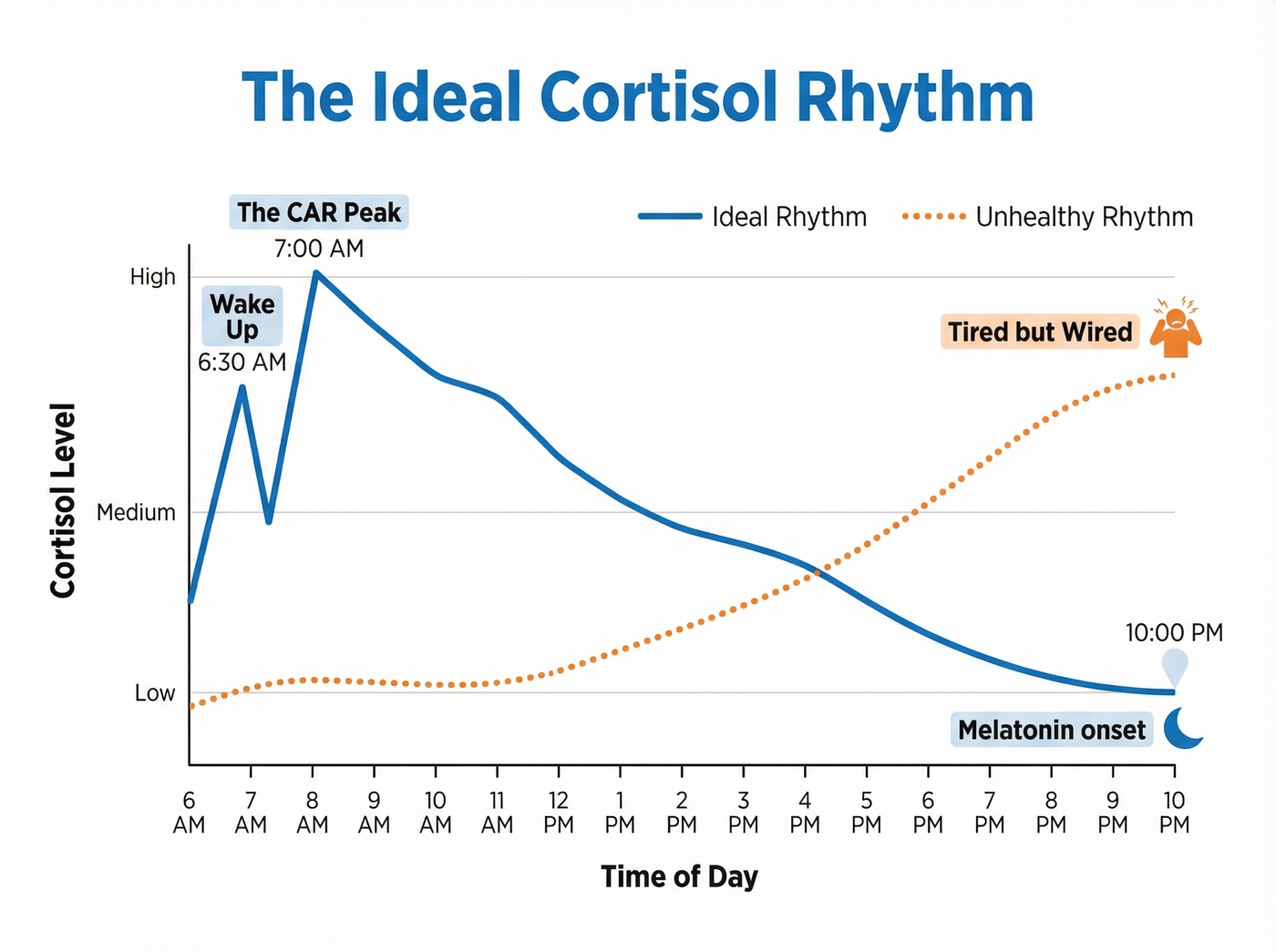
To understand productivity, you must understand the "boot-up sequence" of the human brain. Approximately 30 to 45 minutes after you wake up, your body should naturally experience a rapid, steep surge in cortisol. This is known as the Cortisol Awakening Response (CAR).[1]
This surge interacts with your nervous system to raise your core body temperature and blood pressure slightly, effectively turning on the brain's executive functions. A robust CAR is associated with better cognitive function and emotional regulation throughout the day.[2] Conversely, a "flat" morning curve—where cortisol fails to spike significantly—is often a biological marker of burnout and chronic fatigue.[4]
The Morning Light Protocol
The triggers for this hormonal system are not internal; they are environmental. Your eyes are connected directly to the Suprachiasmatic Nucleus (SCN), the brain's master clock. The specific quality of light found in the early morning—low-angle sunlight with a unique blue-yellow contrast—signals the SCN to authorize the cortisol release.
For optimal results, aim to view sunlight within the first hour of waking. This does not mean staring directly at the sun, but rather allowing natural light to hit your retina without sunglasses (eyeglasses and contacts are generally fine). This light exposure not only stimulates immediate alertness but also sets a timer for melatonin secretion roughly 12 to 14 hours later, helping to secure your sleep for the following night.
The Coffee Strategy: Why You Should Wait
Many of us reach for caffeine immediately upon waking to shake off grogginess, but this can be counterproductive. The grogginess you feel is caused by adenosine, a molecule that builds up the longer you are awake. Caffeine doesn't eliminate adenosine; it simply blocks the receptors so you don't feel it.
If you consume caffeine before your natural cortisol surge has had time to clear out the residual adenosine, you risk a mid-morning crash once the caffeine wears off and the adenosine re-binds to its receptors. By relying on sunlight and movement first, and delaying caffeine intake by 60 to 90 minutes, you allow your natural biology to do the heavy lifting, resulting in sustained energy through the afternoon.
Structuring Work Around Ultradian Rhythms
Just as we have a 24-hour circadian rhythm, we also operate on shorter 90-minute cycles known as ultradian rhythms.[6] Fighting these cycles is a common cause of mental fatigue.
The 90-Minute Focus Bout
Research suggests that the brain can maintain high-intensity focus for roughly 90 minutes before efficiency drops. Structuring your day into "linear bouts" of deep work followed by restorative breaks aligns with the pulsatile nature of cortisol secretion. Attempting to push through this natural dip often results in higher stress and lower output.

The Recovery Paradox
While cortisol is essential for focus, it is catabolic in nature, meaning it breaks down energy stores for use. This is helpful during a workout or a difficult task, but detrimental if sustained for too long. Chronic elevation of cortisol signals the body that the environment is unsafe, which can inhibit anabolic processes like muscle repair and recovery.
The Physiological Sigh
To switch from a high-cortisol state to a recovery state, you can use a breathwork tool known as the physiological sigh. This pattern was identified in the 1930s as a natural reflex to reinflate collapsed alveoli in the lungs and offload carbon dioxide.
How to do it:
- Inhale deeply through the nose.
- Take a second, shorter inhale through the nose (to fully inflate the lungs).
- Exhale fully and slowly through the mouth.
Performing this just one to three times can significantly lower physiological arousal and reset your stress baseline, making it an excellent tool to use between meetings or immediately after a workout to jumpstart recovery.
Summary: Respect the Rhythm
Optimizing cortisol is not about lowering it indiscriminately; it is about ensuring it peaks at the right time. By anchoring your morning with sunlight, delaying caffeine, and respecting your 90-minute energy cycles, you can turn a "stress hormone" into your most powerful productivity asset. A healthy diurnal range of cortisol is not just a marker of health; it is a prerequisite for peak cognitive performance.[5]
Sources
- The Cortisol Awakening Response: Regulation and Functional Significance - PubMed
- The Cortisol Awakening Response: Regulation and Functional Significance
- The Cortisol Awakening Response
- The cortisol awakening response (CAR): Facts and future directions
- Going the Distance: The Diurnal Range of Cortisol and its Association with Cognitive and Physiological Functioning
- Ultradian rhythmicity of plasma cortisol is necessary for normal emotional and cognitive responses in man