

In the early days of computing, writing code was a strictly linear affair. Programs were executed line by line, from top to bottom. While this procedural approach worked well for simple mathematical calculations, it quickly became a nightmare as software grew in complexity. A single change in one line could trigger a domino effect, breaking functionality in distant parts of the application. To solve this, the industry adopted a new way to organize complexity: Object-Oriented Programming (OOP).
OOP allows developers to structure software not as a fragile recipe, but as a collection of self-contained units called objects.[1] This paradigm shift is what allows modern applications—from smartphone interfaces to massive video games—to scale efficiently.
The Blueprint and the House
The most fundamental concept in OOP is understanding the distinction between a class and an object. To visualize this, imagine an architect's office.
A class is like an architectural blueprint. It defines the structure: where the walls go, the plumbing layout, and the electrical specifications. However, you cannot live in a blueprint. It is merely a set of instructions used to build something.[2] In Python, we define this blueprint using the class keyword, typically following the CamelCase naming convention (e.g., BankAccount or SpaceShip).
An object, technically known as an instance, is the actual house built from that blueprint. Just as one set of architectural plans can be used to construct a whole neighborhood of houses, a single Python class can be used to create an infinite number of objects.[5] Each object follows the same structural rules defined by the class, but they exist independently of one another.
The Magic of Initialization: __init__
When you build a house, you don't just erect the walls and walk away; you need to install the fixtures and paint the rooms. In Python, this setup process is handled by a special method called __init__. Often called a "dunder" method (short for "double underscore"), __init__ acts as the constructor.
When you instantiate a new object, Python automatically runs this method to set the object's initial state.[3] Think of the __init__ method as a bank clerk setting up a new account. The logic for the account (the class) exists, but the clerk needs to take your specific name and opening deposit to create your personal record.
Understanding self
Inside the __init__ method—and almost every other method in a class—you will see the parameter self. For beginners, this is often the most confusing part of Python OOP, but its function is strictly practical.
Because a class is just a template, it needs a way to refer to the specific object being utilized at that moment. When you write code like self.name = name, you are telling Python: "Take the value provided and attach it to this specific instance."[4] This ensures that if you change the data in "Object A," "Object B" remains completely unaffected.
Data and Behavior: Attributes and Methods
Objects consist of two main components: attributes (data) and methods (behavior).
- Attributes: These represent the state of the object. If you were modeling a car, attributes would be things like
color,fuel_level, andcurrent_speed. These variables live and die with the object. - Methods: These are actions the object can perform. A
drive()method in a car class wouldn't just print a message; it would actively modify the attributes, perhaps reducingfuel_leveland increasingmileage.
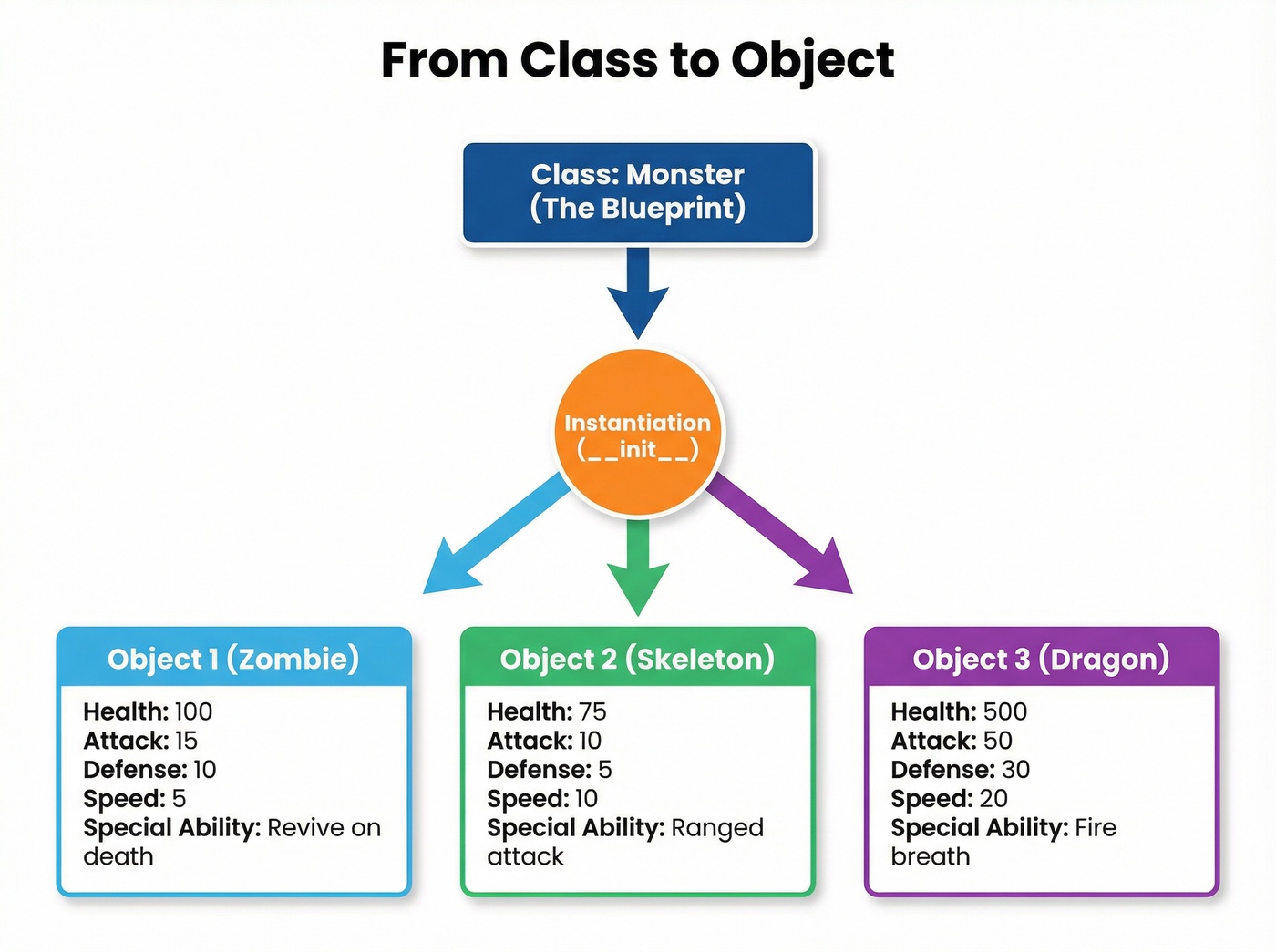
A practical example of this is seen in video game development. In a game, every creature might be an instance of a Monster class. The class defines that monsters have health and strength (attributes) and can attack or take damage (methods).[6]

Without OOP, a game developer would have to track thousands of loose variables for every single enemy on screen, leading to unreadable "spaghetti code." With OOP, the developer simply tells the specific zombie object to take_damage(), and the object handles the math internally.
Scalability and Best Practices
While OOP is powerful, it requires a shift in mindset. It encourages encapsulation—hiding complex logic behind simple interfaces. This is similar to how you use a smartphone: you touch a button (the interface) without needing to understand the electrical engineering behind the screen (the implementation).
However, developers must be wary of over-engineering. There is a risk of creating massive, tangled hierarchies of classes for simple problems. As you begin writing classes, start small. Define the "actors" in your system—whether they are BankAccount, Player, or BlogPost—and focus on what data they hold and what actons they perform.
Listen to the episode
Listen to the full episode on Classes and Objects here.