
When you start learning a new language, few things are as immediately practical as numbers and time. In Norway, where punctuality is a cultural cornerstone, knowing exactly when to arrive for dinner or how to book a train ticket is essential. While the Norwegian system shares many Germanic roots with English, it holds a few surprises—especially when looking at the clock—that can trip up even the most diligent learners.
Counting in Norwegian: From 0 to 100
The journey to fluency begins with the numbers. The Norwegian counting system is generally logical, but it starts with memorizing the unique terms for zero through twelve.
The Basic Numbers (0–12)
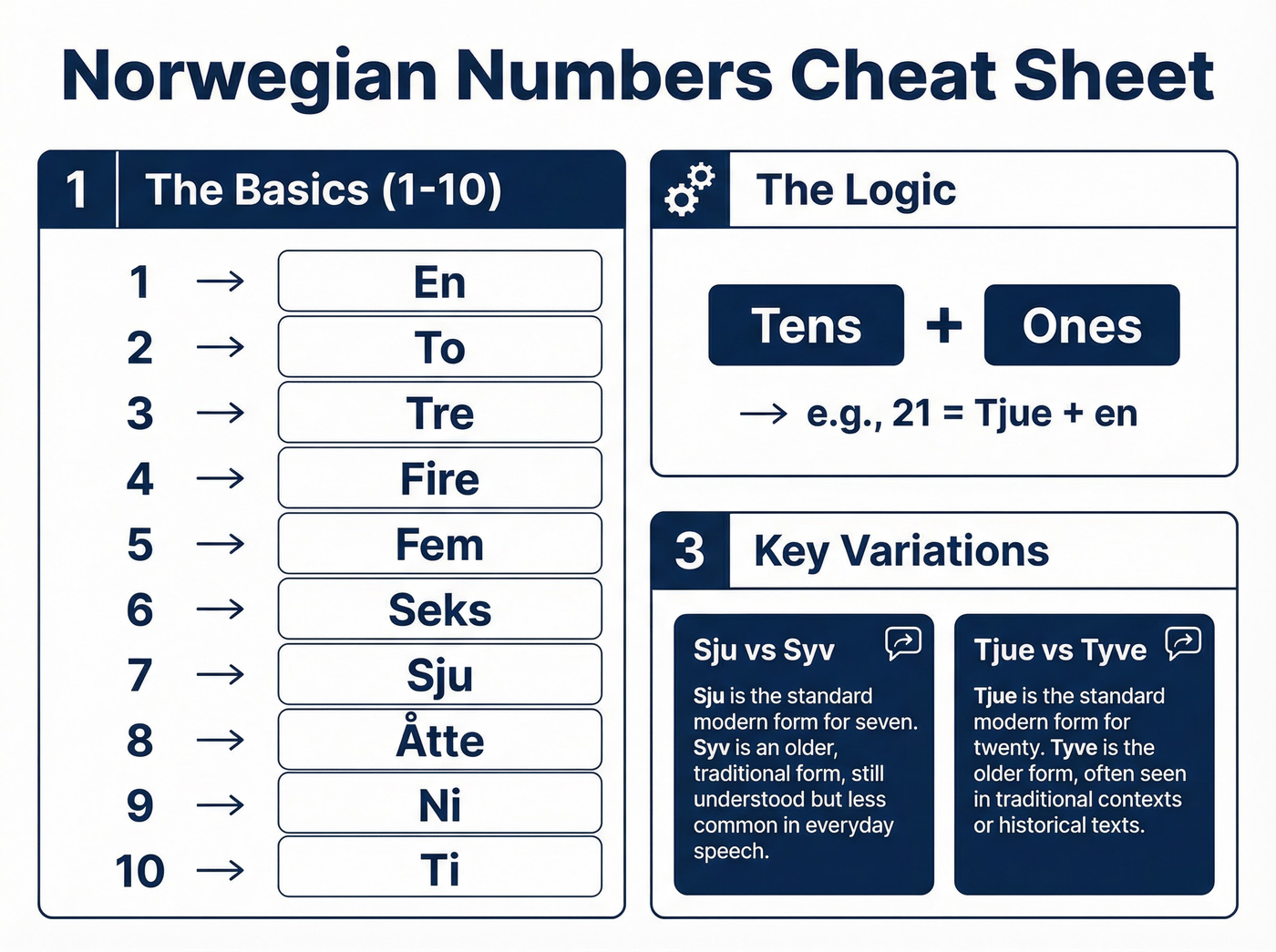
Most of these will sound familiar if you know English or German. The numbers are null (0), en (1), to (2), tre (3), fire (4), fem (5), seks (6), sju or syv (7), åtte (8), ni (9), ti (10), elleve (11), and tolv (12)[3][5].
A critical detail to note is the number one. While usually written as en, ei, or et depending on the gender of the noun it describes, when telling time (“one o’clock”), the neuter form ett is used[1].
Teens and Tens
From thirteen to nineteen, Norwegian numbers end with the suffix -ten, similar to the English “-teen.” For example, thirteen is tretten and nineteen is nitten. The pattern remains consistent, making this section easy to master once you know the roots.
Moving into the tens, the system is base-ten. Twenty is tjue (sometimes pronounced tyve in formal or older contexts). From there, you simply combine the tens and ones: twenty-one is tjueen, thirty is tretti, and so on, all the way up to ninety (nitti) and one hundred (hundre)[5].
Telling Time: Hva er klokka?
Asking “What time is it?” in Norwegian uses the phrase Hva er klokka? (literally “What is the clock?”)[1]. To answer correctly, you must navigate between two systems.
The 24-Hour vs. 12-Hour Clock
In official contexts—such as train schedules, TV listings, and digital appointments—Norway relies on the 24-hour clock to ensure there is no ambiguity. However, in daily conversation, Norwegians prefer the 12-hour system[2]. This conversational system relies heavily on relative time, describing how close you are to the next hour or half-hour.
The “Half” Trap
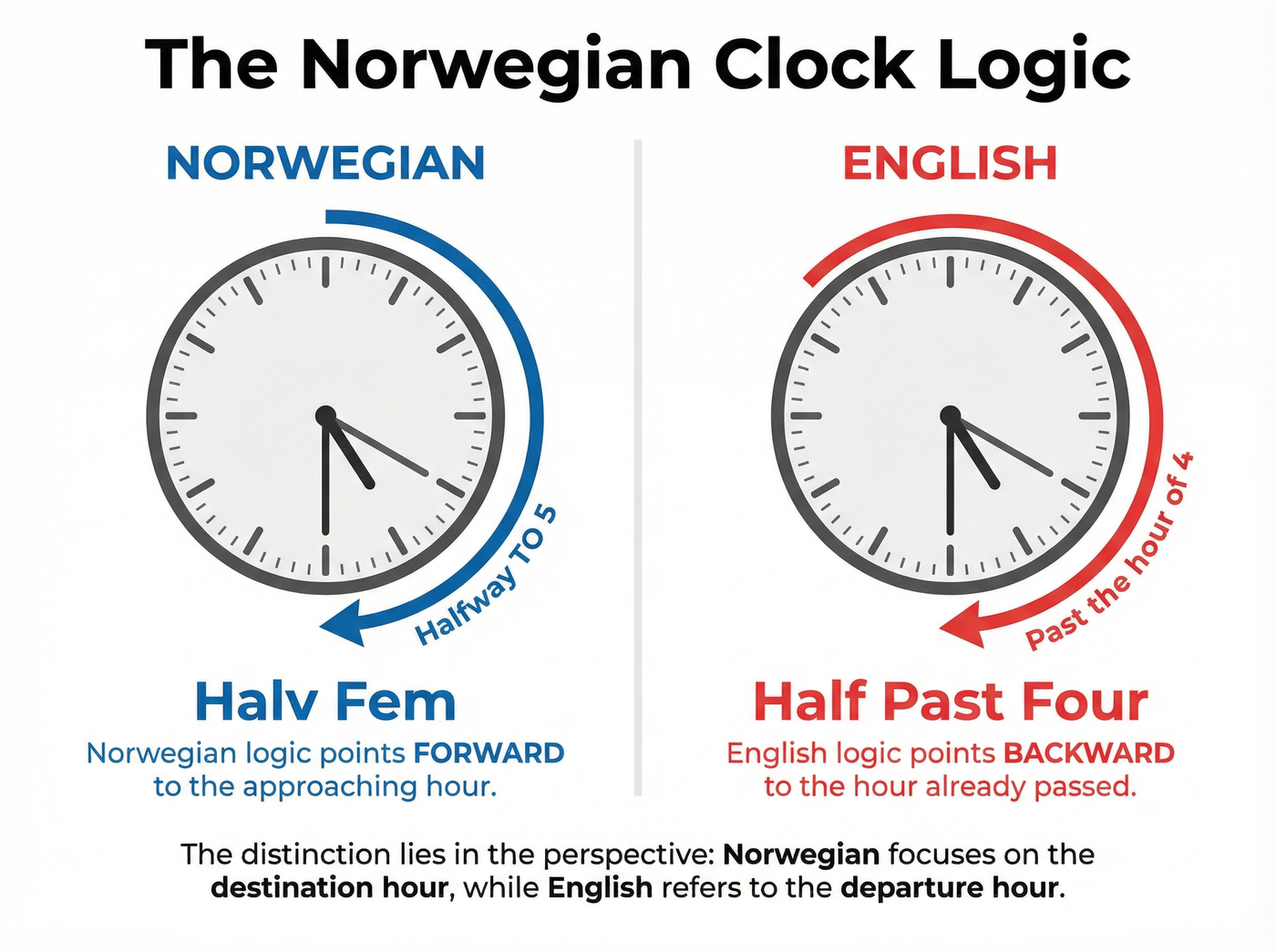
This is the most common stumbling block for English speakers. In Norwegian, the concept of “half” looks forward to the next hour rather than back at the previous one.
If a Norwegian says the time is halv fem (literally “half five”), they mean it is 4:30—halfway to five[1]. If you interpret this as “half past five” (5:30), you will be exactly one hour late.
This relative structure applies to smaller increments as well. 2:20 might be expressed as ti på halv tre (ten minutes before half three), meaning you are approaching the halfway mark to three o’clock[4].
Quarters and Minutes
For quarter hours, the prepositions are straightforward:
- Kvart over: Quarter past (e.g., kvart over to is 2:15).
- Kvart på: Quarter to (e.g., kvart på to is 1:45)[1].
Days, Months, and Dates
Once you are comfortable with the clock, the calendar is the next step. The days of the week are mandag, tirsdag, onsdag, torsdag, fredag, lørdag, and søndag.
A critical grammar rule in Norwegian is that days and months are not capitalized unless they appear at the very start of a sentence[1]. For example, you would write, “See you on mandag.”
Stating the Date
When someone asks, Hvilken dato er det i dag? (Which date is it today?), you should reply using ordinal numbers. If today is February 19, you would say nittende februar (the nineteenth of February). In written format, the logical Day.Month.Year structure is used (e.g., 19.02.2026).
Listen to the episode
Want to hear the pronunciation of these numbers and practice the rhythm of the language? Listen to the full episode below.