
When learning a new language, the first hurdle is often understanding how to name the world around you. In English, a car is just a car. In Norwegian, however, that car has a specific "gender" that dictates how you speak about it. Whether you are preparing for a trip to the fjords or just expanding your linguistic skills, understanding the trio of grammatical genders—masculine, feminine, and neuter—is the foundation of fluency.
This guide breaks down the rules of Norwegian nouns, explains the unique way the language handles the word "the," and helps you build your very first sentences.
Listen to the episode
For a deeper dive into pronunciation and examples, listen to the full episode below:
Nouns, Gender & Articles: Building Simple Sentences
The Three Genders: En, Ei, and Et
In Norwegian, you cannot simply learn a word in isolation. You must learn its gender identity simultaneously [1]. The gender determines which indefinite article (a/an) you use before the noun.
1. Masculine (Hankjønn) – "En"
The masculine gender is the heavyweight of the Norwegian language, accounting for roughly 75% of all nouns. If you ever have to guess, betting on masculine is your safest strategy. Masculine nouns use the article en.
- En mann (a man)
- En bil (a car)
2. Feminine (Hunkjønn) – "Ei"
Feminine nouns use the article ei. While this category naturally includes biological females, it also includes arbitrary objects.
- Ei jente (a girl)
- Ei bok (a book)
- Ei dør (a door)
It is worth noting that in some dialects and modern urban speech, feminine nouns can be treated as masculine (e.g., saying en bok instead of ei bok) [4]. However, learning the feminine forms provides a deeper connection to traditional Norwegian dialects.
3. Neuter (Intetkjønn) – "Et"
Neuter nouns use the article et. This category often includes abstract concepts, materials, or locations.
- Et hus (a house)
- Et bord (a table)
The Magic of Suffixes: How to Say "The"
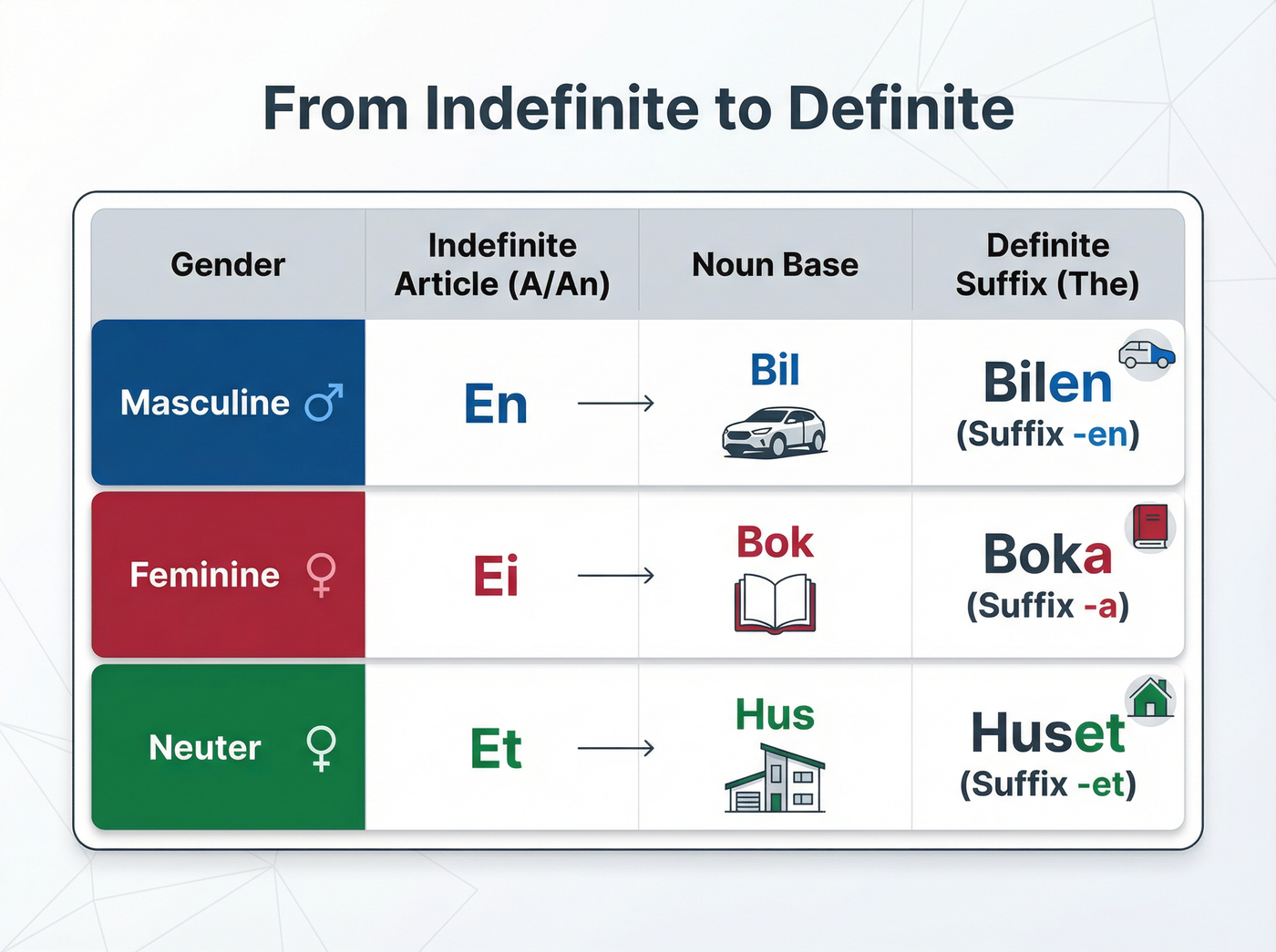
English places the word "the" before the noun. Norwegian does the opposite: it attaches the article to the end of the word as a suffix [4]. This "definite form" changes based on the gender of the noun.
Masculine Nouns: Add "-en"
To make a masculine noun definite, you generally move the en from the front to the back.
- En bil (a car) → Bilen (the car)
- En mann (a man) → Mannen (the man)
Feminine Nouns: Add "-a"
Feminine nouns typically take an -a ending in the definite form. This gives the language a distinct, melodic character.
- Ei bok (a book) → Boka (the book)
- Ei jente (a girl) → Jenta (the girl)
Neuter Nouns: Add "-et"
Neuter nouns add -et to the end. Crucially, in unspoken Norwegian, the final t is silent. So, huset is pronounced roughly like "hoo-seh."
- Et hus (a house) → Huset (the house)
- Et bord (a table) → Bordet (the table)
Building Your First Sentences
Once you understand gender and articles, you can combine them with verbs to express simple ideas. Two essential verbs for beginners are bor (lives/resides) and leser (reads).

By mixing indefinite and definite nouns, you can create sentences with specific meanings:
Example 1: Using "Bor" (Lives)
- Mannen bor i et hus.
The man (definite/masculine) lives in a house (indefinite/neuter). - En mann bor i huset.
A man (indefinite/masculine) lives in the house (definite/neuter).
Example 2: Using "Leser" (Reads)
- Jenta leser ei bok.
The girl (definite/feminine) reads a book (indefinite/feminine). - Ei jente leser boka.
A girl (indefinite/feminine) reads the book (definite/feminine).
Notice how the meaning shifts slightly depending on whether you use the article at the front (en/ei/et) or the suffix at the end. Mastering this switch is the key to sounding natural in Norwegian conversation.