
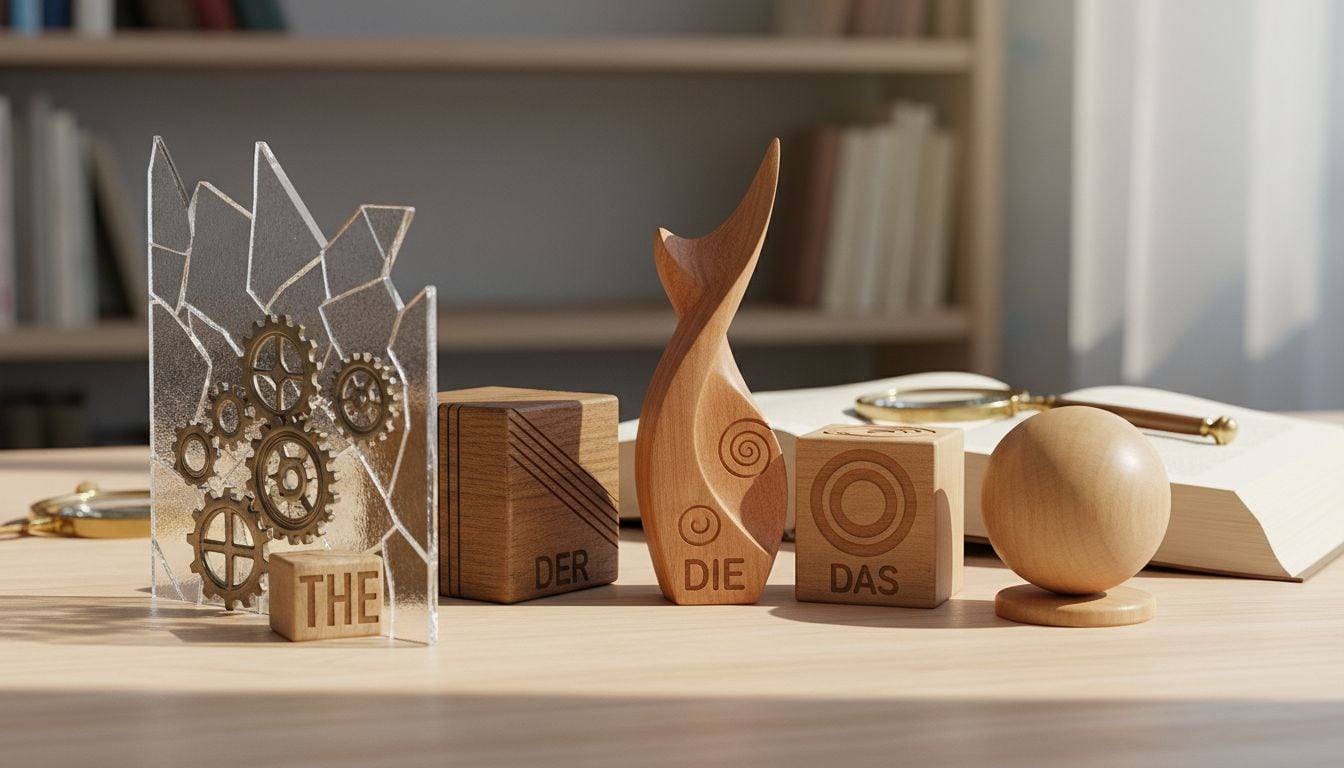
When English speakers start learning German, they often hit a wall immediately. In English, we have one simple, universal word for specific items: "the." In German, however, you have to choose between three: der, die, and das. This isn't just a matter of vocabulary; it is the foundation of German syntax and structure.
- Mechanical sorting: German noun gender is a grammatical category, not necessarily a biological one, separating words into masculine, feminine, and neuter.
- Predictive suffixes: You can often guess a word's gender by its ending, such as -ung for feminine or -ment for neuter.
- Case system mechanics: Articles change form (declension) to show whether a noun is the subject or the object of a sentence.
German Gender: A Mechanical Sorting System
The most important mindset shift for learners is to realize that grammatical gender in German is a mechanical sorting system rather than a reflection of biological reality [1]. While it is true that words for male humans (like der Mann) are often masculine and female humans (like die Frau) are often feminine, the vast majority of nouns follow arbitrary rules that have evolved over centuries.
Take everyday cutlery, for example. In the podcast episode, we discuss how three items that sit next to each other on the dinner table belong to three different categories:
- Der Löffel (the spoon) is masculine.
- Die Gabel (the fork) is feminine.
- Das Messer (the knife) is neuter.
There is nothing inherently "male" about a spoon or "female" about a fork. They are simply assigned to these categories, and mastering this assignment is critical because the article signals the word's function in a sentence.
Why is a Girl "Neuter"?
One of the most confusing examples for beginners is the German word for "girl": das Mädchen. It seems illogical to assign the neuter gender to a young female person. However, German grammar prioritizes the form of the word over its meaning.
The suffix -chen is a diminutive marker, used to describe something small or little (historically, Mädchen meant "little maiden") [3]. In German grammar, any noun ending in -chen or -lein is automatically neuter, regardless of biology. This is a strict rule that overrides natural gender, proving that the system is more about spelling and structure than physical characteristics.
Hacking the System: Predictive Suffixes
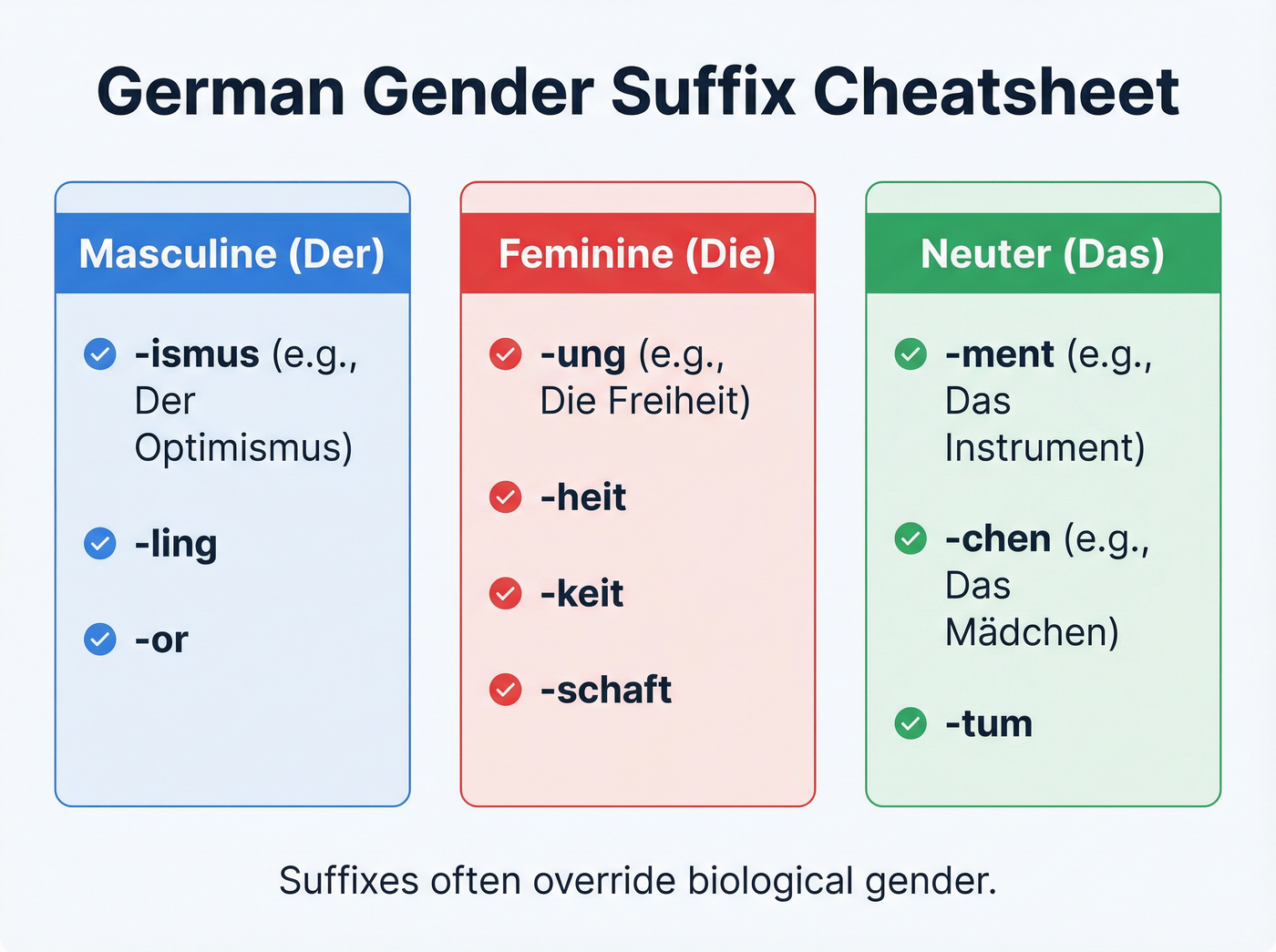
While many noun genders must be memorized, you can use spelling patterns to predict the correct article about 80% of the time [2]. The episode highlights several reliable suffixes that serve as clues.
Feminine Endings
Nouns ending in -ung are almost universally feminine. For example, die Freiheit (freedom) and die Zeitung (newspaper) take the article die. Other common feminine endings include -heit, -keit, and -schaft.
Masculine Endings
If a word ends in -ismus, it is typically masculine. A prime example given in the episode is Der Optimismus. This rule often applies to imported foreign words describing philosophies or systems.
Neuter Endings
Aside from the diminutive -chen, words ending in -ment are usually neuter. The episode uses Das Instrument as a key example. Recognizing these endings allows you to process new vocabulary faster without looking up every single word [4].
Articles and the Case System
Once you know the gender of a noun, you must learn how to manipulate it within a sentence. Using the correct article is essential because German uses a Case System to indicate who is doing what.
Definite vs. Indefinite Articles
Just as English has "the" and "a/an," German has definite and indefinite articles. The indefinite articles (singular) map partially to the genders:
- Masculine: ein (e.g., ein Löffel)
- Neuter: ein (e.g., ein Messer)
- Feminine: eine (e.g., eine Gabel)
Note that masculine and neuter share the same indefinite form ein in the subject case, while feminine nouns add an -e to become eine [5].
The Shift from Subject to Object
In English, we know who is acting based on word order ("The dog bites the man" vs. "The man bites the dog"). German is more flexible with word order because the articles change to show grammatical function.
- Nominative Case: The subject (the actor).
- Accusative Case: The direct object (the receiver of the action).
The masculine gender is the most volatile here. If a masculine noun is the subject, it uses der or ein. If it becomes the direct object, it transforms to den or einen. Feminine and neuter articles generally do not change between the Nominative and Accusative [6].
Understanding this shift—that Der Löffel becomes Den Löffel when you are holding it—is the first step toward building complex, accurate German sentences.
Listen to the episode
Dive deeper into German nouns and practice your pronunciation with the full episode.
Listen to Nouns, Gender & Articles: Building Simple Sentences