

In the quiet friction of modern relationships, there is a recurring moment of exhaustion. It is that specific point where you realize you have spent hours trying to convince someone to see things your way, act more considerately, or simply be the person you need them to be. We often mistake this exertion for "caring" or "putting in effort." However, from a psychological perspective, this is frequently an attempt to manage our own internal anxiety by exerting control over external variables.
This is where the "Let Them" theory enters the conversation. It is not a philosophy of indifference, but a sophisticated tool for emotional survival. At its core, it is a clinical exercise in radical detachment.
This episode explores why trying to manage everyone else is a recipe for burnout and how releasing that grip can actually bring you closer to the peace you are chasing.
Listen to the episode
Dive distinctively deeper into how radical detachment can transform your emotional health in this episode of the Pody.fm podcast.
Listen here: Let Them: The Power of Letting Go of Control
What is the "Let Them" Theory?
Popularized by motivational figures and echoed by mental health practitioners, the "Let Them" theory suggests that much of our psychological suffering stems from the gap between our expectations of others and the reality of their behavior. The theory advocates for a shift from an external locus of control (where your mood depends on others) to an internal locus of control.[1]
This practice involves consciously stepping back and allowing people to be exactly who they are, even when their choices are disappointing or inconvenient. By closing the gap—not by forcing the person to change, but by releasing your expectation—you reclaim the energy you normally waste on "emotional management."
Critics sometimes argue that this approach looks like dismissal or avoidance. However, experts clarify that the goal isn't to become a stone wall. It is to communicate your needs clearly once, and then "let them" decide how to respond. Their response becomes a data point about who they are, rather than a verdict on your worth.[2]
The Psychology of Control and Over-Explaining
Why do we try so hard to control others in the first place? Often, it manifests as over-explaining. Many of us believe that if we just find the perfect analogy or explain our feelings one more time, the other person will finally "get it" and change.
Psychologically, over-explaining is often identified as a potential indicator of high-functioning anxiety or a trauma response. It is an unconscious attempt to create safety through clarity. When we say "Let them," we acknowledge a hard truth: their lack of understanding is often not a result of your poor communication, but of their current capacity or willingness to hear you.
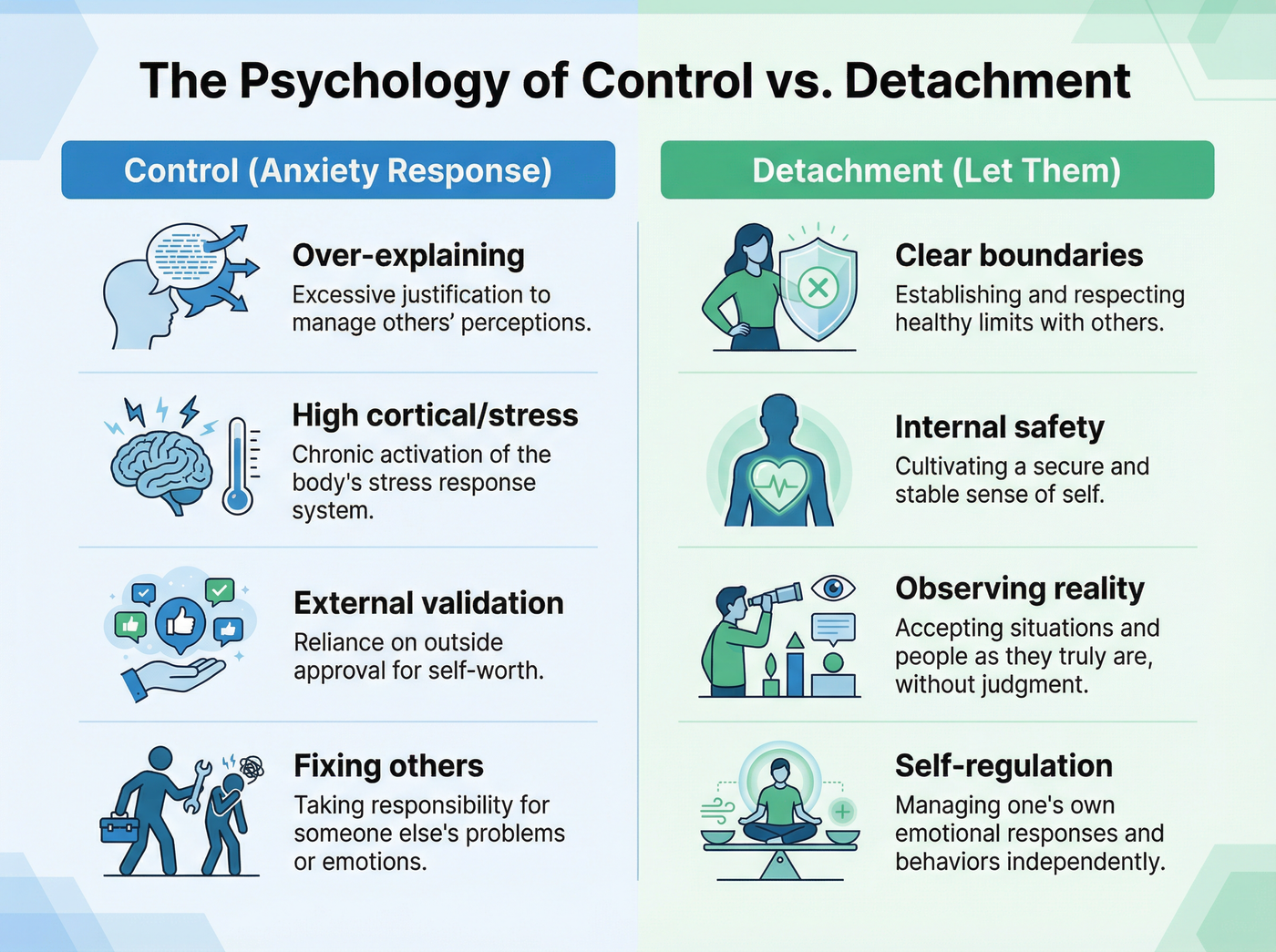
Resisting the urge to control aligns with what researchers call "Integrative Emotion Regulation." This concept, grounded in Self-Determination Theory, distinguishes between forcing emotions down (controlled regulation) and bringing them into awareness without judgment (integrative regulation).[4][5] "Letting them" is the interpersonal application of this healthy regulation.
The Impact on Parenting and Relationships
The benefits of this theory extend beyond internal peace; they deeply impact our relationships and parenting. When we try to control others, our bodies remain in a state of high arousal—a "fight or flight" mode directed at social outcomes.
In parenting, recent developments in developmental psychology have highlighted the dangers of "helicoptering" or over-engagement. A 2021 study published by the American Psychological Association found that parental over-engagement predicts poorer self-regulation in children.[3]
When parents cannot "let" their children experience minor failures or social friction, they inadvertently stunt the child's emotional growth. The psychological benefit of detachment here is twofold:
- The parent gains peace by relinquishing the impossible burden of perfection.
- The child gains the autonomy needed to develop their own internal compass.[6]

How to Practice "Letting Them"
Practical application of this theory requires a high level of mindfulness. It begins with catching the "urge to urge"—that physical sensation in your chest when you want to send a long text correcting someone or offer unsolicited advice.
When that happens, pause and say the words: Let them.
In the WorkplaceIf a colleague consistently under-performs, you "let them" face the natural consequences of their work rather than picking up the slack and resenting them for it. This stops the cycle of over-functioning.In Social CirclesIf a friend is perpetually late or makes choices you disagree with, observe the behavior. Accept it as reality. Adjust your boundaries (e.g., don't wait for them) rather than lecturing them.By doing this, you signal to your nervous system that the external world does not have to be perfect for you to be safe. This lowers cortisol levels and allows you to move from reactive "mess-management" to proactive self-leadership.
Reclaiming Your Power
The "Let Them" theory is ultimately an act of profound self-respect. It is the realization that you are not the manager of the universe, nor the curator of other people’s souls. By stopping the cycle of controlling, you create a vacuum that can finally be filled by your own interests, your own growth, and your own stillness.
You are not giving up on people. You are simply giving them back to themselves, so that you can finally come back to you.
Sources
- Embracing Detachment: The "Let Them" Theory
- A deeper look at the benefits of detachment and self-control
- Learning to let go: Parental over-engagement predicts poorer self-regulation in kindergartners
- Self-determination theory
- Integrative emotion regulation: Process and development from a self-determination theory perspective
- A self-determination theory perspective on parenting