
Moving from a beginner to an intermediate level in a new language often feels like stepping off a generic script and starting to build your own architectural framework. It is no longer just about memorizing vocabulary; it is about cohesive thought. For learners of Norwegian, this transition hinges on three specific pillars: expressing subjective opinions, projecting plans into the future, and using tactical connectors to glue these ideas together.
By mastering these tools, you transform from someone who simply answers questions into a speaker capable of sustaining meaningful conversations and building arguments.
Defining Your Reality: Synes vs. Tror
One of the most critical linguistic hurdles in Norwegian is the distinction between two verbs that both translate to "think" in English: synes and tror. While the line between opinion and belief is often blurred in other languages, Norwegian is sharp and precise. Confusing these can alter the listener's perception of your truthfulness.
Jeg synes at... (Subjective Opinion)
You use Jeg synes at (pronounced yay-sewn-ess-at) when expressing a personal taste, feeling, or an opinion based on direct experience. This phrases grounds the statement in your individual perspective.
- Example: Jeg synes at kaffen er god. (I think the coffee is good.)
Jeg tror at... (Objective Belief)
Conversely, Jeg tror at (pronounced yay-troor-at) is reserved for statements regarding objective facts where you are uncertain, or when making predictions about the future.
- Example: Jeg tror at det vil regne i morgen. (I think it will rain tomorrow.)
If you use synes for a prediction, it sounds like a personal preference rather than a guess about reality. Precision here is key to clear communication.
The Social Glue: Essential Connectors
Once you can articulate your internal state, the next step is externalizing those thoughts through connectors. These words function as the logical pivots of a sentence, allowing you to justify opinions or pivot when a plan needs to change. Mastering just five of these can help you navigate almost any social negotiation.
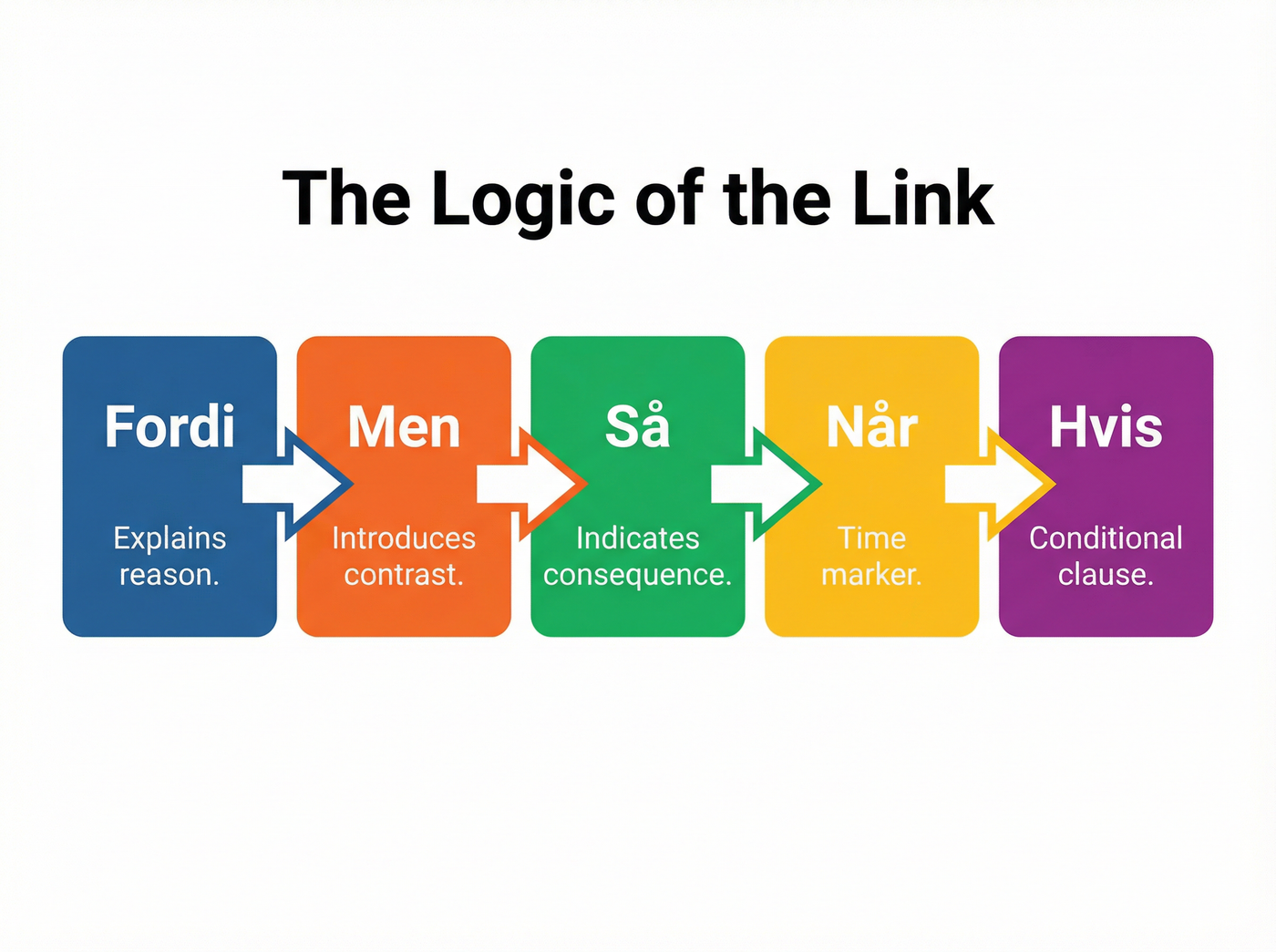
Here are the essential Norwegian connectors to build sophisticated arguments:
Fordi (Because)Explains the reason behind an action.Example: Jeg er glad fordi det er fredag. (I am happy because it is Friday.)Men (But)Introduces a contrast or exception.
Example: Jeg liker kaffe, men jeg liker ikke te. (I like coffee, but I don't like tea.)Så (So)Indicates a consequence or result.
Example: Det regner, så jeg blir hjemme. (It is raining, so I am staying home.)Hvis (If)Introduces a conditional clause, essential for making plans that depend on other factors.
Putting It All Together
Combining personal opinions with logical connectors allows, as noted in recent language acquisition research, for the construction of "scaffolded dialogues." This move from isolated words to cohesive thought is the hallmark of intermediate proficiency.
Consider this sentence structure:
Jeg synes det er dyrt, så jeg kjøper det ikke hvis prisen er høy.
(I think it is expensive, so I am not buying it if the price is high.)
This single sentence demonstrates a sophisticated process: it states a personal judgment (synes), links it casually to a decision (så), and specifies the exact condition (hvis) for that decision. Focusing on this "logic of the link" allows speakers to present themselves as nuanced and thoughtful.
Learning Through Structure
To master these distinctions, relying solely on rote memorization is often insufficient. Educational strategies suggest that structured speaking practices, such as debating exercises, force learners to use connectors naturally. In a debate setting, a student must use Jeg synes to defend a position and fordi to provide evidence, creating a "safe stress" environment that prioritizes clear argumentation over perfect grammar [1].
Furthermore, planning exercises—such as organizing a hypothetical seminar or trip—require students to shift from the present tense to the future. This invites a collaborative response, where the connectors når and hvis become indispensable for maintaining the flow of negotiation [2].

Listen to the episode
Ready to hear these nuances in action and practice your pronunciation? Listen to the full episode below.
Intermediate Toolkit: Opinions, Plans & Connectors