

Have you ever sat in a high-stakes meeting, looked around at your colleagues, and thought, "I have no idea what I'm doing, and it's only a matter of time before they all figure it out"? If so, you are far from alone. Despite your degrees, your promotions, and the praise you receive, there is a nagging voice in your head insisting that you are merely a "sleight-of-hand" artist waiting to be unmasked.
This experience is known as the imposter phenomenon. While it can feel isolating, research suggests it is a nearly universal human experience, affecting up to 70% of individuals at some point in their careers.[4][6]
A Reaction to Achievement, Not a Syndrome
The term was first coined in 1978 by psychologists Pauline Clance and Suzanne Imes. They initially observed this pattern in high-achieving women who, despite objective evidence of their intelligence, believed their success was due to luck, timing, or error.
Decades of research have expanded this view. We now know that imposter feelings are not a sign of brokenness; they are often a sign of growth. The feelings typically arise when we are pushing our boundaries—starting a new job, taking a promotion, or learning a new skill. It is practically a side effect of success.
The 5 Types of Imposter Syndrome
One of the most significant breakthroughs in understanding this phenomenon came from expert Dr. Valerie Young. She discovered that not everyone experiences imposter syndrome the same way. The feelings are rooted in our internal "rulebooks" for what competence looks like.[1]
If you violate your own rulebook—even if you succeed—you feel like a fraud. Dr. Young categorized these into five subtypes:
| Subtype | The Competence Rule | The Trap |
|---|---|---|
| The Perfectionist | Competence means doing it 100% perfectly. | If I miss one minor detail, I am a failure. A "good job" is the minimum; anything less is shameful. |
| The Expert | Competence means knowing everything. | I must know every answer. If I don't know something, I am a fraud. I cannot speak up until I know it all. |
| The Natural Genius | Competence means ease and speed. | If I have to struggle to learn this, I'm not actually smart. I should get it on the first try. |
| The Soloist | Competence means doing it alone. | If I need help, I am weak. Asking for assistance reveals my incompetence to others. |
| The Superhuman | Competence means handling every role perfectly. | I must be the perfect employee, parent, and friend simultaneously. If I drop one ball, I am a fake. |
Identifying your specific type is the first step toward dismantling the unrealistic standards you hold yourself to.
The Cycle of Stress
Imposter syndrome creates a vicious cycle that reinforces itself over time. It typically begins with a new achievement-related task, which triggers anxiety.
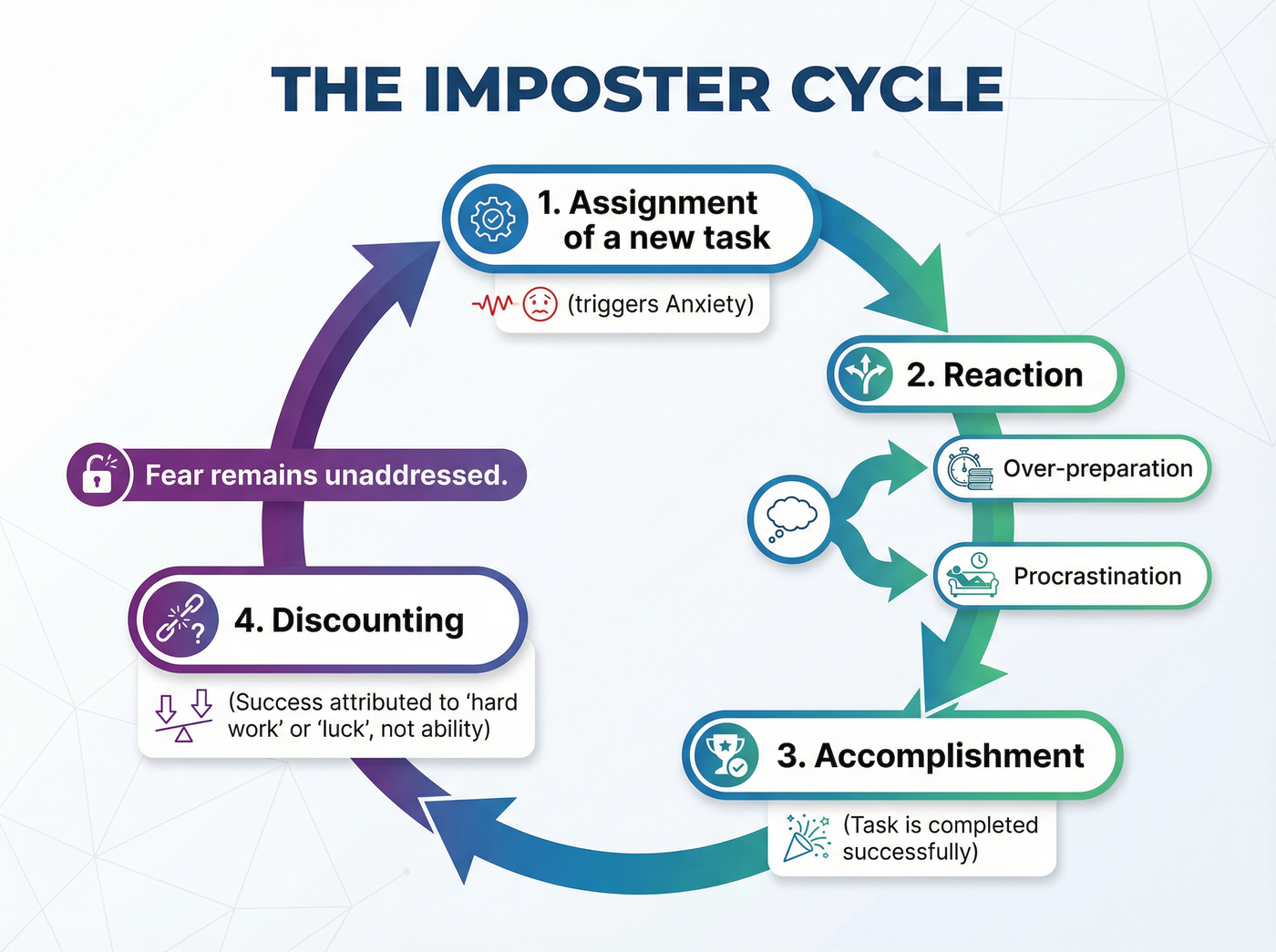
People generally respond to this anxiety with one of two behaviors: frantic over-preparation or procrastination.[5]
If you over-prepare and succeed, you think, "I only survived because I worked three times harder than everyone else." If you procrastinate and pull it off at the last minute, you think, "I got lucky this time, but next time they'll catch me." In both cases, the success fails to sink in, and the fear remains for the next challenge.
How to Reframe the Fear
Overcoming imposter syndrome isn't about eliminating self-doubt entirely—it's about changing how you respond to it. Here are three clinical approaches to reframe your thinking:
1. Shift to a Growth Mindset
In a fixed mindset, every mistake is a verdict on your intelligence. In a growth mindset, mistakes are just data. Adopt the power of "Not Yet." Instead of saying "I don't know how to do this," tell yourself, "I don't know how to do this yet." This simple shift acknowledges you are a learner, which is a legitimate and honest status to inhabit.
2. Externalize the Imposter
Treat the negative voice as a separate entity—a passenger in your car. You can acknowledge its presence without letting it take the steering wheel.[3] By giving the voice a persona, you create the psychological distance needed to evaluate your track record objectively.
3. Keep a Success Journal
Those with imposter feelings are experts at explaining away their wins. To counter this, force yourself to document the specific skills and actions you took to achieve a result. Writing it down moves the accomplishment from a fleeting emotion to an evidentiary fact.[2]

Remember, feelings are the last thing to change. You cannot wait until you feel confident to act. Often, you must act your way into a new way of thinking. If the imposter voice is loud, it is likely because you are doing something that matters.
Listen to the episode
Listen to "Imposter Syndrome: The Secret Fear of the Successful" on Pody.fm
Sources
- The 5 Types of Impostor Syndrome
- Reframing Imposter Syndrome
- The entrepreneur’s guide to managing imposter syndrome
- The imposter phenomenon and its relationship with self-efficacy, perfectionism and happiness in university students
- An Inner Barrier to Career Development: Preconditions of the Impostor Phenomenon
- The impostor phenomenon among doctoral students: a scoping review