
When navigating the stunning landscapes of Norway, from the urban heartbeat of Oslo to the quiet fjords, knowing a few key phrases can transform your experience from that of a tourist to a welcomed guest. Norwegian culture values directness and equality, principles that are deeply embedded in the language itself. By mastering the basics of how to say hello, introduce yourself, and say thank you, you are doing more than learning vocabulary—you are learning the social code of the North.
The Art of Saying Hello in Norwegian
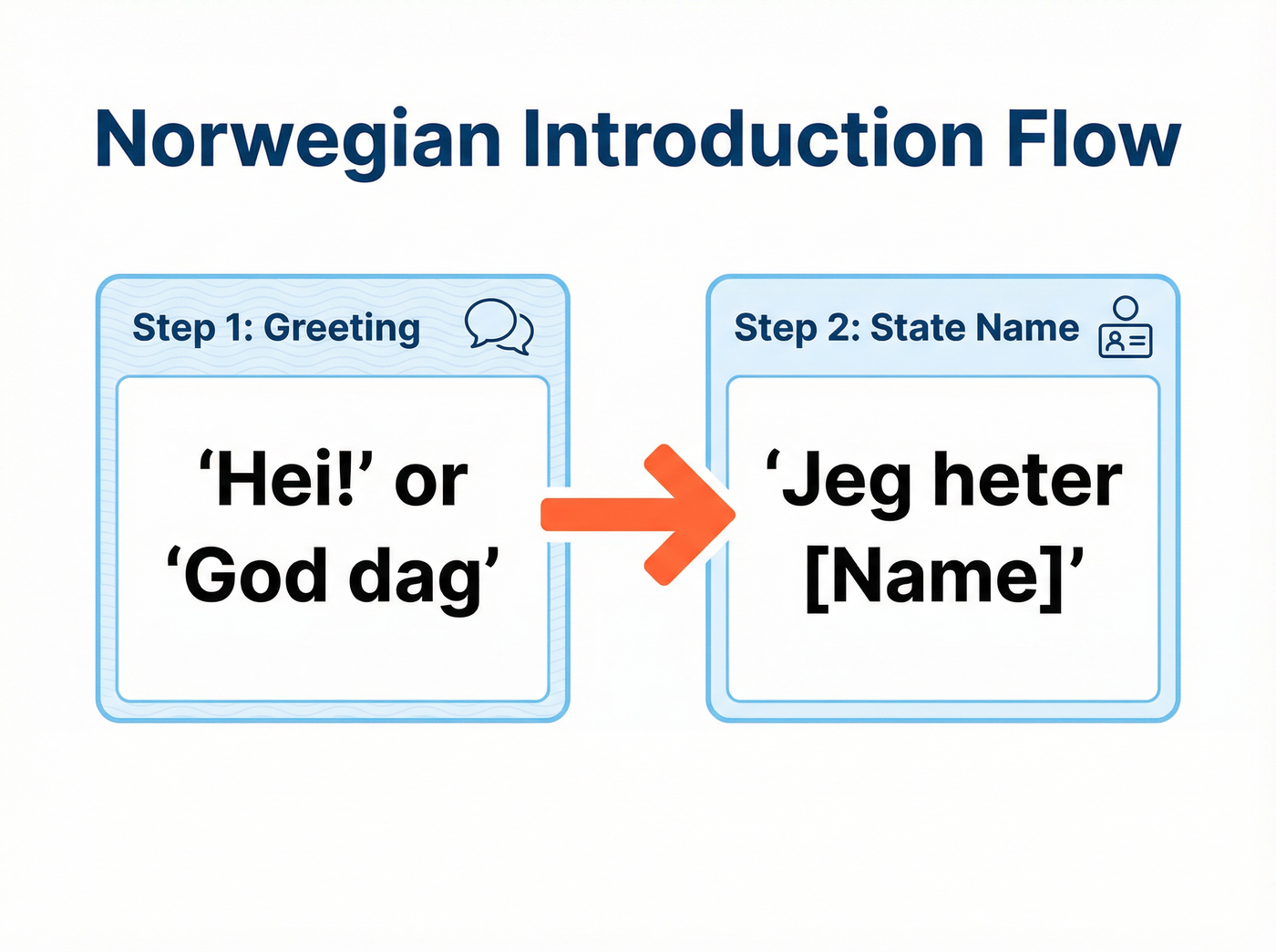
In many languages, there is a strict divide between formal and informal greetings. Norwegian takes a more relaxed approach. The most essential word you will learn is Hei (pronounced like the English "hi"). It is the universal entry point to any conversation.
Whether you are greeting a close friend, a shopkeeper, or a business associate, Hei is appropriate. To make the greeting sound softer and more casual—often used when entering a store or passing a neighbor—Norwegians frequently double it to Hei hei.[2]
Time-Specific Greetings
While "Hei" works 24/7, there are specific phrases for different times of the day that add a touch of polish to your Norwegian:
- God morgen: "Good morning." Note that the "d" in god is very soft, almost silent, making it sound more like "goo."
- God dag: "Good day." This is slightly more formal but widely accepted.[5]
Introducing Yourself: The Direct Approach
When it is time to tell someone who you are, English speakers often instinctively translate "My name is" to Mitt navn er. While this is grammatically correct, it can sound stiff or overly formal in casual conversation. The more natural, Norwegian way to introduce yourself is to say Jeg heter..., which translates literally to "I am called..."[1]
For example, if your name is Thomas, you would simply say: Jeg heter Thomas.
Asking "What is your name?"
To keep the conversation going, you will want to ask for the other person's name. The phrase is: Hva heter du?
The pronunciation of Hva dropson the "h," sounding like "vah." The word du means "you." It is important to note that the formal "you" (De) has largely vanished from modern Norwegian society. Today, a student addresses a professor as du, and a citizen addresses a politician as du. This reflects the country's flat social hierarchy and egalitarian values.[2]
Polite Follow-ups
Once names have been exchanged, custom dictates a polite acknowledgement:
- Hyggelig å møte deg: "Nice to meet you."
- I like måte: "Likewise" (literally "in like manner").[6]
Politeness: Why "Thanks" Means "Please"
One of the most common stumbling blocks for learners is the word "please." In English, we use it constantly. in Norwegian, the direct translation, vær så snill, is reserved for actual favors or pleading. If you use it to order a coffee, it can sound overly dramatic or strange to a native ear.
Instead, Norwegians use Takk (thanks) to soften requests. It acts as the social lubricant in transactions.[3]
Ordering a coffee (English mindset):"One coffee, please."Ordering a coffee (Norwegian mindset):"En kaffe, takk."
By shifting your mindset from "please" to "thanks," you will sound much more natural. Another frequent phrase you might hear is Takk for sist, which means "thanks for the last time [we met]." It is a common way to acknowledge a previous meeting and reconnect with acquaintances.
Saying Goodbye
When the conversation concludes, you have a few options to part ways politely. The standard goodbye is Ha det. This is actually a shortened version of Ha det bra, which translates to "have it well."[4]
If you plan to see the person again soon, you can use the optimistic Vi sees, meaning "see you" or "we'll see each other."
Listen to the episode
Want to hear the correct pronunciation of God morgen or practice the rhythm of Hva heter du? Listen to the full episode below for drills and more cultural context.
Listen to Greetings, Introductions & Polite Phrases
Sources
- How to Introduce Yourself and Others in Norwegian
- How to Greet and Present Yourself in Norwegian - Norwegian Language School
- A Gentle Introduction to Norwegian - NorwegianClass101
- How to Introduce Yourself in Norwegian - Norwegian Language School
- Greetings - NorwegianClass101
- How to introduce yourself in Norwegian