

The Russian language is a linguistic titan, spoken by over 258 million people worldwide today.[1] As the official language of Russia, Belarus, Kazakhstan, and Kyrgyzstan, it serves as a vital bridge across Eurasia. However, the modern tongue we hear today is the result of over a millennium of survival, adaptation, and deliberate transformation.
Understanding the history of Russian requires tracing its path from tribal dialects in the sixth century to the imperial reforms of the eighteenth century. It is a story shaped by religion, invasion, and the ambitious vision of tsars.
The Roots: Proto-Slavic to Kievan Rus
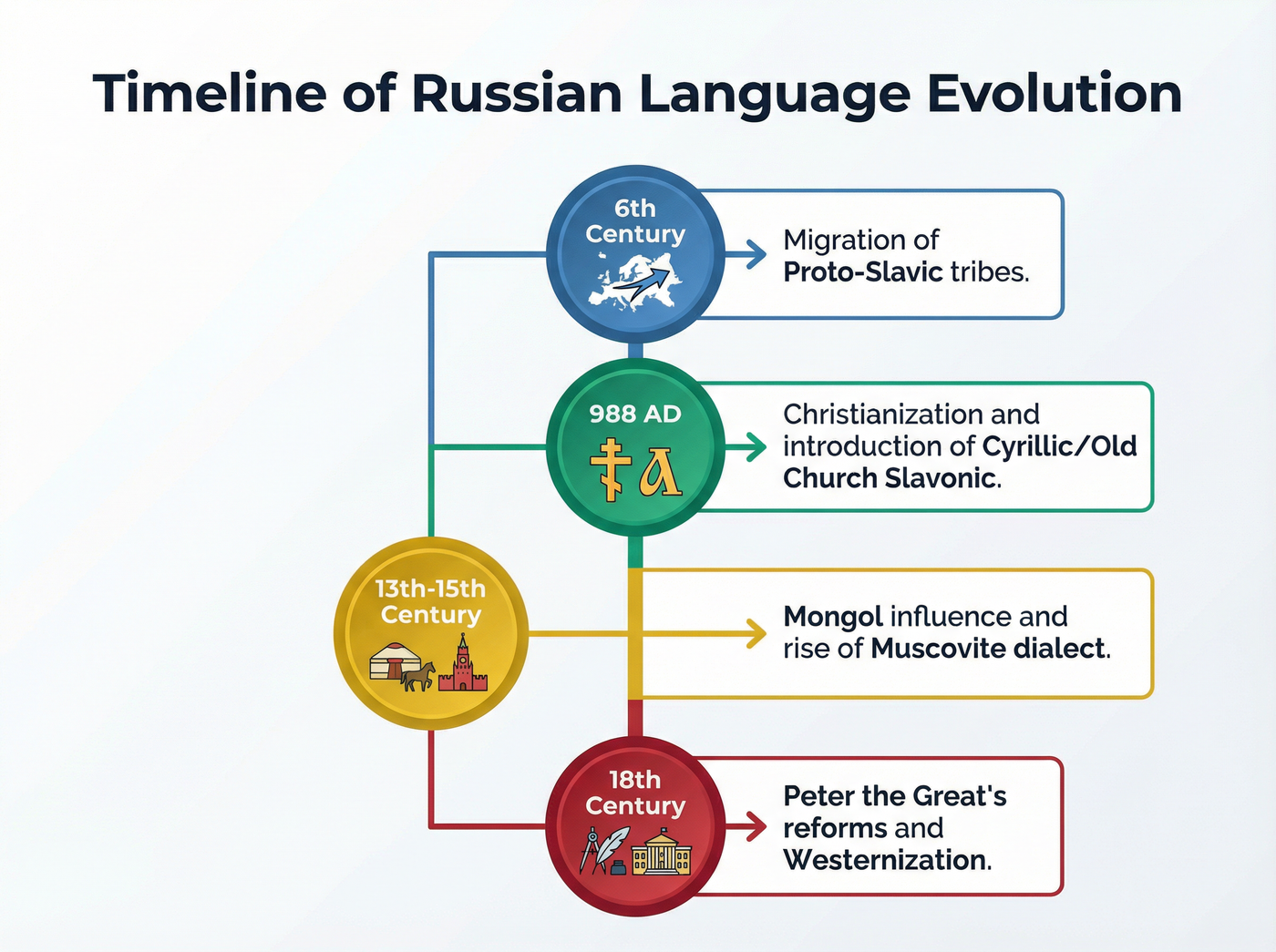
The story begins well before the existence of modern state borders. In the sixth century, Proto-Slavic tribes began migrating across Eastern Europe. As these groups spread, their shared language fractured into three distinct branches: West Slavic, South Slavic, and East Slavic.[4]
The East Slavic branch eventually became the ancestor of modern Russian, Ukrainian, and Belarusian.[3] However, for centuries, these were merely regional variations of a vernacular spoken by tribes living between the Carpathian Mountains and the Dnieper River.
A major turning point occurred in the late ninth century with the rise of Kievan Rus. This medieval federation represented the first centralized political identity for East Slavic speakers.[1] It was here that the language began its initial transition from a collection of tribal dialects into a tool capable of supporting statecraft and trade.
988 AD: The Dual Power of Diglossia
Perhaps the most profound shift in the history of the Russian language arrived with religion. In 988 AD, Kievan Rus adopted Eastern Orthodox Christianity.[1] Along with the faith came the Cyrillic alphabet, developed by Byzantine missionaries to translate scripture.
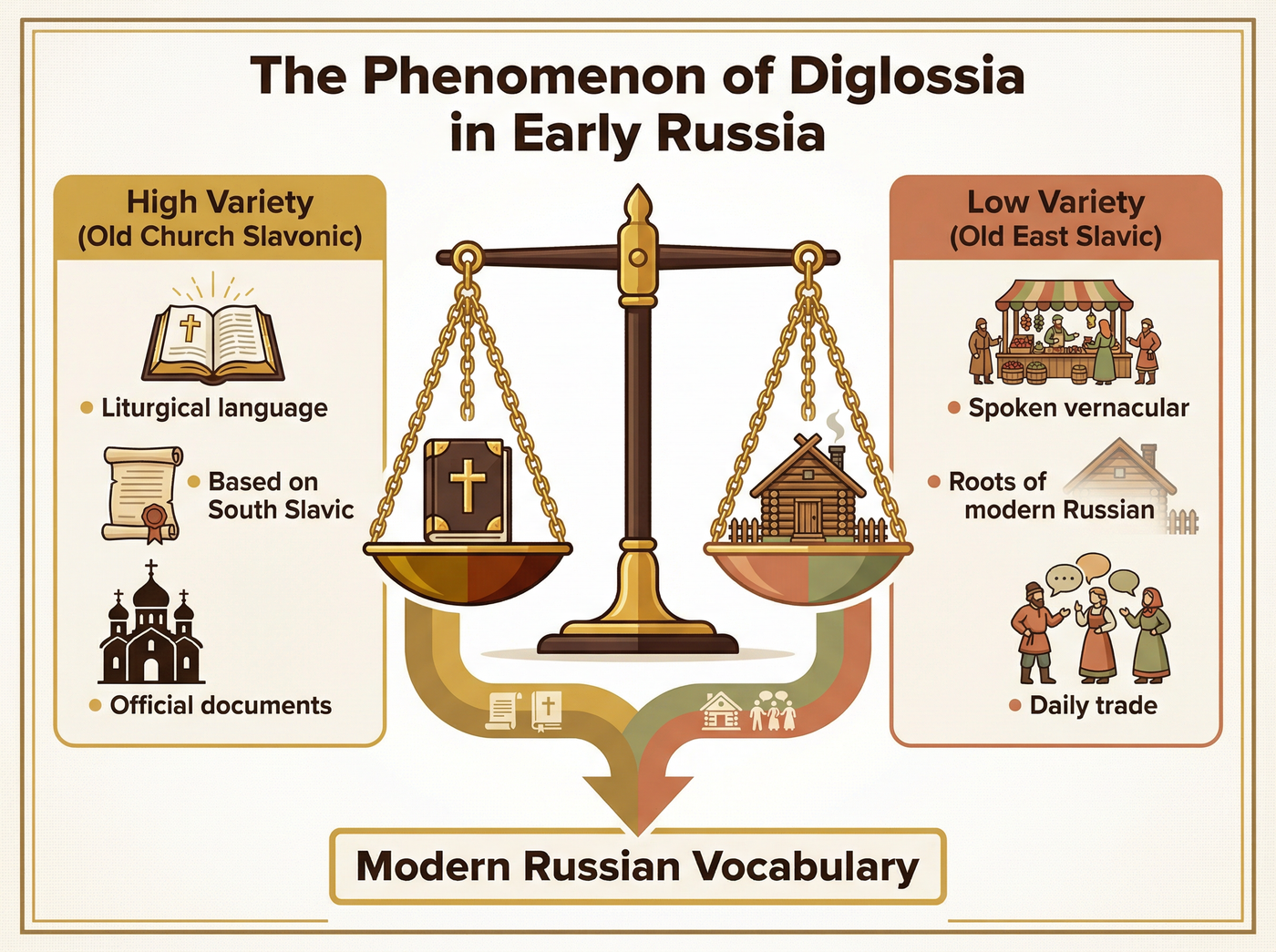
However, the written language introduced—Old Church Slavonic—was based on South Slavic dialects from the Bulgarian region, not the local East Slavic tongue.[3] This created a unique linguistic situation known as diglossia. For centuries, two distinct language varieties coexisted:
- Old Church Slavonic: Used for religious services, literature, and high-stakes legal documents.
- East Slavic Dialects: Used for everyday speech, commerce, and practical communication.
This duality deeply enriched the Russian lexicon, providing it with two sets of words for many concepts—one humble and practical for daily use, and one formal and elevated for literary expression.
The Mongol Yoke and the Rise of Moscow
In the thirteenth century, the Mongol invasions fractured Kievan Rus, ushering in a prolonged period of political chaos and linguistic divergence.[3] As western territories fell under Polish and Lithuanian influence, the eastern lands centered around Moscow began to develop a distinct character.
This era saw the rise of the Muscovite dialect. Isolated from the west, this dialect began to absorb loanwords from Turkic and Mongolic languages, reflecting the political realities of the Mongol rule.[3] Words related to trade, finance, and post roads entered the lexicon during this time, separating the developing Russian language further from its Ukrainian and Belarusian relatives.
Peter the Great: A Language Reforged
By the seventeenth century, Moscow had risen to prominence, but the language remained somewhat archaic. It was Peter the Great who, in the late 1600s and early 1700s, dragged the Russian language into modernity.[1]
Peter recognized that a medieval language was insufficient for a modern empire focused on science and naval power. His reforms were radical and far-reaching:
- New Alphabet: He simplified the Cyrillic alphabet, creating a "civil script" that resembled Western Latin fonts to facilitate printing and literacy.
- Western Loanwords: He actively imported thousands of words from Dutch, German, and French. Terms regarding navigation, administration, and military tactics flooded the language.[1]
These efforts fundamentally changed the trajectory of Russian, transforming it from a localized Slavic tongue into a cosmopolitan language of empire.

The Soviet Era and Beyond
The evolution did not stop with the Tsars. The 20th century brought the Soviet era, which introduced mass literacy campaigns and a new wave of political terminology. Standardized Russian became the language of education and administration across the Soviet Union, solidifying its status as a global powerhouse.[4]
Today, the language continues to evolve, facing a new influx of English loanwords driven by the internet and technology. Yet, beneath the modern slang, the foundations laid by ancient monks, Mongol interactions, and imperial reformers remain visible.
Listen to the episode
Delve deeper into the fascinating history of how Russian evolved from tribal dialects to a global language in our full episode.
Listen to From Old East Slavic to Modern Russian: Key Linguistic Shifts