
Updated: Saturday, May 9, 2026
Listen to the Episode
Want to dive deeper into the internal plumbing that keeps you alive? Listen to "From Cells to Bodies: Tissues, Organs, and Homeostasis" on pody.fm.
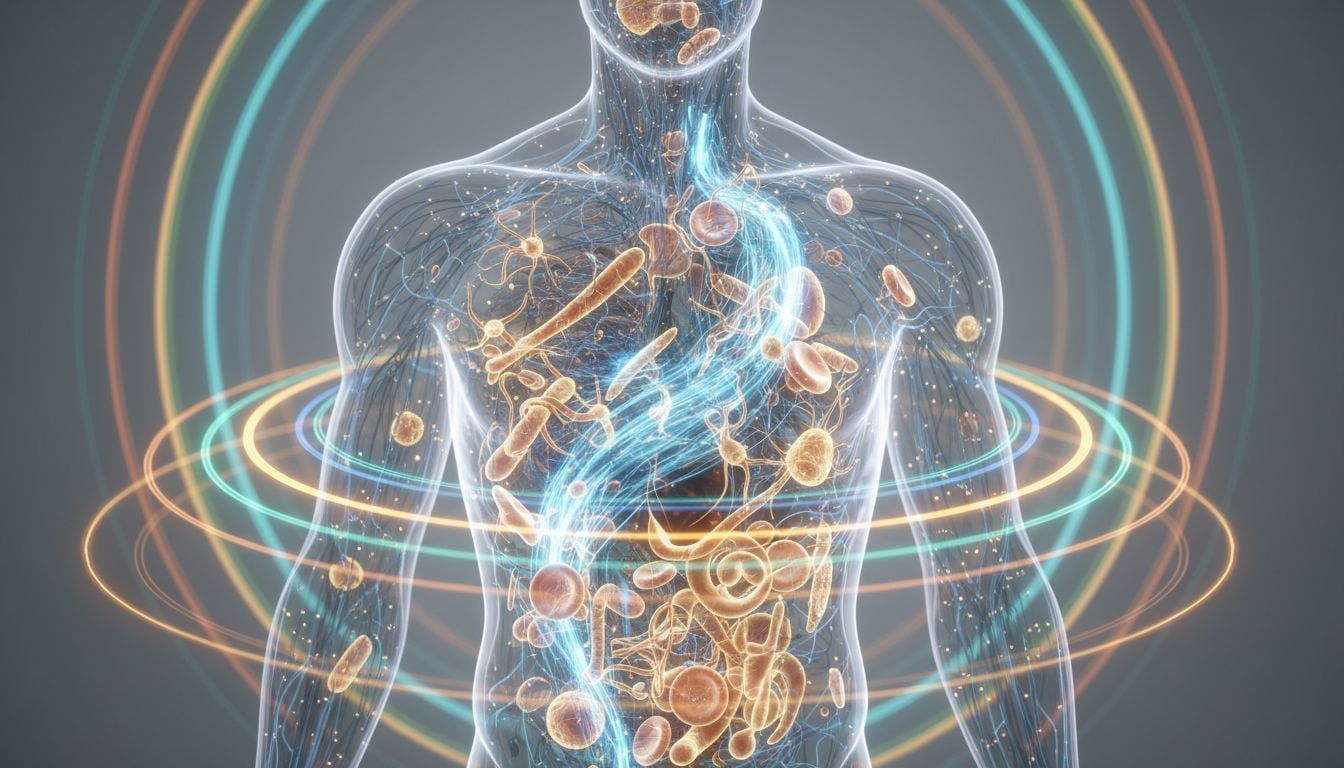
The hallmark of complex life is not merely possessing many cells, but the seamless coordination of those cells into a unified, self-regulating whole. Unlike a single-celled organism that interacts directly with a volatile environment, a human body creates its own internal world. This protected internal space is governed by a silent architecture of feedback loops and physiological hierarchies that keep us alive in environments where individual cells would otherwise instantly perish.
The Trade-Off: Generalists vs. Specialists
To understand physiological coordination, we must look at the cellular transition from generalists to specialists. In a single-celled organism, one cell must be a jack of all trades, handling everything from digestion to movement and waste disposal. In a multicellular system, cells undergo massive differentiation. Specialized cells dedicate themselves to singular tasks: muscle fibers specialize in contraction, while neurons specialize in high-speed signaling.
However, this specialization creates a massive demand for logistics. Because a neuron is entirely dedicated to processing signals, it relies on the body's vast transport networks to bring it fuel and carry away cellular trash. The primary risk of this lifestyle is systemic fragility. If the body's infrastructure fails, or if the composition of the extracellular fluid shifts even slightly, these specialist cells lose their ability to function. Ultimately, interdependent tissues form complex organs (like the kidneys or the heart) precisely to manage and protect these fragile, highly specialized workers.
The Invention of the Internal Environment
The concept of internal constancy was first championed by the 19th-century French physiologist Claude Bernard. He used the term milieu intérieur (or internal environment) to describe the precisely balanced extracellular fluid that bathes our cells[4]. Bernard's profound insight was that the stability of this surrounding fluid is the primary condition for a free and independent life. If your internal environment remains stable, you can wander into an arid desert or dive into a freezing lake without your internal chemistry mirroring the external chaos.
In the early 20th century, American physiologist Walter Cannon refined this breakthrough idea, formally coining the term homeostasis[5]. Derived from Greek words meaning "similar" and "standing still," homeostasis is frequently misunderstood as a completely static state. In reality, it is a state of dynamic equilibrium. Much like an airplane autopilot constantly micro-correcting a flight path through turbulence, the body exists in perpetual, measured agitation, making millions of tiny corrections to maintain balance.
Negative Feedback Loops: The Body's Autopilot
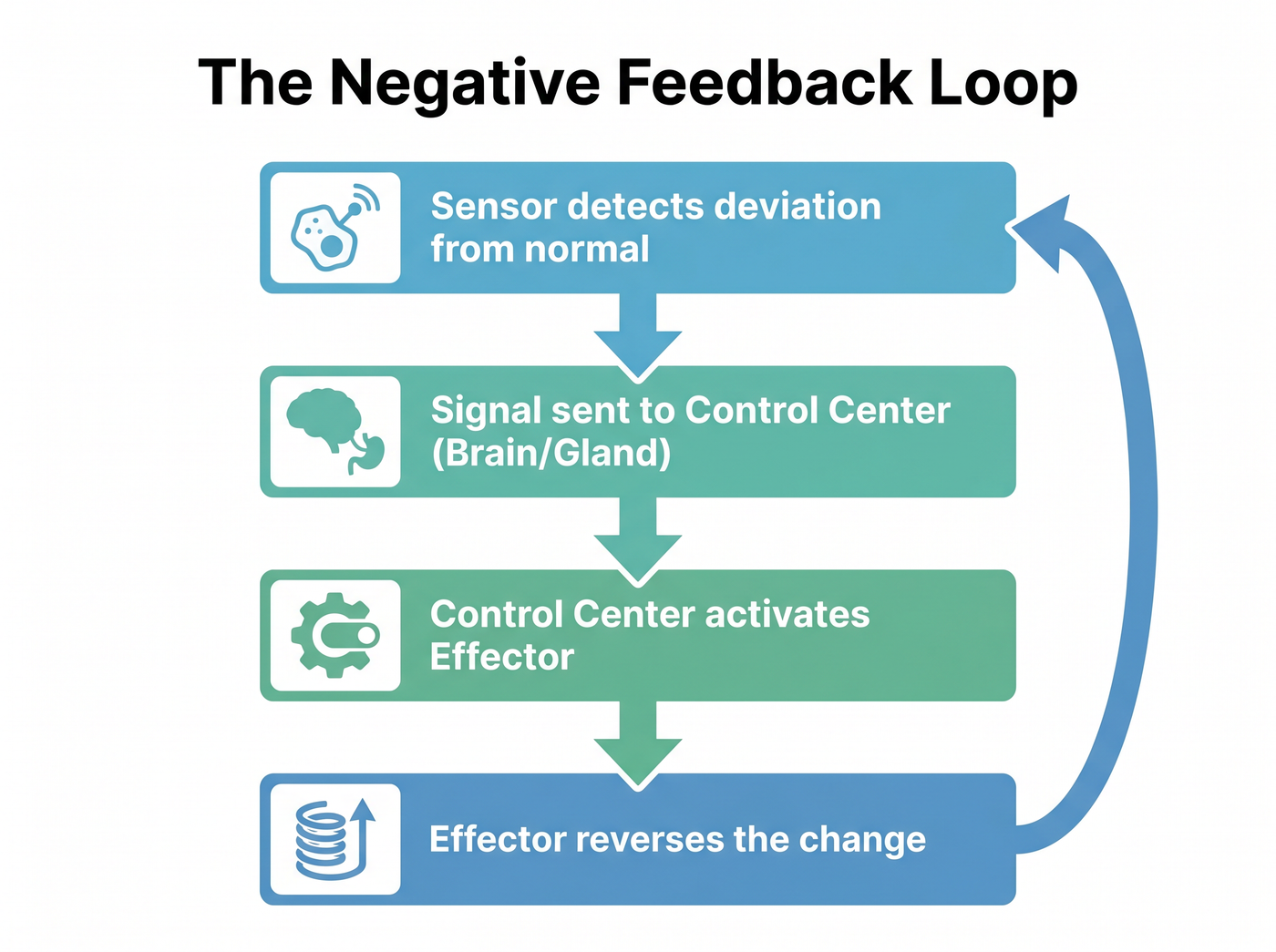
The primary mechanism for maintaining internal stability is the negative feedback loop. This acts as the body's fundamental if-then logic. A sensor detects a deviation from a physiological set point (such as a drop in body temperature) and sends a signal to a control center, which is typically the brain. The control center then activates an effector to counteract the change.
The "negative" in negative feedback does not mean bad; it simply means the response actively reverses the initial stimulus to bring the system back to the center. This contrasts sharply with positive feedback loops, which amplify changes. While vital for specific, self-limiting biological events like blood clotting or labor contractions, positive feedback is generally the enemy of systemic stability. Homeostasis relies almost exclusively on the dampening power of negative feedback to prevent runaway physical reactions.
Real-World Homeostasis: Temperature, Glucose, and Water
Several core variables must be constantly managed by your internal operating system to sustain multicellular life:
Thermoregulation
Humans are endotherms, meaning we generate our own heat metabolically. The hypothalamus acts as the body's master thermostat. When it senses a sudden drop in core temperature, it triggers rapid muscle contractions (shivering) to generate physical heat, along with vasoconstriction to pull warm blood away from the skin and protect vital organs.
Blood Glucose Management
Blood sugar regulation is a masterpiece of endocrine coordination between the pancreas and the liver. After a meal, rising blood glucose prompts the pancreas to release insulin, allowing glucose to enter cells and prompting the liver to store excess energy as glycogen. When fasting, the release of glucagon reverses the process. In a healthy adult, this tightly coordinated loop keeps blood sugar precisely within a narrow range of about 4 to 6 mmol/L[2].
Osmoregulation and pH Balance
Our cells live in a salty inner ocean, and its concentration must be precise. The kidneys filter the blood continuously, adjusting the concentration of our urine based on signals from antidiuretic hormone (ADH) to prevent our cells from shriveling or bursting[6]. Even blood pH is fiercely defended, securely held between 7.35 and 7.45. To uphold this specific balance, the lungs expel acidic carbon dioxide for immediate adjustments, while the kidneys manage bicarbonate levels to ensure long-term stability.
Allostasis and the Future of Biological Repair
Modern physiology recognizes a complex tension between strict homeostasis and allostasis. While homeostasis focuses on holding a rigid set point, allostasis is the process of achieving stability through anticipation and change. For example, your heart rate does not just increase after you start running; it begins to rise the moment you consciously decide to run. This predictive regulation keeps the body ahead of impending stress.
However, constant allostatic tuning comes with an energy cost known as allostatic load. Chronic environmental or metabolic stress can overwork regulatory loops, leading to their eventual failure, which scientists suspect is at the root of many modern chronic diseases[3].
Researchers are even exploring how to repair these feedback networks at a microscopic level. A fascinating study published in Nature Communications in March 2026 demonstrated that plant-derived nanothylakoids could successfully restore organelle homeostasis in stressed animal cells. By providing a light-driven energy source, these tiny units helped maintain mitochondrial function, indicating a bold future for cell-level bioengineering[1].
Ultimately, your body's primary job is to stay the exact same while everything in the external world changes. Every breath you take is a calculated adjustment designed to keep your internal chemistry in a perfect Goldilocks zone. By respecting our body's limits and supporting these incredible feedback loops, we ensure the stability necessary for a healthy, vibrant life.
Sources
- Natural photosynthetic system for restoring homeostasis of animal organelle interaction network | Nature Communications
- Homeostasis: How the Human Body Keeps Itself in Balance
- Homeostasis: The Operating System of Life | MARIA OS
- Homeostasis: The Underappreciated and Far Too Often Ignored Central Organizing Principle of Physiology (PMC)
- Frontiers | Homeostasis: The Underappreciated and Far Too Often Ignored Central Organizing Principle of Physiology
- Homeostasis - The secret lives of cells