
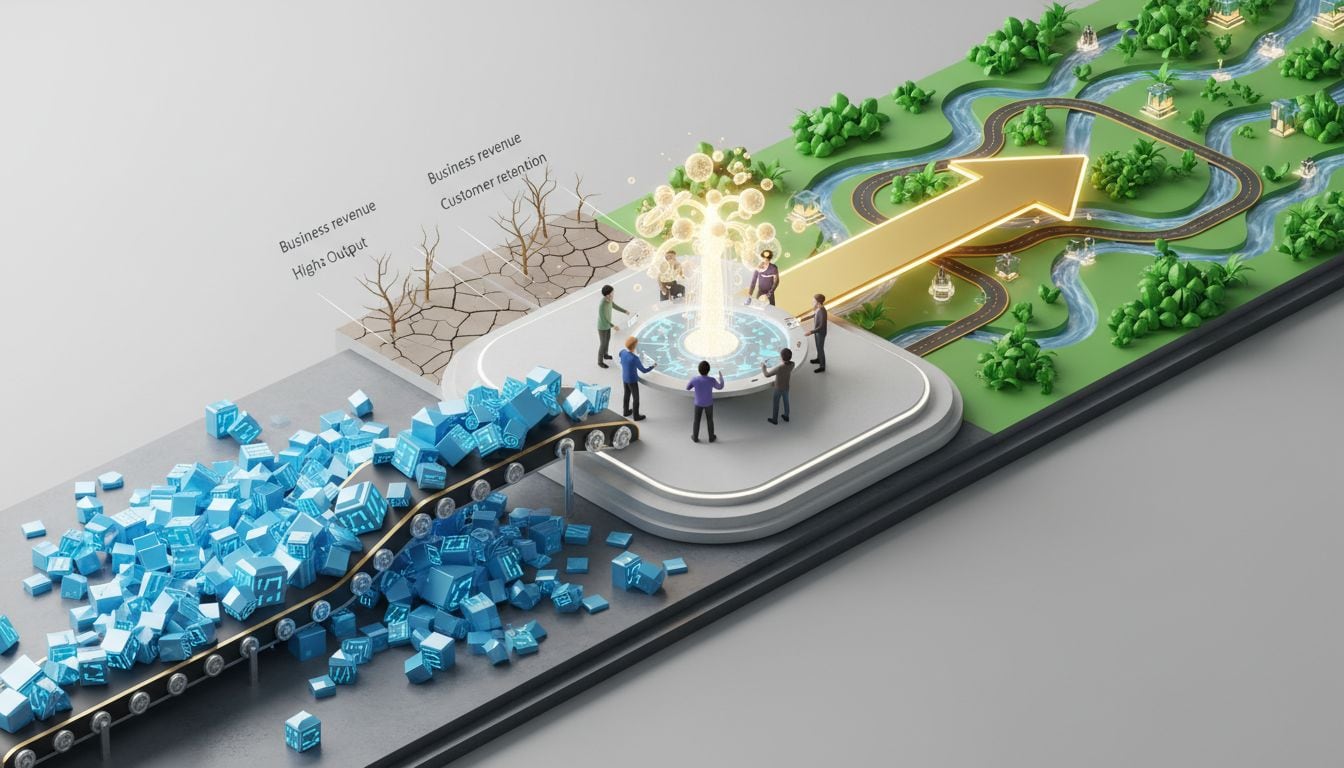
Have you ever found your engineering team shipping code at record speed, yet business revenue and customer retention remain completely flat? This is the core symptom of the Build Trap, a concept popularized by product strategist and former Harvard Business School faculty member Melissa Perri.[3] In the landscape of modern technology, high output in software development is frequently mistaken for genuine success. Teams often confuse being busy with delivering actual value.
To unpack this industry-wide issue, we recently explored the nuances of outcome-based product management and how companies can stop acting like feature factories. Below we dissect why a relentless drive to push new features can turn your product into a bloated liability rather than a growth engine.
Listen to the episode
For a detailed breakdown of these concepts, listen to our full episode: Escaping the Build Trap: From Output to Outcomes.
Defining the Build Trap
At its core, the Build Trap occurs when organizations prioritize the sheer volume of code shipped over the actual value created for users. This mindset turns companies into a Feature Factory.[1] Management teams often get distracted by glowing green project boards or high sprint velocity. These metrics provide a false sense of security while the business side of the organization suffers from flat growth or lost customers.
While output is measurable in quantity (tickets closed or features shipped), outcomes are qualitative. Outcomes are measured in impact, such as customer retention, revenue growth, or specific user problems solved. Unlike a car factory, more production in software does not inherently equal more value. Every additional feature increases the potential for bugs and contributes to user interface clutter. Success is determined by whether the solution actually moves the business needle.
The Product Death Cycle
The journey into the build trap usually begins when a company observes declining engagement metrics and experiences sudden panic regarding their market position. The misguided reaction is to immediately ask customers, "What features do you want?" to stop the bleeding.[5]
While customers are experts at identifying their own pain points, they are rarely equipped to design the technical or product solutions to solve them. When a software team builds exactly what a customer asks for (like a highly specific button or custom dashboard) without understanding the underlying problem, the product becomes bloated.
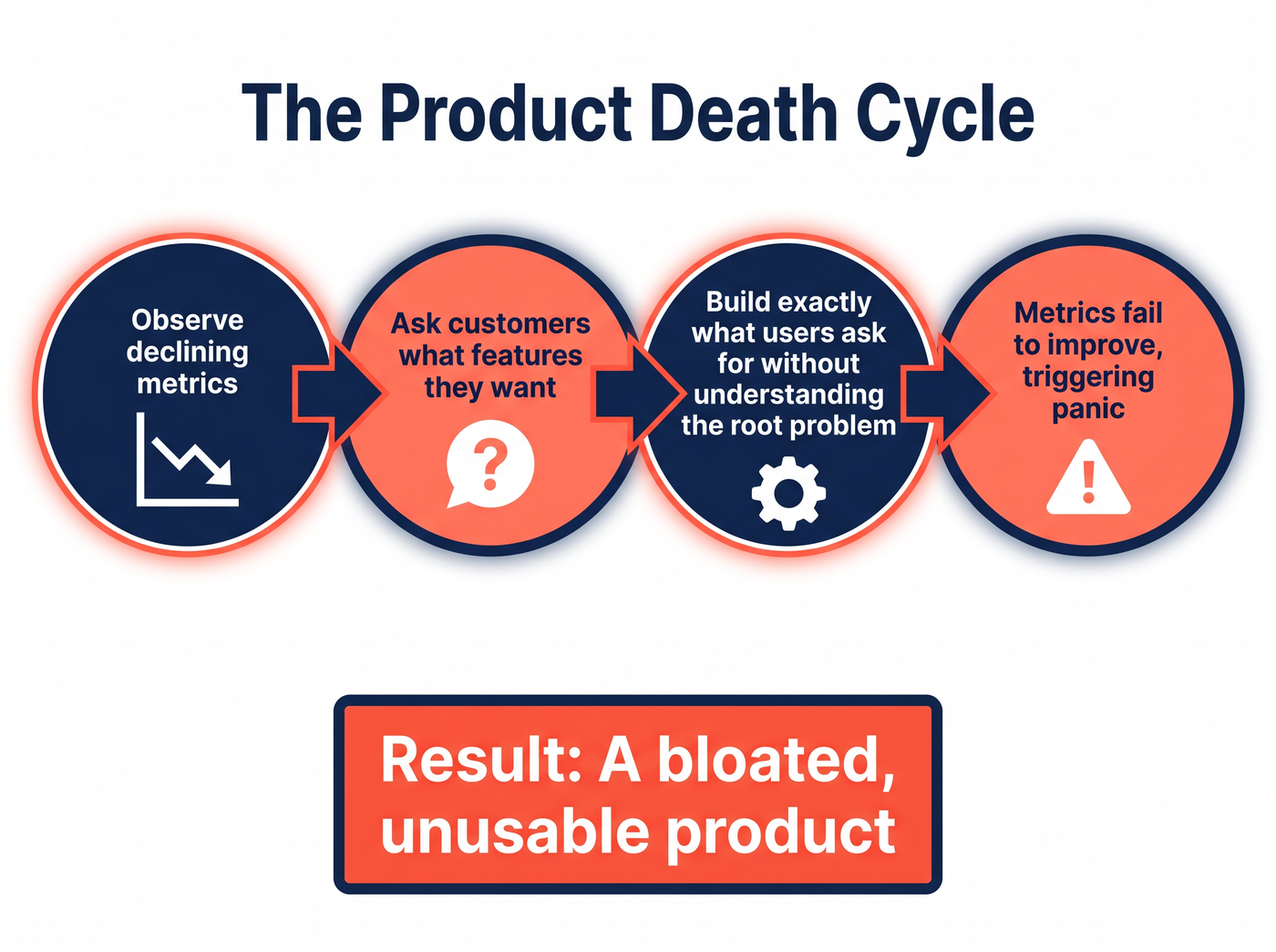
Failing to see growth after the initial feature release often leads management to conclude that they simply have not built enough yet. This triggers a cycle of over-production that severs the connection between the company and its users.
Restoring the Value Exchange System
At the core of every successful business is a functional Value Exchange System.[3] This system operates as a simple two-way street. The business identifies a specific customer problem and provides a solution, while the customer provides value in return through money, time, or data.
When a company becomes a feature factory, it stops viewing the user as a partner in an exchange. The user is instead viewed merely as a consumer of production, and the actual problem-solving side of the equation is ignored.
To escape this trap, teams must transition their mindset from being delivery-focused to being discovery-focused. Instead of asking what to build, product managers must identify the core problem that, if solved, would encourage the customer to provide more value back to the company. Escaping the trap requires the courage to stop building unnecessary features and the discipline to validate whether a solution is actually working before committing massive development resources.

Redefining Product Management and Strategy
One of the most radical shifts proposed by Melissa Perri is the redefinition of the Product Manager. In many organizations, the PM is treated as a waiter taking orders from executives to deliver to the engineering kitchen. However, a true PM is a risk reducer. They use data and experimentation to kill features that will not drive value, long before those features reach the development stage.[6]
When discussing this shift, it is critical to address the strategy gap. Most companies mistake a plan for a strategy. A plan is a list of features to be built over the next twelve months. Strategy is a deployable decision-making framework, a concept aligned with Stephen Bungay's framework in The Art of Action. A strategy tells teams how to evaluate what is worth doing rather than just giving them a list of tasks.
The Product Kata
This outcome-based philosophy brings us to the Product Kata, a systematic process of continuous improvement derived from the Toyota Kata.[3] It forces teams to constantly ask three questions:
- What is our goal?
- What is the current state?
- What is the biggest obstacle in our way?
Instead of building an entire feature at once, the team builds the smallest possible experiment to see if the obstacle can be overcome. This saves time, money, and sanity.
The AI Era and the Future of Product Operations
As organizations scale, managing these continuous experiments becomes complex. This has led to the rise of Product Operations (Product Ops), which acts as the connective tissue providing the tools and data transparency needed so teams can focus on customer problems rather than internal logistics.[4]
As of Friday, May 1, 2026, the integration of artificial intelligence into software development is arguably making the Build Trap even more dangerous. If AI can help developers write code ten times faster, a feature factory will simply produce ten times more useless features. In an age of infinite output, the premium on strategic choice and market validation has never been higher.
Escaping the build trap is not just about changing how you build software. It is about fundamentally changing why you build it. By shifting from a focus on static projects to dynamic, outcome-based organisms, companies can move past the illusion of velocity and start driving genuine innovation.