
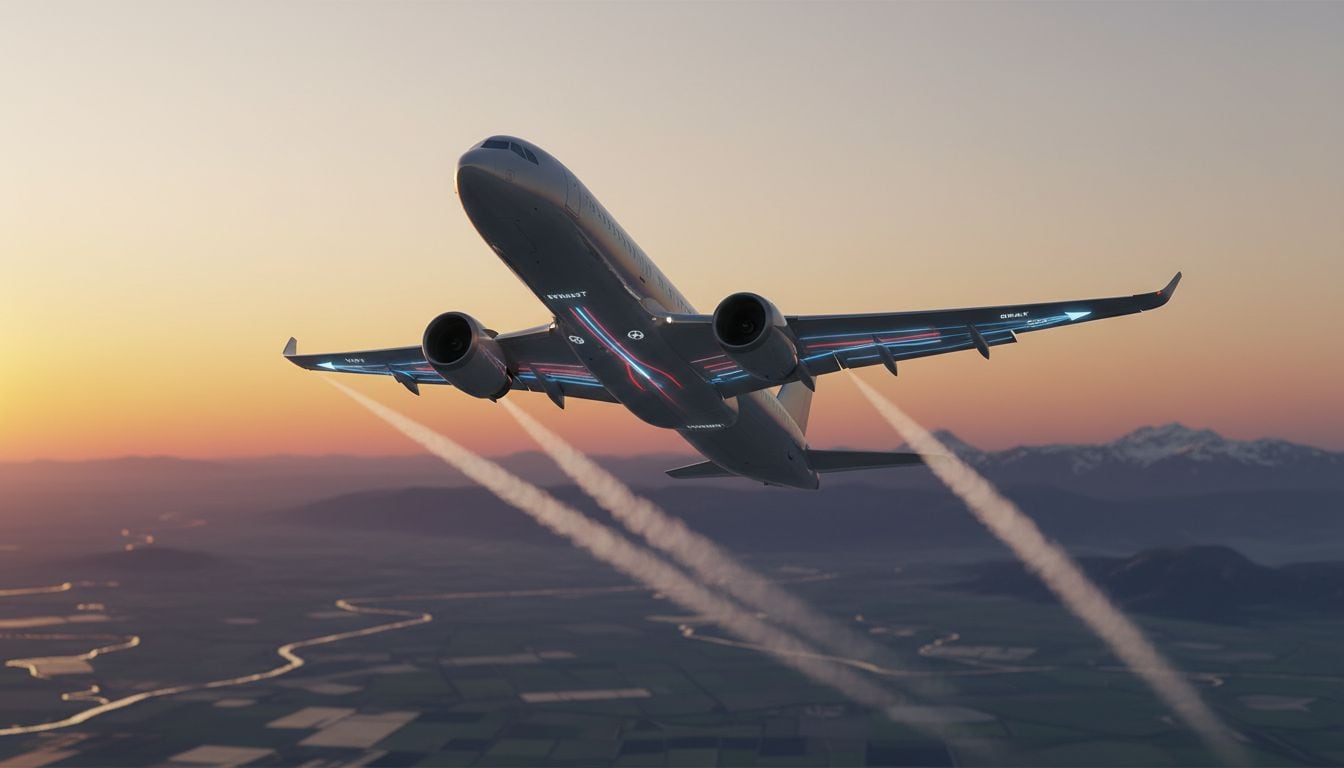
Have you ever sat in a window seat, watched the ground peel away beneath you, and wondered how a machine weighing hundreds of tons manages to hang suspended in the air? It is a question that crosses almost everyone's mind at 30,000 feet. While aviation can feel like magic, it is actually a beautiful orchestration of physics.
Today, we represent the principles of flight not through complex equations, but through simple concepts you can see and feel—using an analogy as simple as a car ride on a highway.
The "Hand Out the Window" Analogy
The easiest way to understand lift is to recall a childhood experiment many of us have performed. Imagine you are in the passenger seat of a car moving down the highway at about 60 mph. If you stick your hand out the window with your palm flat and parallel to the ground, the air rushes past it smoothly. You feel some resistance, but your hand stays relatively level.
However, if you tilt the front of your hand upward just slightly, you feel a sudden, powerful force yanking your arm toward the sky. That force is lift. In this scenario, your hand is acting as a makeshift wing.
The specific tilt of your hand is what pilots and engineers call the angle of attack. By changing this angle, you alter how the air interacts with the object. When your hand (or a wing) is tilted, it deflects the rushing air downward. According to Newton's Third Law of Motion, for every action, there is an equal and opposite reaction.[4] Because the wing forces the air down, the air pushes back with an equal force, lifting the wing up.[3]
The Four Forces of Flight
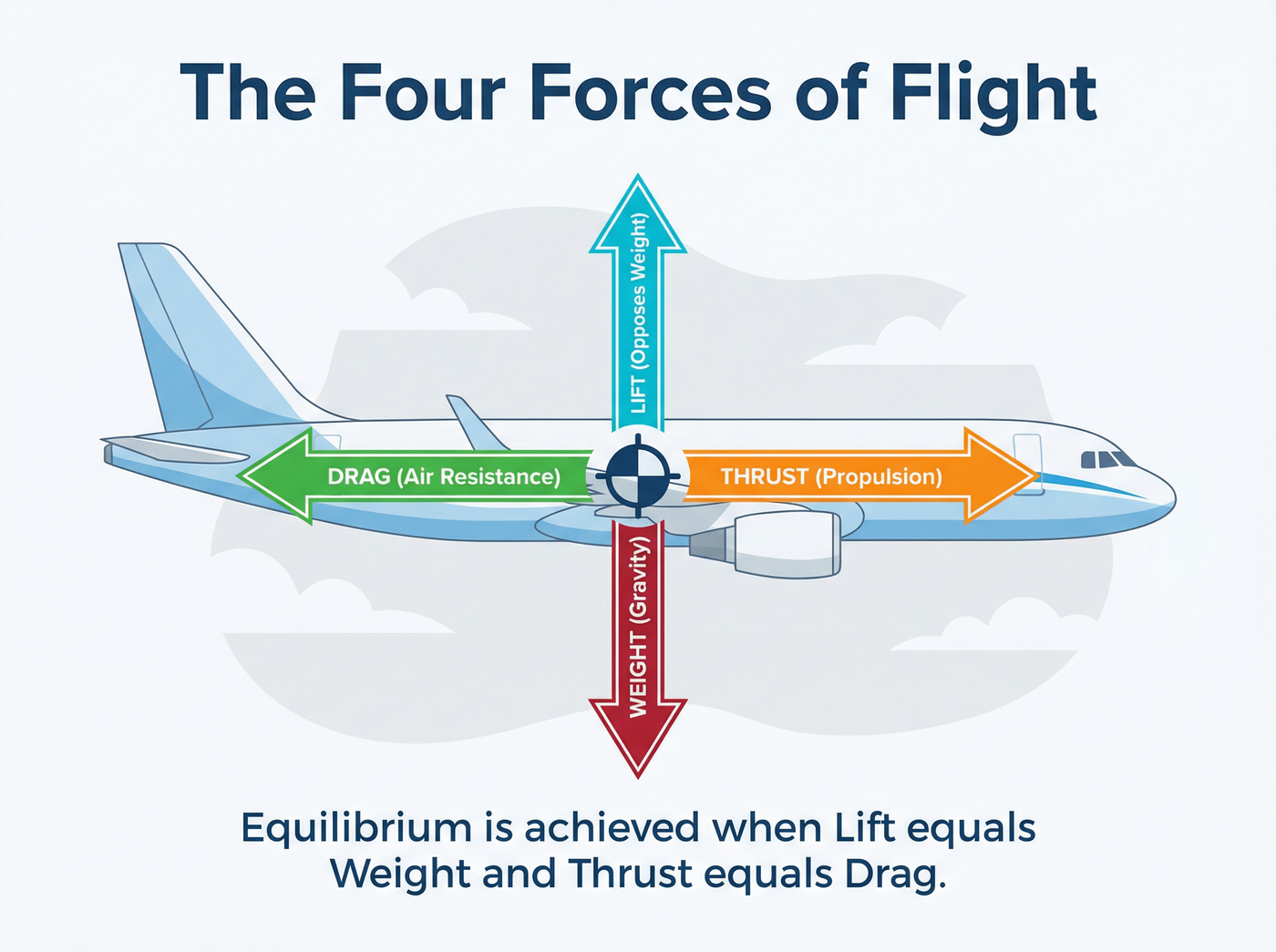
While the hand analogy explains lift, sustaining flight requires balancing four distinct forces. A plane doesn't just float; it is locked in a constant varying struggle between these physical laws.
1. Lift
As discussed, lift is the force that opposes the weight of the airplane and holds it in the air. It is generated by the motion of the airplane through the air.[5] It acts perpendicular to the flight direction.
2. Weight
This is the force of gravity pulling the aircraft toward the center of the Earth. To fly, an aircraft must generate enough lift to cancel out its own weight.
3. Drag
Remember the resistance you felt on your hand even when it was flat? That is drag. It is the aerodynamic friction of moving through a fluid (yes, air is considered a fluid in physics). Drag acts parallel to the airflow and tries to slow the airplane down.[6]
4. Thrust
To overcome drag, you need forward energy. Thrust is the force produced by the plane's engines—whether they are propellers or jet turbines. Thrust pushes the aircraft forward, maintaining the speed required for the wings to generate lift.[2]
Why Engines Matters: Combating Drag
A common misconception is that engines push the plane "up." In reality, engines push the plane forward. The wings are responsible for the "up."
Thrust serves two crucial purposes:
- Overcoming Drag: It fights the air resistance that wants to stop the plane.
- Enabling Lift: Without forward motion, air stops flowing over the wings. If the air stops flowing, lift vanishes, and gravity takes over.
This relationship explains why planes have sleek, streamlined shapes. Engineers design aircraft to minimize drag so that the engines don't have to work as hard to maintain speed. It also explains why pilots use things like "flaps" during landing—they intentionally change the shape of the wing to create more drag and lift simultaneously, allowing the plane to fly slower without falling out of the sky.[1]
The Shape of the Wing: The Airfoil
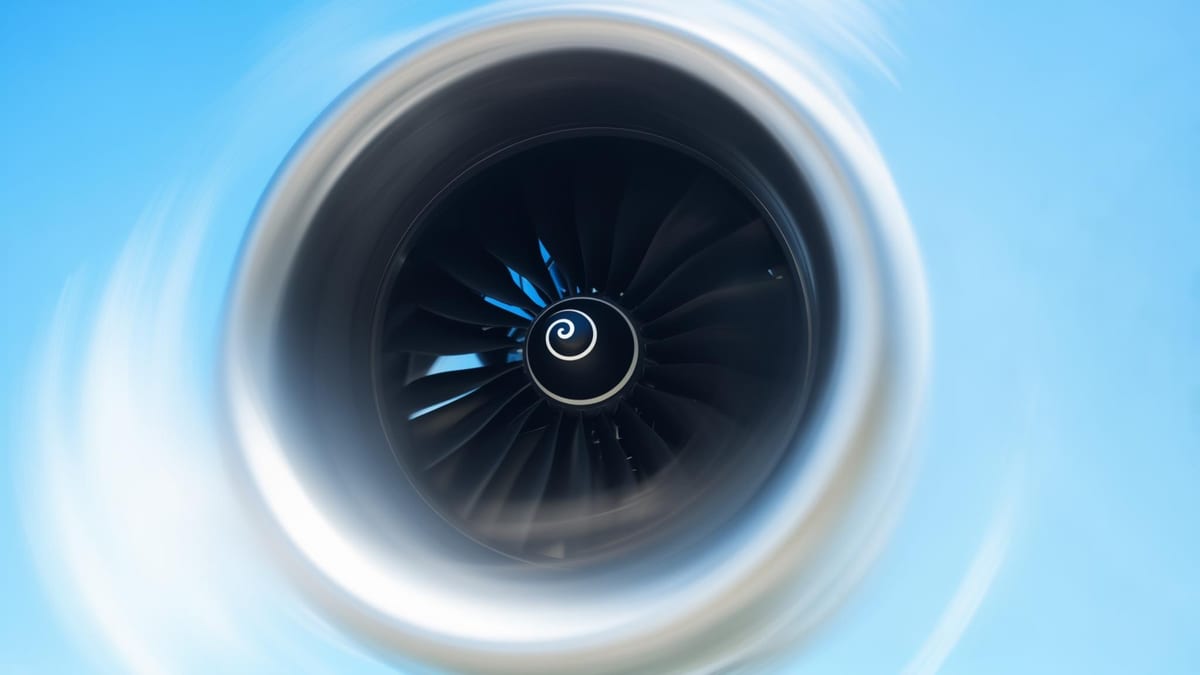
While a flat board (or a hand) can generate lift if tilted, it isn't very efficient. Airplane wings use a special shape called an airfoil—curved on the top and flatter on the bottom. This shape takes advantage of Bernoulli's Principle, which states that faster-moving air has lower pressure.
Because of the curve, air traveling over the top of the wing has to move faster than the air below it. This creates lower pressure above the wing and higher pressure below it, effectively sucking the wing upward. While physicists often debate the exact ratio of contribution between Bernoulli's pressure differences and Newton's deflection of air, the consensus is that both principles work in tandem to keep you safe in the sky.[6]
Listen to the episode
Want to hear more about the invisible forces that keep us airborne? Listen to the full explanation in our latest episode below.
ELI5: How Do Airplanes Stay Up in the Sky?