

The High-Stakes Biological Market
To truly understand the natural world, we must zoom out from individual plants and animals to view the planet as a series of overlapping, high-stakes markets. Far from a peaceful garden, nature is a brutal and efficient economy. In this system, the ultimate currency is carbon, and the penalty for bankruptcy is extinction. By shifting our perspective to population dynamics, we uncover how every organism operates like a corporate entity within a vast supply chain.
- The biological economy: Ecosystems function under strict rules where species must manage energy and resources to survive.
- Niches as professions: A biological niche is not an address but a highly specialized professional job description that prevents direct conflict.
- The 10 percent rule: Energy flows in a one-way street, losing 90 percent of its power at every tier of the food web.
- Matter cycles indefinitely: While energy dissipates, raw materials like carbon and nitrogen are infinitely recycled through the planetary plumbing system.
Populations as Corporate Entities
When ecologists examine a population, they are entirely focused on a collective unit of the same species living in a specific area. A population of grey wolves in a national park operates as a single cohesive entity that expands, shrinks, and shifts based on the availability of its assets. But populations never exist in a vacuum. The moment a second population is introduced, such as the elk the wolves hunt, the framework scales up into community ecology. A community is the sum of all populations in a habitat, defined heavily by how these distinctly different groups interact, compete, and stabilize one another [1].
The Biological Niche: What is Your Profession?
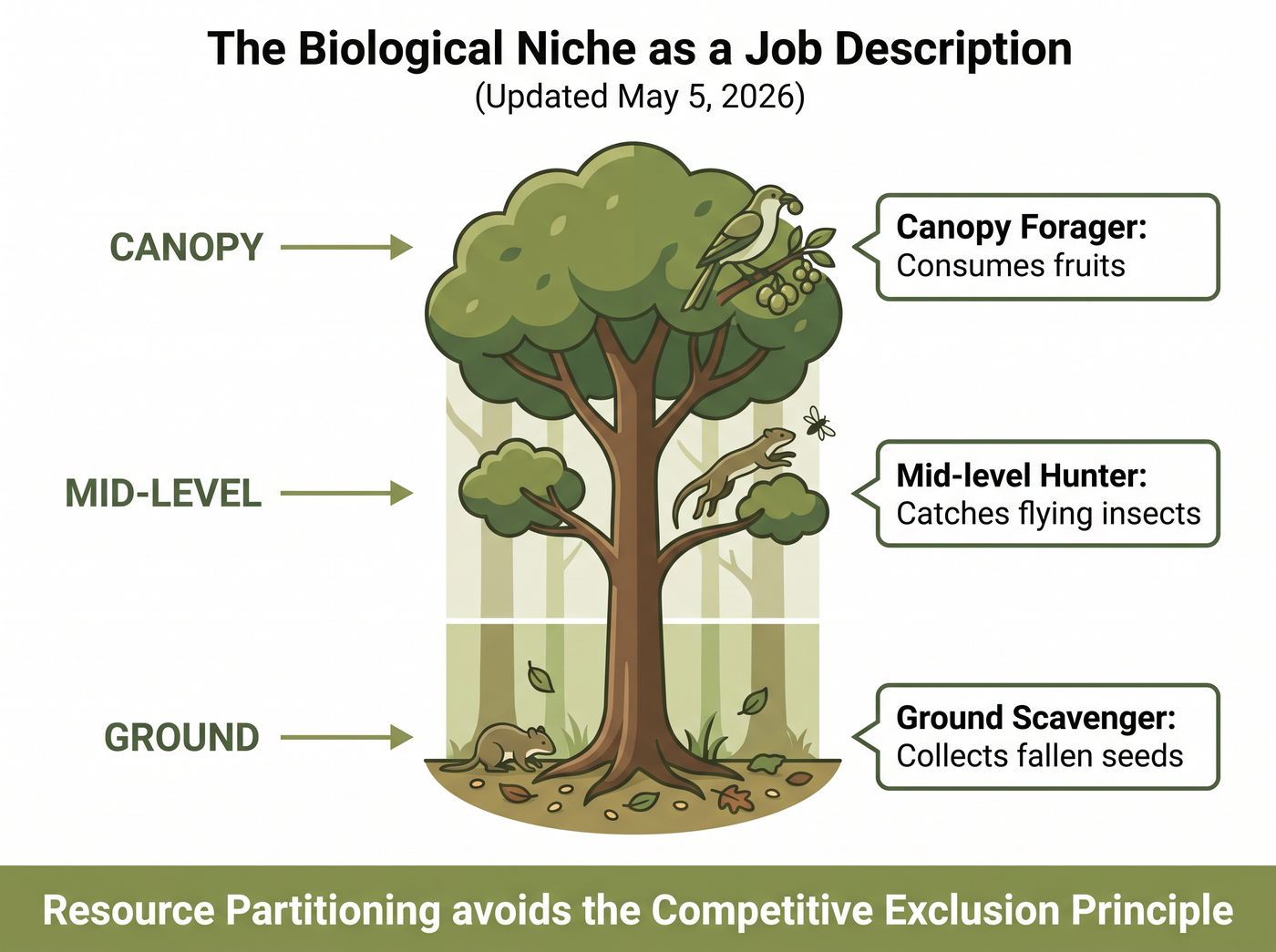
The term "niche" is frequently misunderstood by the general public as merely a physical place, such as a hollow log or a specific patch of forest. In modern ecology, a niche is actually a comprehensive professional job description. It encompasses everything a species needs to survive: its exact active hunting hours, its temperature tolerances, and its highly specific dietary requirements.
This brings us to the Competitive Exclusion Principle. This fundamental rule dictates that no two species can occupy the exact same role within the same environment. If they attempt to perform identical professional tasks, direct competition will invariably lead to one species being out-competed and pushed toward local extinction. To avoid this localized warfare, nature utilizes resource partitioning. By subtly splitting their job responsibilities, such as one bird eating seeds from the canopy while another consumes the fallen leftovers, species create distinct sub-niches. This reduces direct conflict and allows incredible biodiversity to thrive in overlapping physical spaces.
Beyond the Simple Food Chain
Textbooks often rely on the simplistic concept of a linear food chain, showing energy moving neatly from grass to rabbit to fox. However, this model fails to capture the chaotic and intricate reality of environmental interactions. Nature relies on a messy, multi-dimensional web. These webs are organized by trophic levels, which represent the hierarchical positions organisms occupy based on how they acquire energy [6].
The foundation of every food web is the primary producer tier, which consists mostly of plants and phytoplankton. They hold a unique market monopoly because they are the only organisms capable of capturing solar radiation and turning it into organic chemical energy. Without these autotrophs, the entire system would collapse almost instantly [3]. Interestingly, primary producers only capture about 1 percent of the sunlight that hits the Earth, yet this tiny fraction powers the rest of the terrestrial globe [3].
This flow of energy carries a brutal thermodynamic cost. Moving energy through lower and higher tiers follows the 10 percent rule. On average, only about 10 percent of the energy stored in one trophic level is passed up to the next. The remaining 90 percent is lost to the environment as heat, movement, or metabolic waste [2][3].
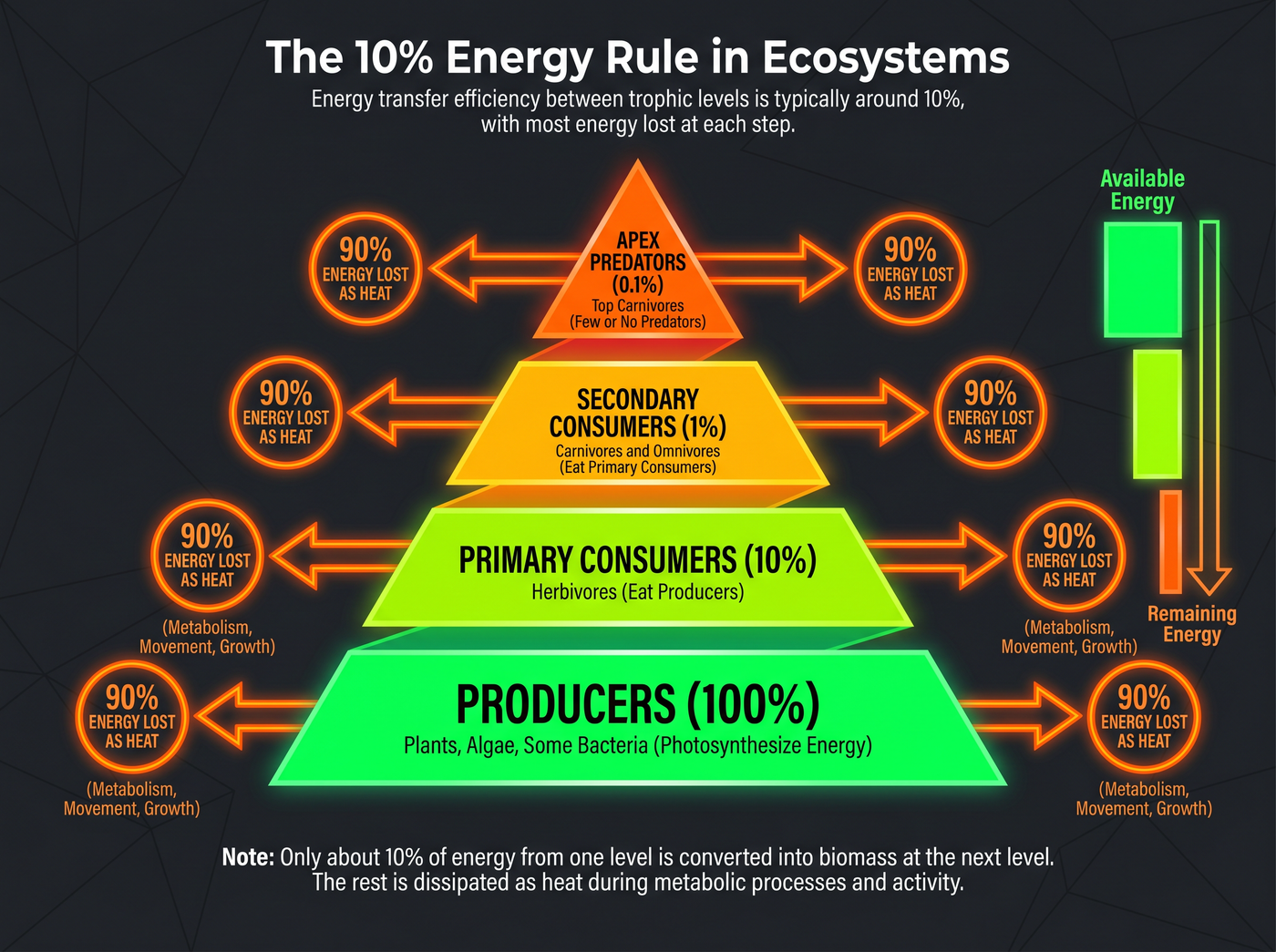
This immense energy loss explains why large apex predators are relatively rare compared to populations of insects or grasses. Ecologically speaking, the environment simply does not have enough capital in its energy budget to support a massive population of top-tier carnivores.
The Plumbing of the Planet: Cycling Matter
While energy flows through a system in a one-way street, matter behaves differently. Matter is recycled. The atoms making up biological life today have been cycling through the planet for millions of years. This is driven by biogeochemical cycles, most notably the carbon and nitrogen cycles [4][5].
Carbon moves between the atmosphere and the terrestrial world through photosynthesis and respiration. When an animal eats a plant, it temporarily borrows that carbon to build its own tissues. When that animal eventually dies and decomposes, the carbon returns to the ecosystem. Meanwhile, the nitrogen cycle acts as the building material provider. Every strand of DNA requires nitrogen, yet most global nitrogen is stuck in the atmosphere as an unusable gas. Ecosystems rely on a hidden workforce of specialized soil bacteria to fix this gas into a usable format, highlighting how microscopic processes completely dictate macroscopic outcomes [4].

Listen to the Episode
Ready to rethink the way you view the natural world? Deep-dive into population dynamics, the truth about ecological stability, and the fascinating ways species avoid the sting of direct competition. Listen to the full episode on Ecosystems, Food Webs, and the Cycling of Matter.
Sources
- Community Ecology: Thinking in Interaction Graphs, Energy Budgets, and Recoveries
- Ecology of Ecosystems and Energy Flow in Food Webs
- Energy Flow Through Ecosystems
- Nutrient Cycles in Ecosystems
- Understanding Ecosystem Ecology: The Dynamics of Energy Flow and Nutrient Cycling
- Trophic Interactions: Understanding the Flow of Energy in Ecosystems