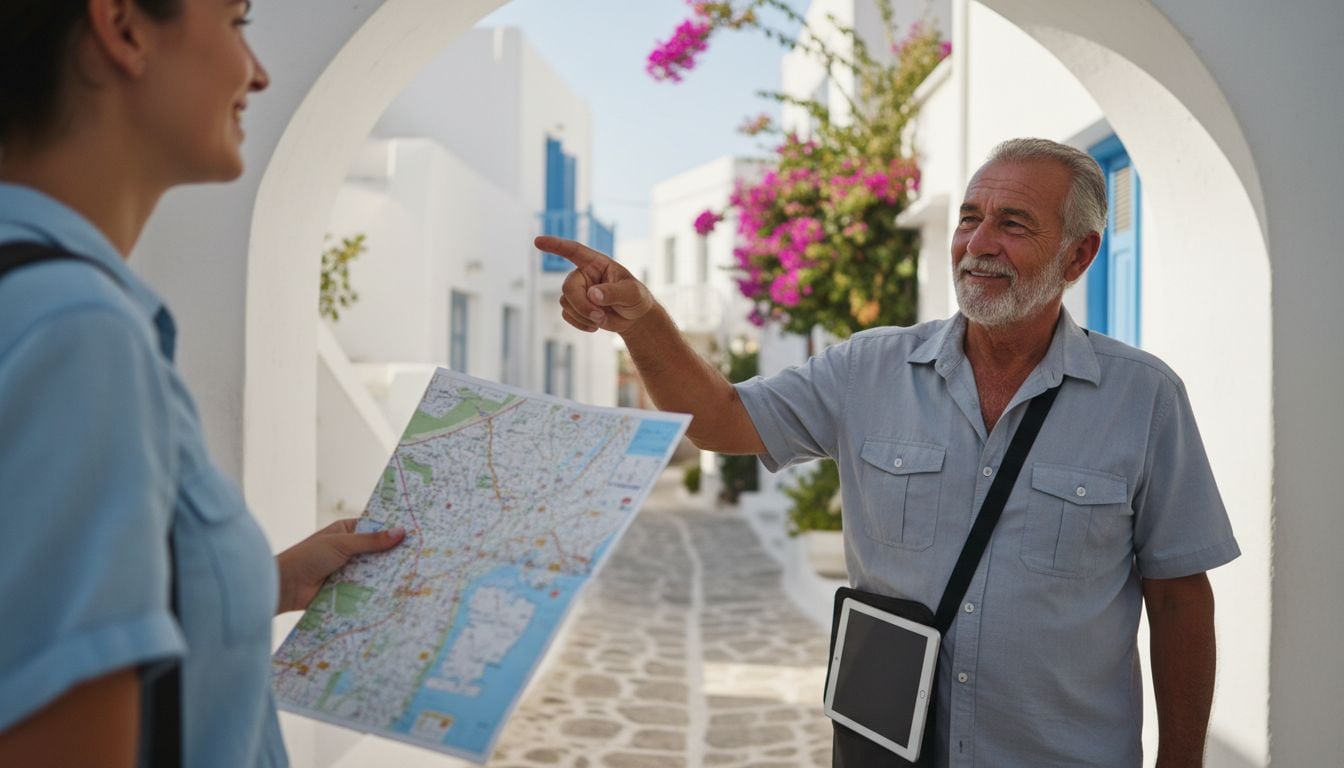
Getting lost in a foreign city can be a serendipitous adventure, or it can be a source of frustration—especially when time is tight. For travelers in Greece, the ability to navigate goes beyond simply following a digital map; it represents a genuine opportunity to connect with locals. While GPS technology is ubiquitous, mastering the art of asking for directions in the local language remains a vital skill for immersive travel [5].
Whether you are wandering the labyrinthine streets of Plaka or trying to catch a bus in Thessaloniki, knowing a few key Greek phrases can transform your experience. Today, on Friday, March 13, 2026, we explore the essential vocabulary and cultural etiquette required to navigate Greece with confidence. From understanding spatial anchors like strict lefts and rights to the politeness markers that soften your requests, this guide brings the latest episode of pody.fm directly to your travel toolkit.
The Art of Asking: Politeness First
In many cultures, including Greece, jumping straight into a question can be perceived as abrupt. To bridge the communication gap effectively, you must employ a "buffer phrase"—a polite opener that signals your intent to ask for assistance without intruding [2].
The magic word in Greek is Συγνώμη (Sygnómi). It translates to "Excuse me" or "Sorry." Once you have the listener's attention, you can proceed with the standard question formula: Πού είναι...; (Poú íne...?), which means "Where is...?".
For example, if you are looking for the nearest train station, the full sentence would be:
Συγνώμη, πού είναι ο σταθμός; (Sygnómi, poú íne o stathmós?)
Spatial Anchors: Left, Right, and Straight
Once you have asked the question, the challenge shifts to understanding the answer. Navigational instructions in any language, including Greek, rely on what linguists call "spatial anchors"—fixed points of reference [4]. Recognizing these three core words is fundamental to finding your way:
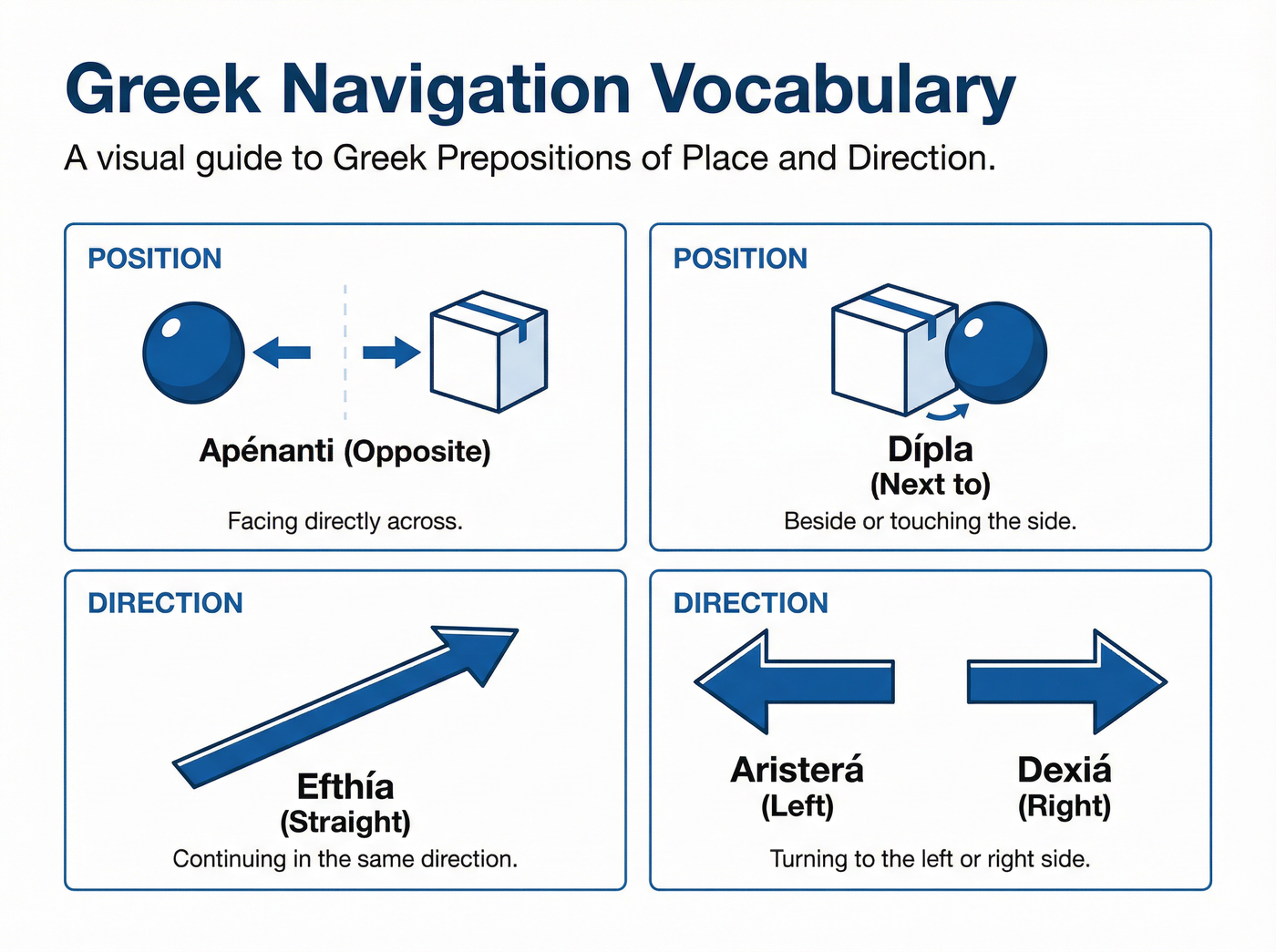
Αριστερά (Aristerá) Left. Listen for the stress on the last syllable. Δεξιά (Dexiá) Right. This is distinct from the English "dexterity," though they share a root. Ευθεία (Efthía) Straight. Often accompanied by a hand gesture pointing forward.Hearing these words in context is often enough to get you moving in the correct general direction, even if you miss the rest of the sentence details.
Using Landmarks and Prepositions
Greek locals are less likely to give you precise distances (e.g., "walk 100 meters") and more likely to reference notable buildings or landmarks. This "landmark-based" navigation requires you to know a few prepositions of place.
Two essential terms to keep in your vocabulary are:
- Απέναντι (Apénanti): Meaning "opposite" or "across from." You might hear, "Απέναντι από το φαρμακείο" (Opposite the pharmacy).
- Δίπλα (Dípla): Meaning "next to." For instance, "Δίπλα στο φούρνο" (Next to the bakery).
Public Transport Vocabulary
When walking isn't an option, you will need to rely on Greece's public transport network. Whether you are in Athens using the metro or on an island taking a local bus, specific vocabulary is required to purchase fares and identify vehicles.
Key Essential Terms
- Το λεωφορείο (To leoforío): The bus.
- Το τρένο (To tréno): The train.
- Το εισιτήριο (To isitírio): The ticket.
To buy a ticket, you can use the phrase: Θέλω ένα εισιτήριο (Thélo éna isitírio), which simply means "I want a ticket." Be prepared to hear numbers in reply, such as the price. A common fare might be expressed as "Ένα ευρώ και είκοσι λεπτά" (One euro and twenty cents).

Listen to the episode
Ready to hear these phrases pronounced by native speakers and practice with interactive drills? Listen to the full episode below to perfect your accent and build your confidence.
Directions & Travel: Getting Around in Greek