
Have you ever felt that your Norwegian sentences sound a bit "robotic" or translated directly from English? You likely have the right vocabulary, but the rhythm is off. This often comes down to one fundamental principle: the V2 rule. Think of the verb as the "heartbeat" of the sentence—it anchors everything else.
Today, we explore how to combine essential daily routine vocabulary with strict word order rules to help you sound less like a textbook and more like a local.
Listen to the episode
Daily Routine & Word Order: V2 Rule and Speaking Naturally
The Unmovable Anchor: Understanding the V2 Rule
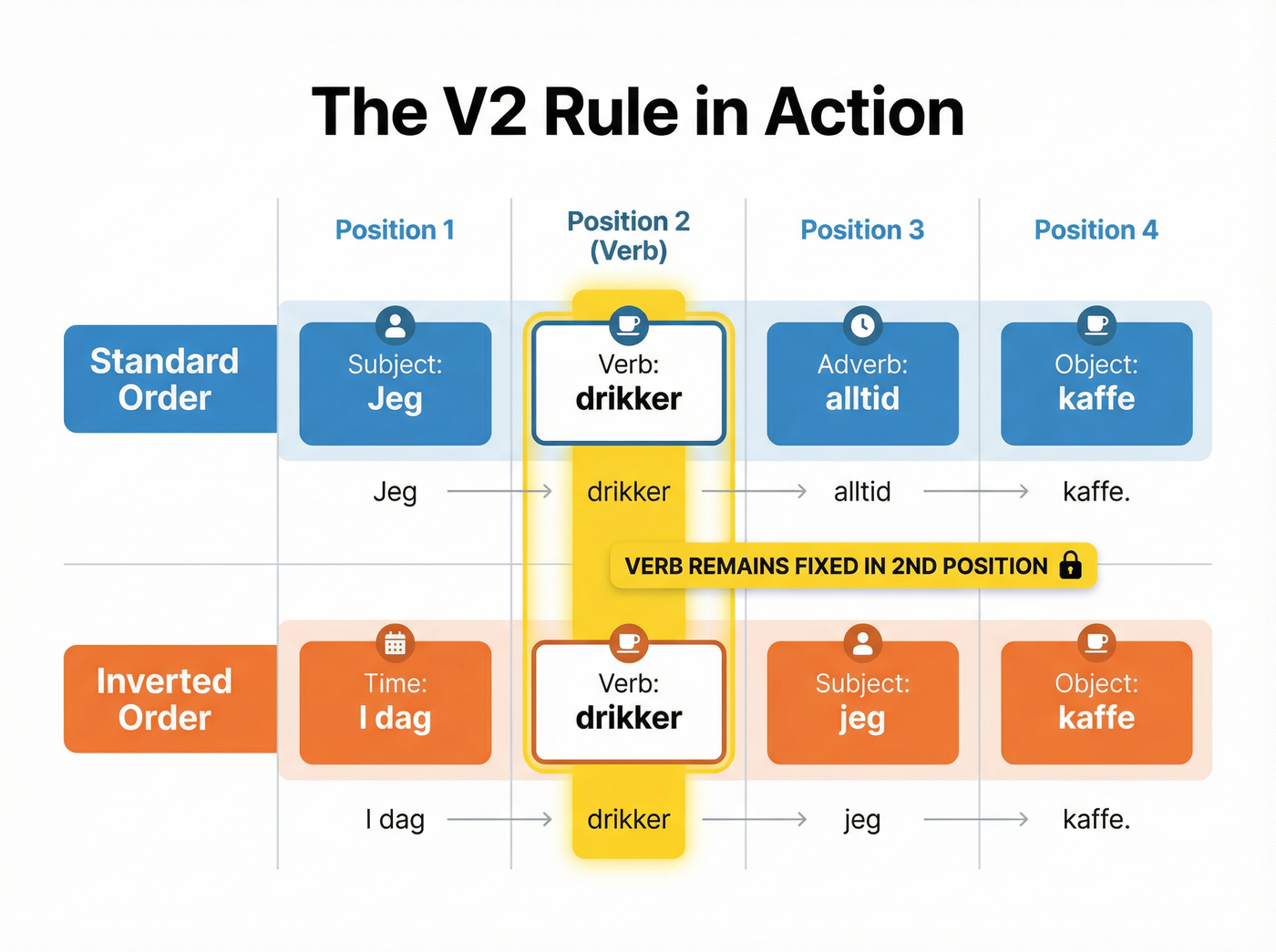
The most critical concept in Norwegian syntax is the V2 (Verb Second) rule. In almost every declarative main clause, the finite verb must appear in the second grammatical position.[1] This does not necessarily mean it is the second word, but rather the second element.
In English, word order is relatively flexible, often following a Subject-Verb-Object pattern even when extra words are added. In Norwegian, however, the verb is rigid. If you move other parts of the sentence around, the verb stays put, and everything else must pivot around it.
For example:
- Jeg våkner. (I wake up.)
- Jeg spiser frokost. (I eat breakfast.)
In these simple sentences, the subject (Jeg) is position one, and the verb (våkner/spiser) is position two. This mirrors English structure perfectly. The challenge—and the fun—begins when we add more detail.
Essential Daily Routine Vocabulary
To practice these grammar rules, you need concrete actions. Describing your morning routine is one of the best ways to drill sentence structure because the actions are sequential and repetitive.
Here are common verbs to get you started:
Jeg våkner (pronounced: yay vawk-ner) I wake up. Jeg står opp (pronounced: yay stawr op) I get up / stand up. Jeg dusjer (pronounced: yay doo-sher) I shower. Jeg lager kaffe I make/brew coffee.Placing Frequency Adverbs: The Logic of "Alltid" and "Ofte"
A common mistake for English speakers is placing the adverb before the verb (e.g., "I always drink coffee"). In Norwegian main clauses, the adverb effectively never comes between the subject and the verb. Because the verb demands the second spot, the adverb is pushed to the third position.[3][5]
Let’s look at the correct structure using alltid (always), ofte (often), and aldri (never):
- Incorrect (English style): Jeg alltid drikker kaffe.
- Correct (Norwegian V2): Jeg drikker alltid kaffe. (Literally: I drink always coffee.)
- Correct: Jeg dusjer ofte om morgenen. (I shower often in the morning.)
- Correct: Jeg spiser aldri frokost. (I never eat breakfast.)
This "Verb first, Adverb second" sequence is a hallmark of fluent speech. Mastering it prevents your sentences from sounding disjointed.
Mastering Inversion: Starting with Time
To sound truly natural, you shouldn't start every sentence with "Jeg" (I). Native speakers vary their sentence structure by placing time expressions or locations at the beginning. This creates flow and emphasizes when something happens.
However, when you move a time phrase like Om morgenen (In the morning) to the front (position one), the verb must still be in position two. This forces the subject (jeg) to move to position three. This is called inversion.[1][4]
Consider this transformation:
- Standard: Jeg drikker kaffe om morgenen. (Subject - Verb - Object - Time)
- Inverted: Om morgenen drikker jeg kaffe. (Time - Verb - Subject - Object)
If you were to say "Om morgenen jeg drikker kaffe," it would be grammatically incorrect because the verb drikker would be in the third position.

Practice Drills
Try switching up your sentence starters to practice this flexibility. Instead of listing habits starting with "I," try starting with the time:
- Nå spiser jeg. (Now I am eating.)
- Klokken fem drar jeg hjem. (At five o'clock, I go home.)
- I dag trener jeg. (Today I am exercising.)
Summary
The secret to Norweigan sentence structure lies in respecting the verb's position. Whether you are describing a simple habit like showering or explaining your entire daily schedule, keep the verb anchored in the second spot. If you start with a time phrase, remember to invert the subject and verb. It may feel strange at first, but with practice, this rhythm will become second nature.