

Do you feel like your Greek sounds a bit robotic? You aren't alone. Many learners master the basics of vocabulary but get stuck using rigid sentence structures that don't quite match how native speakers talk. To bridge the gap between textbook Greek and real life, you need to master three things: core daily verbs, the rhythm of adverbs, and the art of flexible word order.
Today, we dive into the specific vocabulary and grammatical nuances that will help you describe your day with natural flow and confidence.
Mastering the Morning Verbs
To describe your life, you need the right building blocks. In Greek, the verbs we use for morning activities often requires specific biological stress patterns or reflexive forms. Here are the three essentials covered in this episode:
- To wake up: Ξυπνάω (Xypnáo). Listen carefully to the stress—it falls on the second syllable.
- To wash: Πλένομαι (Plénome). This is a reflexive verb, meaning the action is performed on oneself.
- To work: Δουλεύω (Doulévo). The cornerstone of most daily schedules.
Once you are comfortable with these verbs, you can move beyond simple statements like "I wake up" and start building a narrative about your lifestyle.
Adding Frequency using Adverbs
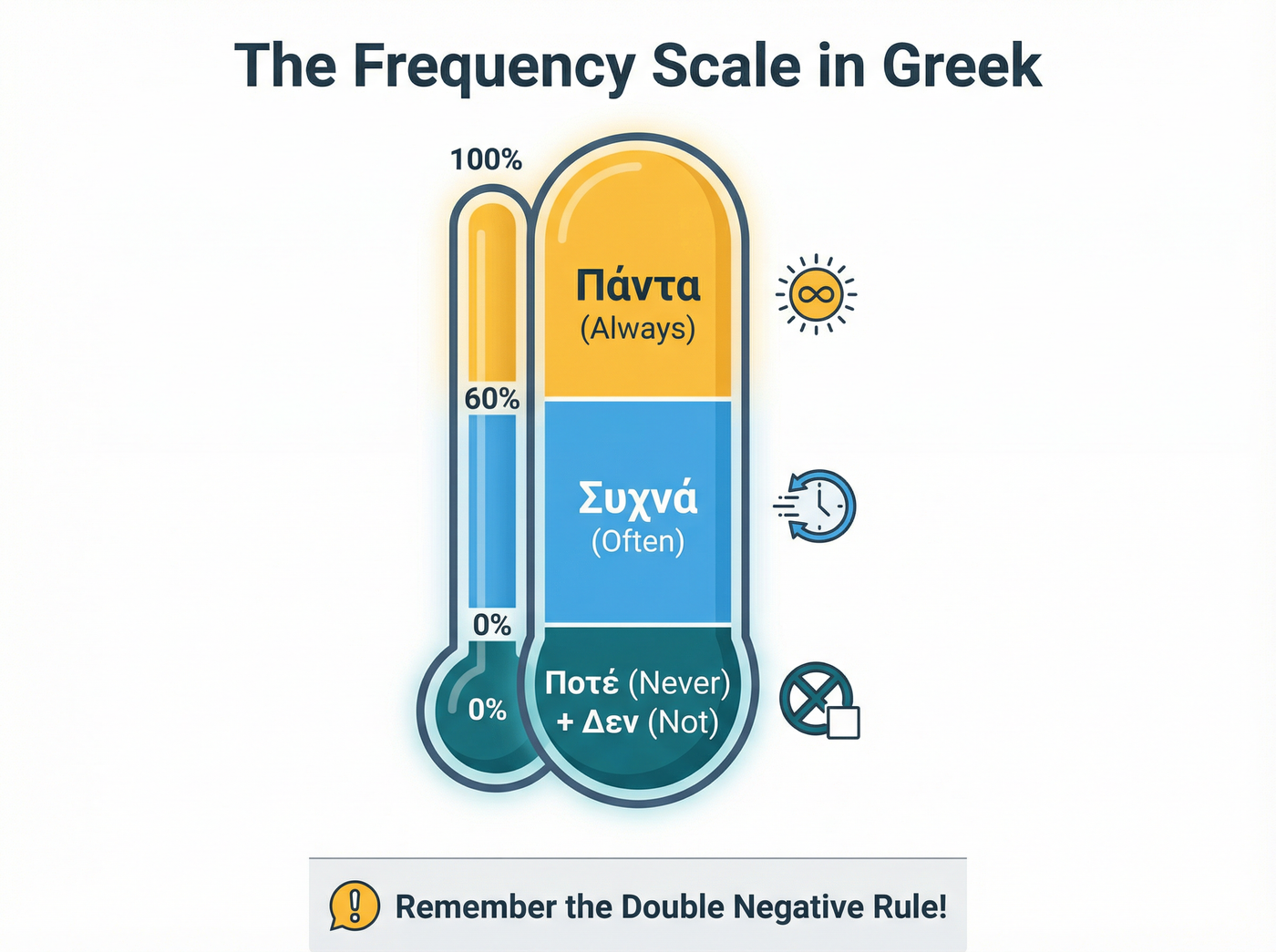
To turn a list of actions into a story, you need adverbs of frequency. These words act as a scale, indicating how often a habit occurs. In general linguistics, these adverbs range from 100% frequency (always) down to 0% (never)[2].
Here is how that scale looks in Greek:
- Always: Πάντα (Pánta)
- Often: Συχνά (Sychná)
- Never: Ποτέ (Poté)
The Rule of Double Negation
Greek grammar has a strict requirement that often trips up English speakers: the double negative. If you want to say you "never" do something, you cannot simply use the word poté. You must also include the negative particle den before the verb.
For example, to say "I never work," the correct phrase is: "Δεν δουλεύω ποτέ" (Den doulevo pote). Omitting the standard negative marker would make the sentence sound incomplete to a native ear.
Flexible Word Order: The Secret to Natural Speech
Perhaps the most exciting difference between English and Greek is word order. English syntax is notoriously rigid, relying heavily on a strict Subject-Verb-Object structure to convey meaning[5]. In English, we usually place adverbs of frequency directly before the main verb (e.g., "I always wake up").
Greek, however, offers delightful flexibility. You can shift the position of the adverb to change the emphasis of the sentence without breaking grammatical rules.
Consider these two variations:
- Emphasis on the habit: "Πάντα ξυπνάω στις οκτώ" (Pánta xypnáo stis októ). By placing "always" first, you highlight that this is a non-negotiable rule.
- Emphasis on the action: "Ξυπνάω πάντα στις οκτώ" (Xypnáo pánta stis októ). Here, the focus shifts slightly to the act of waking up itself.

Learning to move these words around prevents your speech from sounding monotonous. It allows you to speak with the same nuance and cadence as a local, highlighting exactly what matters most in your sentence.
Listen to the episode
Ready to hear these examples in action? Listen to the full episode to practice your pronunciation and get a feel for the rhythm of these sentences.
Daily Routine & Word Order: Speaking More Smoothly