
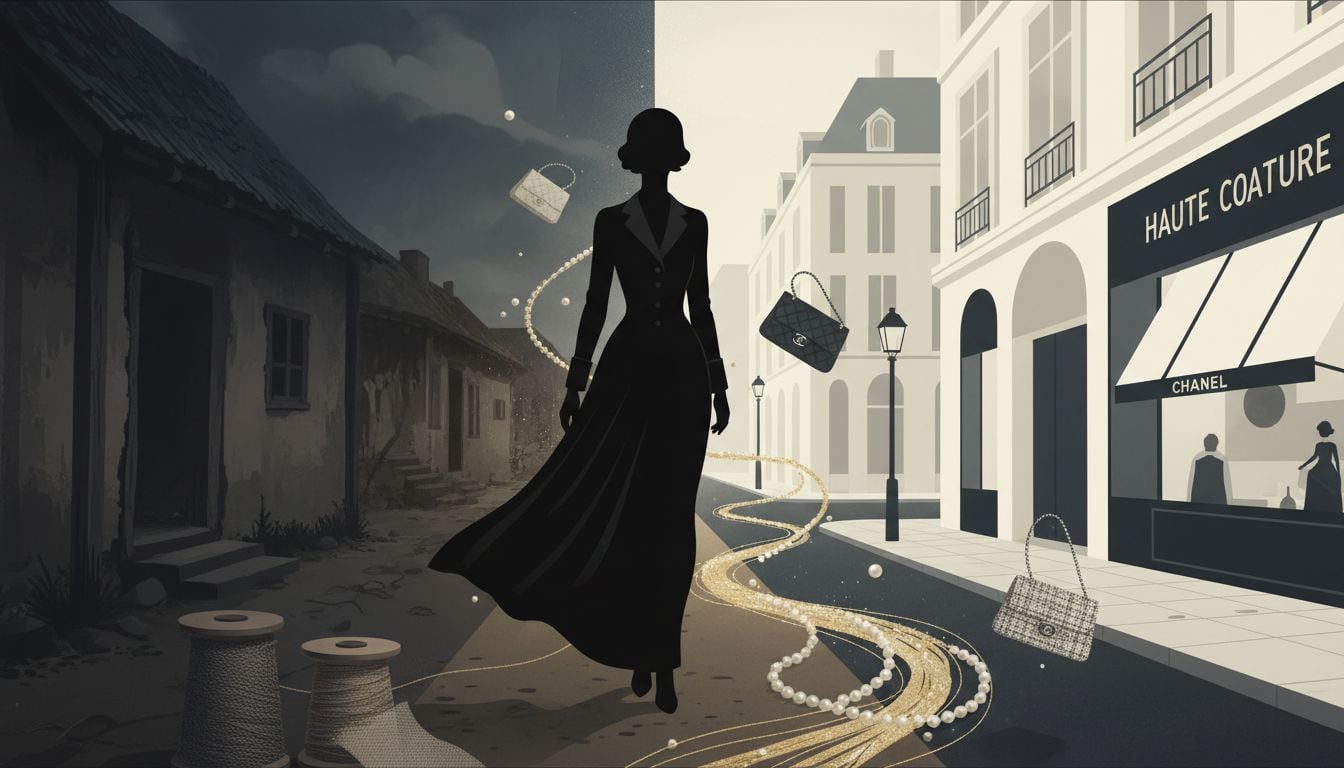
When we see the interlocking Cs of the Chanel logo today, we immediately think of unparalleled luxury, Parisian chic, and timeless elegance. Yet, the woman behind the empire, Gabrielle "Coco" Chanel, constructed her life on a foundation of carefully crafted myths designed to obscure a tragic and impoverished past. Her journey from a rural poorhouse to the pinnacle of high society is not just a rags-to-riches story; it is a masterclass in self-invention that fundamentally altered the 20th century.
In this deep dive, we explore how an orphan’s austere upbringing created the visual DNA of modern fashion, and how a controversial legacy of wartime collaboration complicates the story of the woman who liberated the female silhouette.
The visual DNA of an orphan
The legend of Coco Chanel is often polished to a high shine, but the reality began in the jagged landscape of the Auvergne region in France. Born in 1883 in a charity hospital to a laundrywoman and a street vendor, Gabrielle Chanel’s early life was defined by hardship. Following her mother's death, her father abandoned her at the Aubazine Abbey, a Cistercian monastery that functioned as an orphanage.[1]
It was within these cold stone walls that the Chanel aesthetic was born. The nuns who raised her wore austere black-and-white habits, a stark contrast that would later become the hallmark of her brand’s identity. Furthermore, the geometric patterns found in the abbey’s stained glass windows are widely believed to have inspired the interlocking logo that would one day adorn handbags and perfume bottles globally.[1] Chanel took the symbols of her poverty and discipline—simplicity, functionality, and a lack of ornamentation—and transformed them into the ultimate signifiers of chic.
From cabaret to corsets: The birth of a revolutionary
Before she was a couturiére, she was a singer. In her early twenties, Gabrielle attempted to make a living in the cabarets of Moulins and Vichy. It was here, performing for a crowd of soldiers, that she acquired the moniker "Coco"—likely referencing the popular songs she sang.[2] While her singing career never took flight, this period was crucial for developing the magnetic charisma that would later help her charm her way into the French elite.
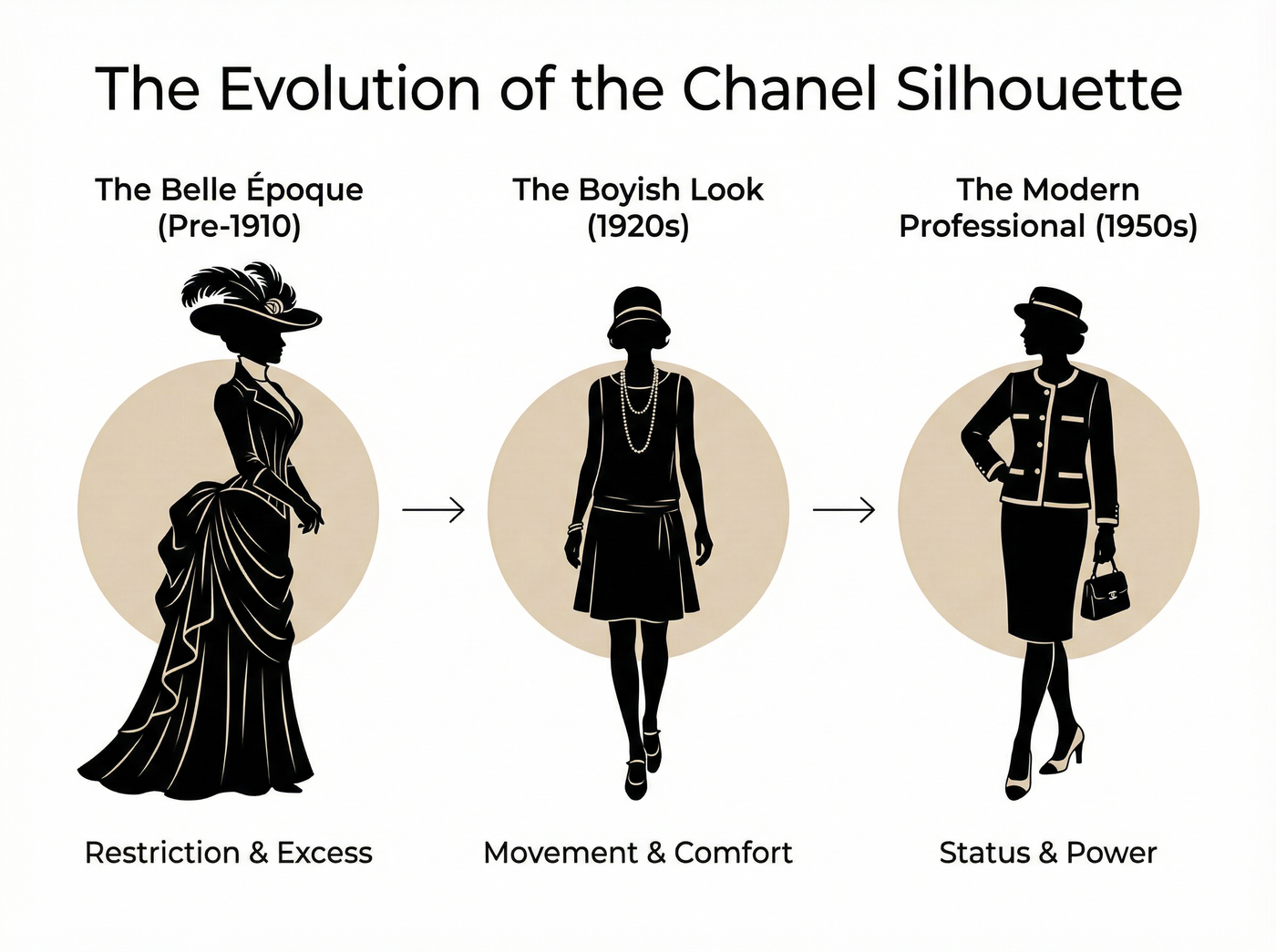
Her entry into the upper echelons of society came through her relationships with wealthy men, notably Etienne Balsan. Living at his estate, Chanel began to subvert the fashion norms of the "Belle Époque." She borrowed items from the male wardrobe, wearing breeches and loose jackets that stood in sharp defiance to the restrictive corsets and ornate gowns of the era. This was the spark of her design philosophy: liberation through subtraction.
The fabric of freedom
Chanel’s business genius lay in her ability to turn necessity into luxury. During World War I, when traditional luxury fabrics were scarce, she cornered the market on jersey, a pliable textile previously reserved for men’s underwear.[4] Using jersey allowed Chanel to create garments that draped beautifully and allowed women to move, drive cars, and participate in sports comfortably.
By 1926, she had introduced the Little Black Dress (LBD). American Vogue famously dubbed it the "Ford" of fashion—promising it would become a uniform for all women of taste.[2] She had effectively democratized elegance, proving that luxury did not require feathers or frills, but rather a perfect cut and an attitude of confidence.
The shadows of occupation
The narrative of Chanel as a feminist icon hits a darker, more complicated chapter during the 1930s and 40s. As Europe descended into World War II, Chanel’s actions became deeply entangled with the Nazi occupation of Paris. She resided at the Hotel Ritz, which served as the German headquarters, and engaged in a romantic relationship with Baron Hans Günther von Dincklage, a German officer.
Recent historical research and declassified documents have scrutinized her role as an operative for the Abwehr (German military intelligence).[6] Evidence suggests she was involved in "Operation Modelhut," a mission that aimed to use her personal connection to Winston Churchill to broker a separate peace.[3] Furthermore, she attempted to use Aryan laws to seize control of her perfume business from her Jewish partners, the Wertheimer family.[6]
While she was never officially charged after the liberation of Paris—spending the subsequent years in exile in Switzerland—this period remains a stark contradiction to the fierce independence she projected throughout her life. It serves as a reminder that the "outsider" narrative she cultivated allowed her to survive, but arguably at a significant moral cost.
The comeback and enduring legacy
In 1954, at the age of 71, Chanel staged a remarkable comeback. While the French press was unforgiving of her wartime activities, the British and American markets embraced her return. They were hungry for the Chanel Suit—the collarless tweed jacket and slim skirt that would become the uniform of the modern working woman.[4]
Today, as of Saturday, January 24, 2026, Chanel remains one of the few global luxury houses that is still privately held, maintaining the allure and secrets of its founder. Gabrielle Chanel proved that luxury must be comfortable, otherwise it is not luxury. She did not just design clothes; she designed a lifestyle and a brand identity so powerful that it could withstand even the darkest controversies of her personal history.
Listen to the episode
Dive deeper into the fascinating and often surprising origins of this global fashion icon in our latest episode. We uncover the profound self-mythology of Gabrielle Chanel and how she rewrote her own history.
Listen to "Coco Chanel: Stitching a Modern Revolution"
Sources
- The true story of Coco Chanel's childhood
- How Global Icon Coco Chanel Reinvented Women's Fashion
- How Coco Chanel embroidered her contradictory life story
- From the Margins to the Core of Haute Couture: The Entrepreneurial Journey of Coco Chanel
- Coco Chanel: From Fashion Icon to Nazi Agent - Harvard Business School