
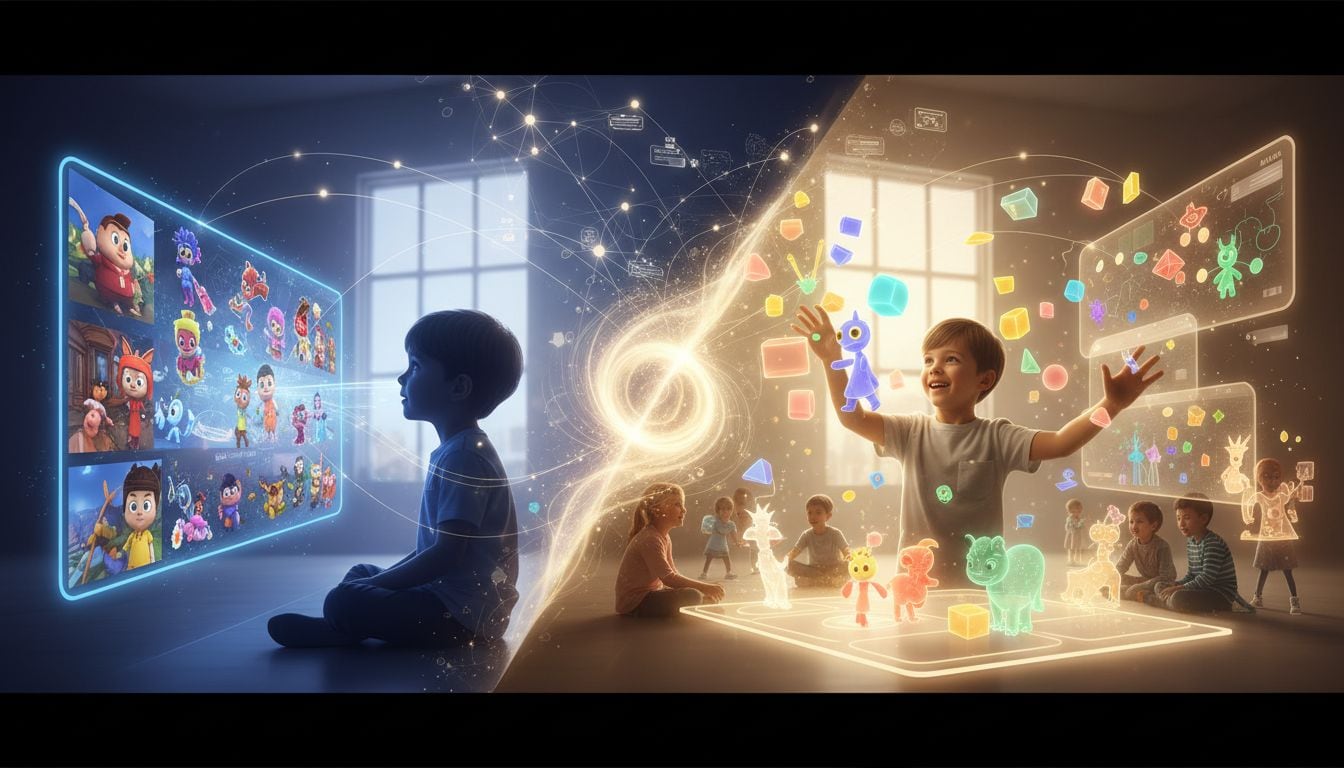
For decades, the concept of a "Netflix for Kids" implied a massive, static library where children could browse endlessly for pre-made content. The model was linear: studios produced the cartoons, and algorithms merely suggested which one to watch next. However, the landscape of children's media is undergoing a seismic shift in 2026. We are moving from an era of passive consumption to one of active algorithmic creation.
Leading this charge are platforms like Pixley AI, which leverage generative artificial intelligence to transform simple inputs—like a text prompt or a child's hand-drawn sketch—into fully animated narratives. This technological leap does not just change how children watch cartoons; it fundamentally alters how they learn, creating a future where education is hyper-personalized and the barrier to content creation is virtually non-existent.
From Passive Viewing to Active Creation
The traditional model of digital entertainment for children relied heavily on recommendation algorithms—typified by platforms like YouTube Kids—which served up content based on click history. While effective at capturing attention, this model often trapped young viewers in passive loops.
The new paradigm, exemplified by startups like Pixley AI, empowers the user to be the creator. Instead of searching for a video that might be relevant, a parent or teacher can now build one that is perfectly tailored. This shift democratizes animation production. Historically, creating a three-minute animated short required a team of illustrators, voice actors, and editors working for weeks. Today, generative AI tools allow for the conversion of static drawings into moving narratives with synchronized audio in minutes.
The Power of Bespoke Education
The most profound implication of this technology lies in personalized learning. In a standard classroom or educational app, the curriculum is static. If a child struggles with long division, they are usually offered the same explanation again, perhaps at a slower pace.
With algorithmic creation, the content adapts to the child's passions. If a student finds math boring but is obsessed with paleontology, the AI can generate a custom cartoon featuring a T-Rex explaining the steps of long division. This is not just a novelty; it is a pedagogical breakthrough. By wrapping difficult concepts in a narrative wrapper that the child already loves, the friction of learning is significantly reduced.
The 'Equivalence Principle' in Virtual Teaching
Is an AI-generated character actually an effective teacher? The science suggests the answer is yes. A pivotal 2025 study published in Education and Information Technologies investigated how children aged three to six responded to AI-generated pedagogical agents (AIPAs). The findings revealed a phenomenon researchers call the equivalence principle.
The study found that children perceived these digital characters with a level of trust and engagement comparable to human teachers. Crucially, in terms of academic outcomes, there was no significant difference in reading performance between children who learned from AI instructors and those who learned from human teachers[1]. This suggests that as these tools become more sophisticated, they can serve as viable, scalable companions in early childhood education.
Navigating the Challenges of AI in EdTech
Despite the promise, the integration of generative AI into the nursery and classroom is not without risks. As we transition from curated libraries to on-the-fly generation, the "human-AI balance" becomes critical. Experts warn that while an AI can tailor a lesson to a skill level, it lacks the emotional intelligence to fully recognize frustration or providing the nuance of care found in human interaction[2].
Furthermore, a child rights audit of GenAI in EdTech has highlighted concerns regarding data privacy and the potential for these tools to prioritize engagement metrics over genuine learning outcomes[3]. There is a risk that tailored entertainment becomes too perfectly engineered to keep the child staring at the screen, rather than encouraging critical thinking.
The role of the educator is evolving from a content curator to a "prompt engineer" and ethical mediator. Pre-service teachers are increasingly being trained to treat AI as a co-creator, learning to guide these systems to produce characters that reflect the diversity and specific needs of their classrooms[5].
The Future of Screen Time
As we look toward the future of media, the distinction between watching and making will continue to blur. The "Netflix for Kids" of the future will not be a catalog; it will be a creative studio. The most successful platforms will be those that use AI not to replace human creativity, but to amplify it—giving every child the power to see their imagination come to life.
Listen to the episode
Building the 'AI Netflix' for Children
Sources
- Can AI-generated pedagogical agents (AIPA) replace human teacher in picture book videos?
- Child-centered integration of generative AI in early learning: balancing promises and challenges
- A child rights audit of GenAI in EdTech: Learning from five UK case studies
- A Study on the Development of an AI-Based Animation Production Instructional Model