
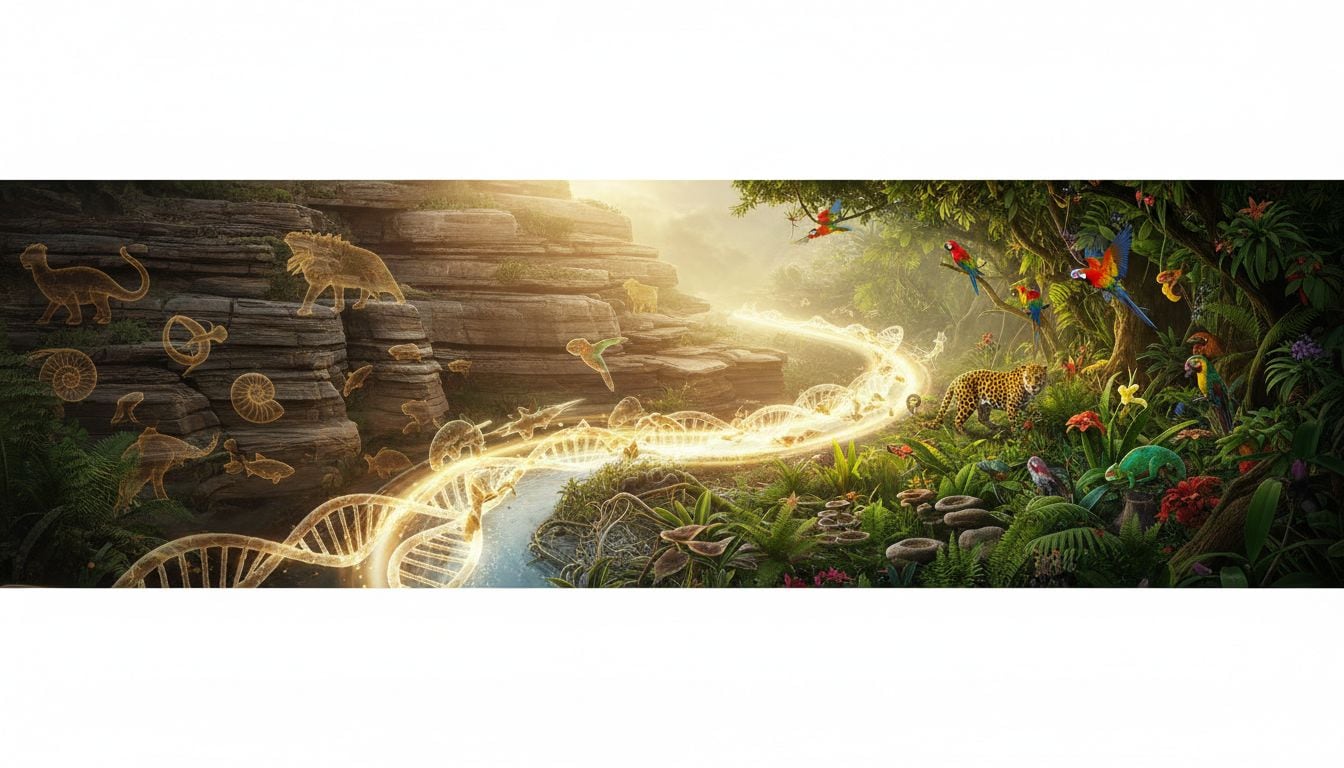
The history of life on Earth is an epic narrative that spans nearly four billion years. It is a story driven less by a static environment and more by a restless, creative tension between the arrival of new forms and the disappearance of old ones. At the core of this system is biodiversity (the dizzying variety of life from microscopic genes to sprawling ecosystems). Biodiversity acts as the living shield that stabilizes our planet, yet today, that shield is thinning at a rate rarely seen in the fossil record. To understand where life is headed as of May 4, 2026, we must examine the mechanisms that build biological resilience and the modern forces threatening to tear it down.
- Natural speciation builds life: Geographic isolation acts as a creative force, naturally allowing distinct species to evolve and adapt to unique environments.
- Extinctions are accelerating exponentially: The planet is currently losing species at a rate 100 to 1,000 times higher than undisturbed historical baselines.
- Genetic erosion is a hidden crisis: A rapid decline in within-population genetic variation leaves surviving species vulnerable to dynamic environmental shocks.
- Ecosystems are humanity's foundation: Global stability heavily depends on complex biological networks for agricultural pollination, water filtration, and climate regulation.
Listen to the Episode
Dive much deeper into the evolutionary mechanisms behind our planet's ecological systems. Listen to the full podcast episode: Biodiversity, Extinction, and the Future of Life on Earth.
The Engine of Life: Speciation vs. Extinction
At the center of global biodiversity is the process of speciation. Speciation is the evolutionary engine where one biological lineage splits into two or more distinct species. This is often driven by geographic isolation. When a population is separated by physical barriers like a rising mountain range or a shifting river, it slowly begins to adapt to its unique surroundings. Over millennia, these subtle genetic tweaks accumulate until the separated groups can no longer interbreed. This moment of separation is the primary source of life's incredible variety.
However, for every species born, another eventually fades away. Extinction is a natural part of the evolutionary cycle. The historical background rate of extinction typically sees about one to five species disappear each year. But humanity has pushed the planet far beyond this baseline. Our current reality is a loss rate estimated to be 100 to 1,000 times higher than the natural norm[3]. Scientists universally refer to this as the Sixth Mass Extinction, and unlike the asteroid impact that ended the age of dinosaurs, the singular driver of this crisis is human activity.
More Than Just Megafauna: The Ecosystem Support System
The decline of biological variety is not merely a tragedy involving charismatic megafauna like pandas and tigers. It is the active unraveling of the Earth's life support system. Every species functions as a worker within a complex web of ecological dependencies. When we lose a species, we do not just lose an animal; we lose a highly specialized functional unit.
Agricultural PollinationInsects pollinate the crops that feed billions of people. Recent data points to a collapse in flying insect biomass (down over 75 percent in some regions), triggering a trophic cascade that actively threatens human food security.Nutrient CyclingComplex networks of fungi and bacteria process organic matter, continually refreshing the soil required for farming and botanical growth.Water FiltrationIntricate wetland ecosystems act as natural purifiers. They safely filter incoming toxins and regulate water tables essential for both surrounding flora and human communities.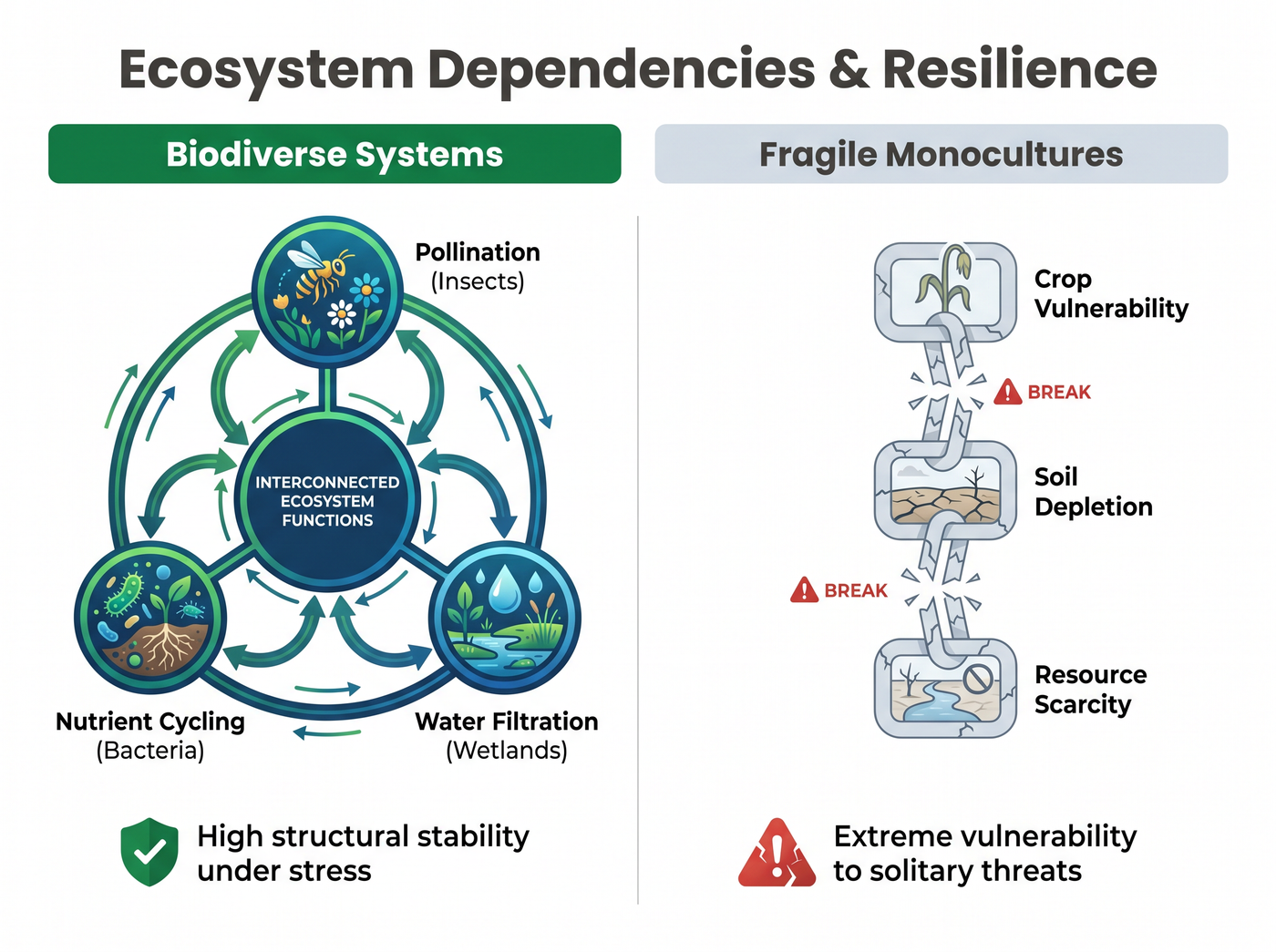
The Invisible Threat: Genetic Erosion
Habitat loss and physical fragmentation remain the most immediate external threats to wildlife. But there is a more microscopic, insidious loss happening simultaneously. A major global meta-analysis published in early 2025 revealed that within-population genetic diversity is declining rapidly across more than 600 evaluated species[4].
High genetic diversity is the raw evolutionary toolkit a species uses to adapt to novel diseases or shifting temperatures. If an animal population becomes genetically uniform, it loses its ability to adapt. As this internal variety vanishes, entire species transition into biological dead ends, unable to evolve their way out of a changing climate. This depletion of internal variety serves as a stark leading indicator of how unstable our biological baseline has become.
Climate Change as a Threat Multiplier
As we navigate 2026, the synergy between habitat destruction and climate change is the defining challenge of modern conservation biology[5]. Climate change acts as an aggressive threat multiplier. It alters the timing of seasonal blooms, disrupts water availability, and pushes pests into new territories.
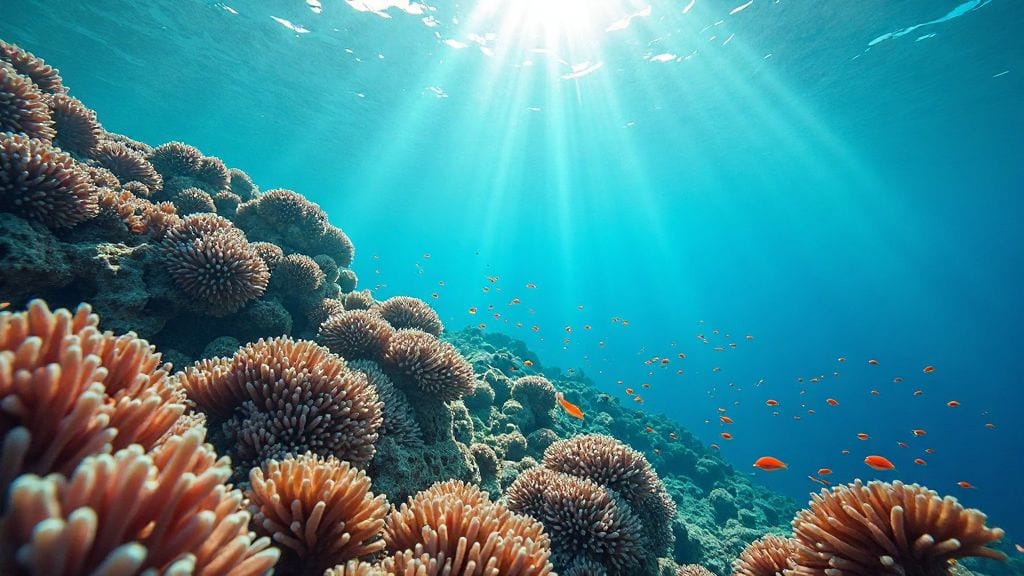
Ocean ecosystems mirror this vulnerability beautifully and tragically. Coral reefs support roughly one-quarter of all marine species despite covering less than one percent of the ocean floor. While recent research highlights that older, deep-sea corals have survived ancient extinction events, the critical shallow-water reefs we rely on are reaching their breaking point due to sustained marine heatwaves[6]. Without these shallow reefs, humanity loses both a massive nursery for global fisheries and a vital natural barrier against incoming storm surges.
A Systemic Risk to Global Stability
The financial and political world is rapidly recognizing that ecology and human security are deeply intertwined. For years, climate change was the primary environmental metric that businesses measured. Now, global financial authorities identify the loss of biodiversity as a massive material risk to corporate supply chains and global markets[1].
Simultaneously, national security experts have issued stark warnings. A 2026 assessment by the UK government highlighted that severe ecosystem collapse poses a direct threat to geopolitical stability[2]. When critical ecosystems fail, they reliably trigger catastrophic crop shortages and severe water insecurity, which inevitably lead to mass human migration and conflict over dwindling resources. Biodiversity is no longer categorized merely as an environmental concern; it is recognized as a foundational pillar of modern global society.
Rewilding Our Future
There is still cause for cautious optimism, fueled by the sheer resilient willpower of living organisms. Resilience is the unique ecological capacity to absorb devastating shocks and continue functioning. We see this resilience continuously unlocked in modern "rewilding" projects. Whether it is the return of apex predators to major national parks or the aggressive restoration of aquatic seagrass meadows, nature bounces back with impressive speed when given adequate, connected space.
The central question for the rest of this century is whether humanity possesses the wisdom to rapidly transition from a driver of mass extinction to a facilitator of biological resilience. Moving forward requires us to integrate our economic systems into natural ones through regenerative agriculture, the creation of continuous ecological corridors, and nature-positive development. The survival of Earth's complex biological architecture is entirely dependent on the collective actions we choose to take today.
Sources
- Biodiversity Loss in 2026: Why It's the Next Climate Crisis for Business
- National Security Assessment on Global Ecosystems (UK Government)
- Summary for policymakers of the global assessment report on biodiversity and ecosystem services
- Global meta-analysis shows action is needed to halt genetic diversity loss
- The 2025 State of the Climate Report: A Planet on the Brink
- A global coral phylogeny reveals resilience and vulnerability through deep time