
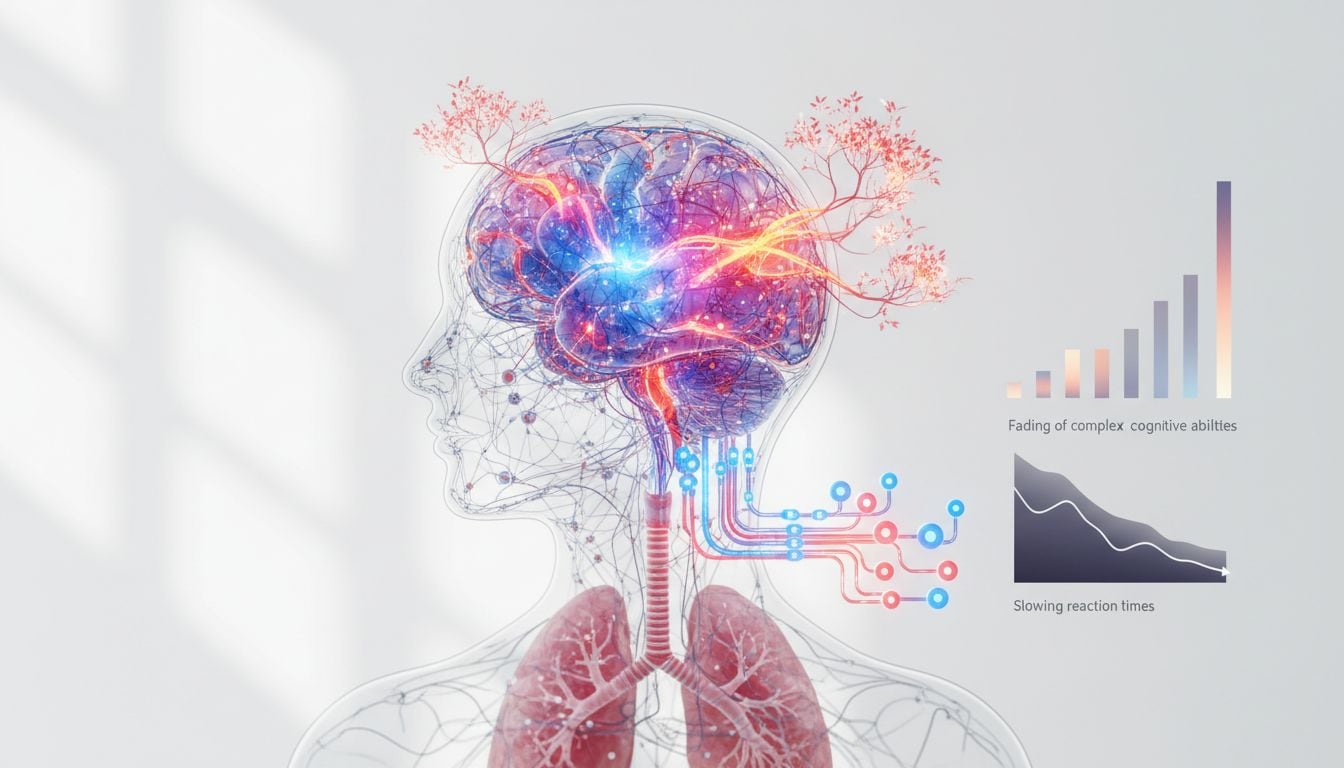
For decades, biology textbooks have painted a picture of the brain as a well-irrigated garden, receiving a constant, uniform stream of oxygen to fuel our thoughts. However, recent technological leaps in neuroimaging have revealed a far more dynamic—and precarious—reality. We now know that the air we breathe has a direct, minute-by-minute impact on our reaction times, memory validation, and decision-making accuracy.
It turns out that even in a healthy brain, oxygen delivery is not perfectly steady. The cortex experiences tiny, transient areas of oxygen depletion known as "hypoxic pockets."[3] While this sounds alarming, new research suggests that when controlled, these micro-fluctuations actually trigger beneficial adaptations, such as the growth of new blood vessels and strengthened synaptic connections.
The Myth of Constant Flow
The discovery of hypoxic pockets helps explain the dual nature of oxygen in the brain. In optimal health, these brief dips in oxygen availability act as a training stimulus, promoting what researchers call "cognitive resilience."[3] It is similar to how muscles strengthen after the stress of exercise. However, when the balance tips—due to aging, injury, or environmental factors—these pockets can persist, leading to dysfunction in critical areas like the hippocampus and prefrontal cortex.
The First Functions to Fail
When oxygen delivery is compromised, even slightly, the brain does not shut down all at once. Instead, specific cognitive skills begin to erode in a predictable hierarchy. A recent systematic review and meta-analysis of simulated altitude studies revealed that reaction time is one of the first discrepancies to appear.[6]
This isn't merely a slowing of the muscles; it is a delay in the "premotor" cognitive processing—the split-second coding of information required to make a decision. Interestingly, highly motivated individuals, such as pilots or athletes, often unconsciously sacrifice speed to maintain accuracy, masking the early signs of impairment.
Furthermore, memory encoding is notoriously sensitive to oxygen levels. The hippocampus, the brain's archiving center, is highly susceptible to sustained hypoxia. Research indicates that while we might adapt to these conditions over time, acute exposure leads to significant deficits in forming new memories and retrieving complex information.[8]
Sensitivity of Cognitive Domains to Hypoxia
Not all brain tests are equally good at spotting oxygen deficiency. A comprehensive review of 86 different cognitive tests found that auditory and verbal memory tasks were the most likely to reveal impairment.
| Cognitive Domain | Test Sensitivity (% of studies showing impairment) | Primary Function Affected |
|---|---|---|
| Auditory/Verbal Memory | 83% | Delayed recognition and recall |
| Evoked Potentials (EEG) | 60% | Neural electrical processing speed |
| Visual/Spatial Memory | 50% | Delayed recognition of shapes/locations |
| Stroop Test | 42% | Executive function and inhibition |
| Sustained Attention | 47% | Focus over long durations |
Data synthesized from Post et al. (2023).[7]
The Electrical Signal: What Happens Inside?
Beyond behavioral tests, scientists are now using EEG (electroencephalography) to watch the brain's electrical response to low oxygen in real-time. The findings are fascinating: hypoxia creates a "slowing" effect on the brain's background activity, characterized by an increase in delta and theta waves—patterns usually associated with drowsiness or deep relaxation, not active processing.[8]
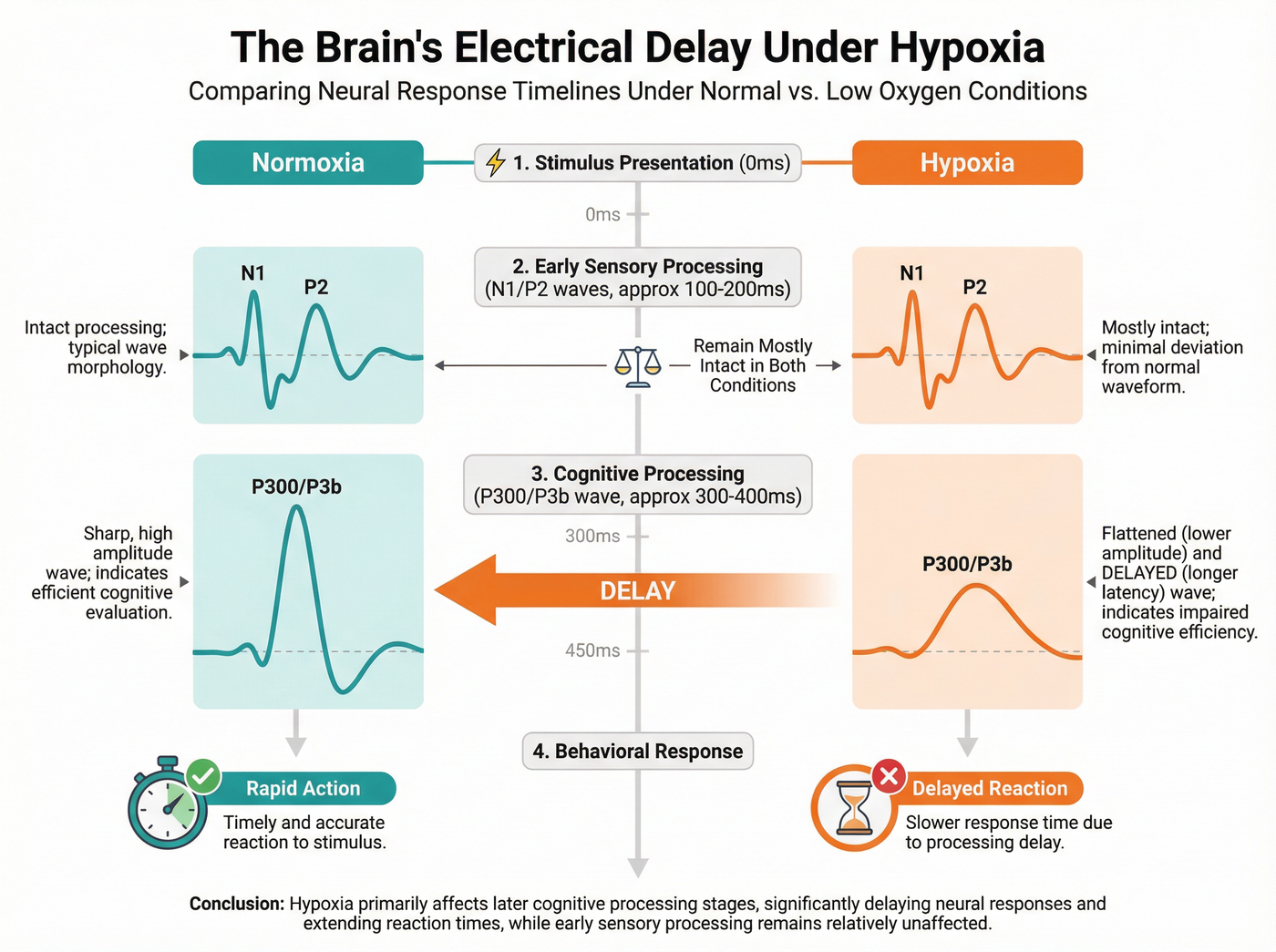
When measuring Event-Related Potentials (ERPs)—the brain's electrical spike in response to a specific stimulus—researchers found that early sensory processing remains largely intact. Your brain "sees" or "hears" the stimulus just fine. The breakdown occurs milliseconds later, during the cognitive verification phase (specifically the P3b component), where the brain tries to categorize that information and decide what to do with it.[2][8]
The "Recovery Gap" in High-Performance Environments
The implications of this research are critical for high-stakes professions like military aviation. Pilots often face "unexplained physiological episodes" where cockpit oxygen fluctuates. The dangerous misconception has been that once oxygen levels (SpO2) return to normal, the pilot is "fine."
However, recent evidence suggests a disconnect between physiological and cognitive recovery. While blood oxygen saturation might stabilize quickly, cognitive functions—particularly complex logical reasoning and memory—can lag behind, remaining impaired for hours after the event.[2] This has driven the development of next-generation wearables, such as helmet-integrated dry electrode systems, which aim to monitor the pilot's brain state rather than just their breathing equipment.
Turning Science into Resilience
We don't need to be fighter pilots to benefit from these insights. The mechanisms that regulate hypoxic pockets can be influenced by our daily routines. Research highlights that lifestyle factors can actively remodel how our brains handle oxygen.

Physical activity enhances neurovascular coupling, ensuring that when neurons fire, blood flow follows instantly. Similarly, cognitive challenges and social engagement increase localized oxygen demand, which, over time, improves the efficiency of oxygen utilization in cortical regions.[3] By challenging our brains and bodies, we essentially train our neural networks to survive—and thrive—even when resources fluctuate.
Listen to the episode
Dive deeper into the science of breath and brain function in our latest episode:
The Respiratory System: Oxygen's Role in Cognitive Function
Sources
- Frontiers in Cognition: Neurocognitive Monitoring (2025)
- From hypoxic pockets to daily routines: linking brain oxygenation and cognitive resilience
- Effects of Acute Hypoxic Exposure in Simulated Altitude in Healthy Adults on Cognitive Performance: A Systematic Review and Meta-Analysis
- Sensitivity of cognitive function tests to acute hypoxia in healthy subjects: a systematic literature review
- From oxygen shortage to neurocognitive challenges: behavioral patterns and imaging insights