

In the evolution of every Python programmer, there is a distinct threshold where code shifts from being a rigid sequence of instructions to an expressive, fluid art form. This transition is often marked by moving away from standard loops and verbose functions toward more functional programming patterns. Today, we dive comfortably into the tools that define professional Python development: comprehensions, decorators, generators, and lambda functions.
By mastering these features, you can transform your scripts into maintainable, efficient software that scales elegantly.
The Elegance of Comprehensions
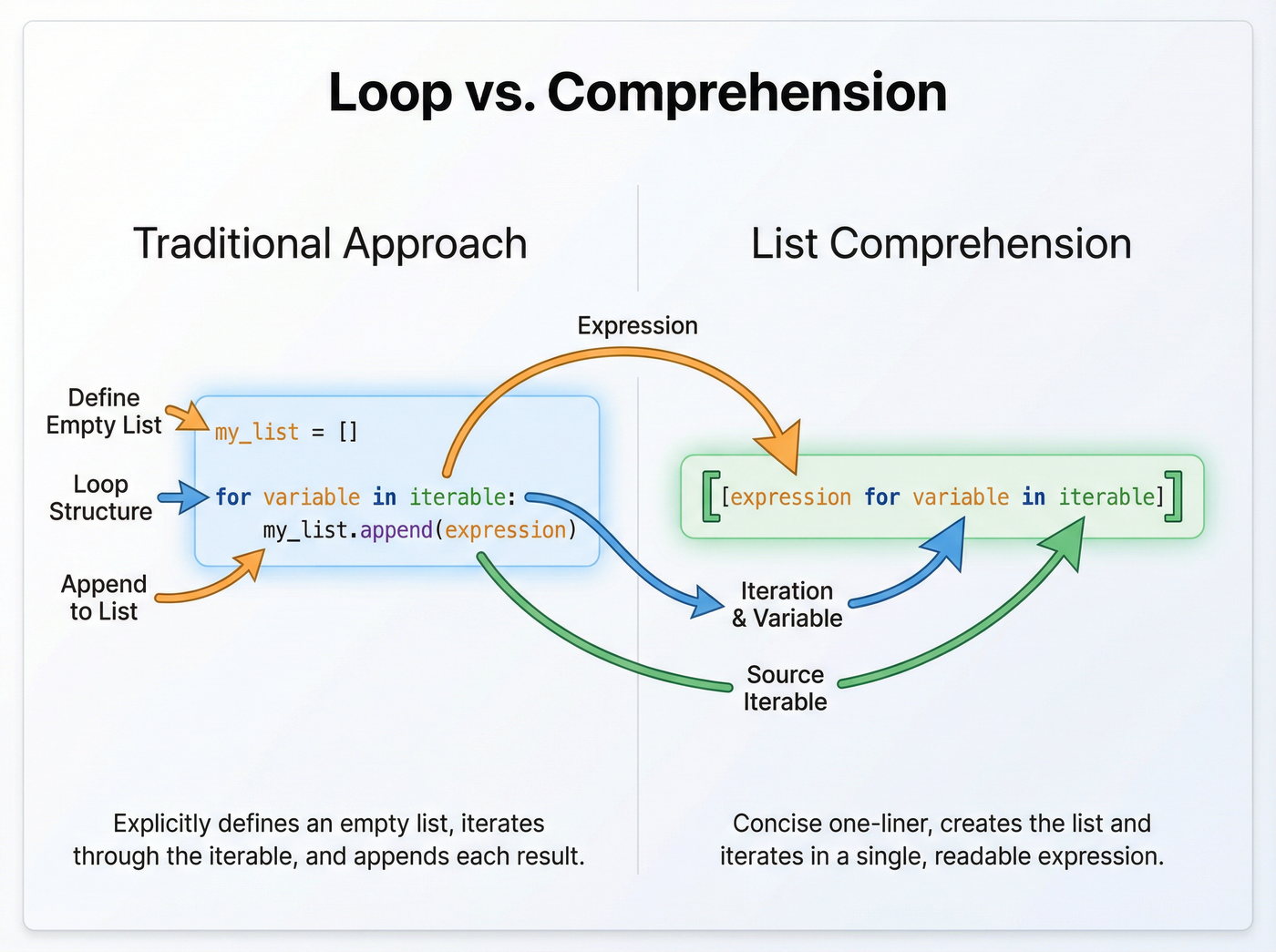
The most immediate upgrade you can apply to your code is the adoption of comprehensions. Traditionally, populating a list requires initializing an empty variable, writing a for loop, and appending items one by one. List comprehensions collapse this ritual into a single, declarative line.
The syntax [expression for item in iterable] describes what the list should be, rather than how to construct it. For example, squaring a list of numbers becomes a mathematical one-liner.[1]
This logic extends to dictionary comprehensions as well. Using curly braces {}, you can efficiently map keys to values, such as swapping the keys and values of an existing dictionary or cleaning up configuration data.[4] You can even include conditional logic, like if n % 2 == 0, directly inside the comprehension to filter data on the fly.[6]
However, a word of caution: while these tools are powerful, readability is paramount. If a comprehension becomes overly nested or complex, refactoring it back into a standard loop is often the professional choice to ensure long-term maintainability.[1] Recent updates to Python have further enhanced these features with tools like the walrus operator (:=), which allows for assignment within an expression to avoid redundant calculations.[3]
Lambda Functions: Logic as Data
As your code becomes more concise, you may encounter situations where defining a full named function feels excessive. Enter the lambda function. These are small, anonymous functions restricted to a single expression. They are the tactical tools of Python, used most effectively as arguments to higher-order functions like sorted(), filter(), or map().
For instance, sorting a list of complex dictionaries by a specific key often requires nothing more than a simple lambda, saving you from writing a throwaway function that clutters your namespace.
Decorators and Generators: Efficiency and Structure
While comprehensions handle data, decorators manage behavior. Adhering to the \"Don't Repeat Yourself\" (DRY) principle, decorators allow you to wrap existing functions with additional logic—such as logging access or measuring execution time—without touching the original source code. By placing a simple @decorator_name above a function definition, you keep your business logic pure and separate from your infrastructure logic.

Finally, when dealing with massive datasets, generators become essential. Unlike lists, which are \"eager\" and load all elements into memory simultaneously, generators are \"lazy.\" Using the yield keyword, they produce items one at a time, pausing execution until the next value is requested. This allows you to process potentially infinite streams of data without crashing your application due to memory overload.
Listen to the episode
Ready to hear a deep dive into these features with practical examples? Listen to the full episode via the link below.
Listen to Advanced Python: Comprehensions, Decorators & Generators
Conclusion
The transition to advanced Python isn't just about using fancy syntax; it is about intent. Use comprehensions to transform data cleanly, lambdas for ephemeral logic, decorators to modularize behavior, and generators to ensure scalability. However, remember the Zen of Python: \"Simple is better than complex.\" These tools should simplify your architecture, not obscure it.